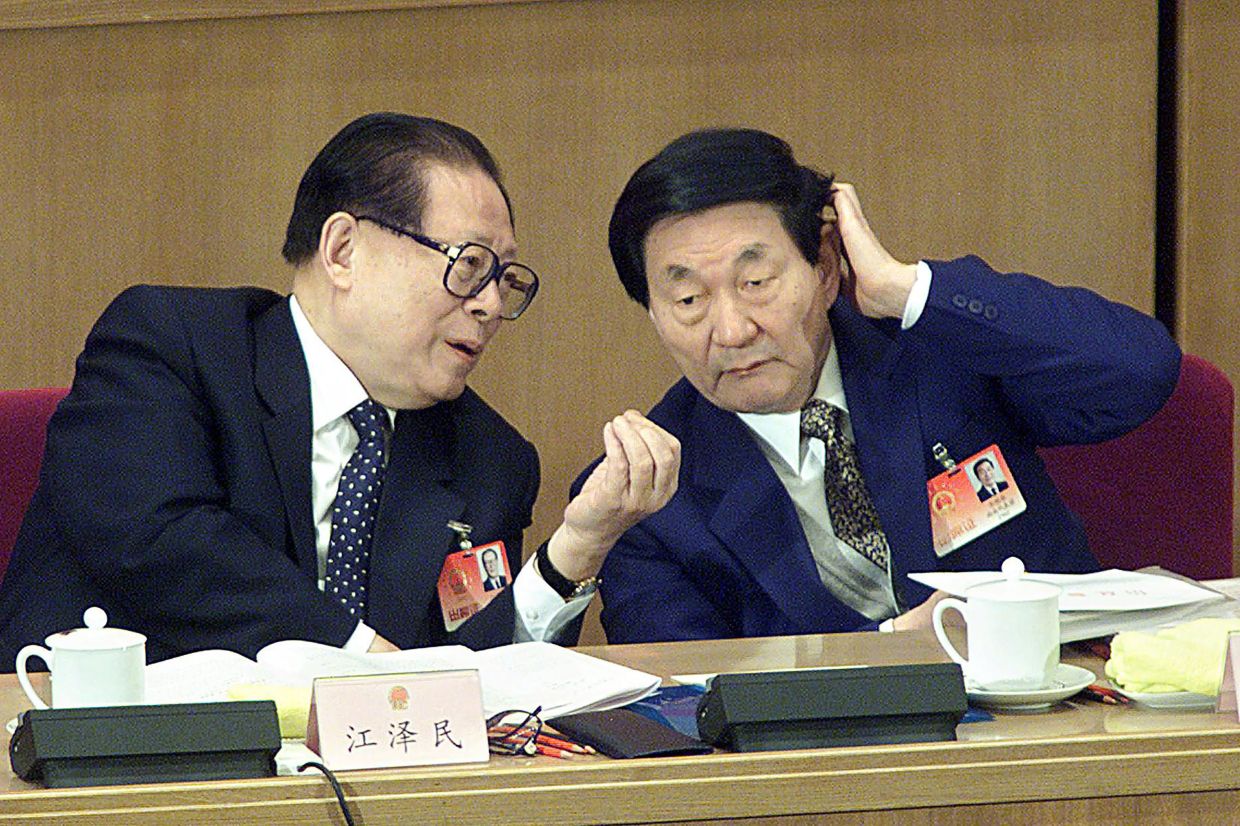
China's political establishment has undertaken a carefully choreographed remembrance of two towering figures from its recent past, with the back-to-back memorials for former president Jiang Zemin and ex-premier Zhu Rongji opening a window into an era of rapid transformation while simultaneously raising uncomfortable questions about the present. Zhu, who passed away at 97 on August 12, received state honors at his funeral on August 18, with flags lowered across the country in tribute. This solemn occasion followed immediately after August 17, when the Communist Party marked what would have been Jiang's 100th birthday with an elaborate state ceremony at the Great Hall of the People. The proximity of these two commemorations—occurring less than a day apart—has not escaped the attention of political observers, who view the timing as both historically resonant and strategically significant.
President Xi Jinping's personal presence at both events underscored the political weight assigned to the memorials. At Jiang's centennial celebration, Xi delivered a 40-minute address that positioned the late leader as a paragon of revolutionary virtue, praising what he termed Jiang's "indelible contributions" to the nation. The ceremony itself extended beyond a single day's observance, with the state television broadcasting a 12-episode documentary series chronicling Jiang's life and policy achievements in the weeks leading up to August 17, while commemorative stamps were issued nationwide. This comprehensive approach to memorialization follows established protocol—Deng Xiaoping's centennial was similarly honored in 2004—yet the current iteration carries distinct implications given the contemporary economic and geopolitical context.
Jiang and Zhu formed one of modern China's most consequential leadership partnerships, governing jointly from 1998 to 2003 during a period that fundamentally reshaped the nation's economic structure and international standing. Their partnership represents what many Chinese citizens and international observers recall as a golden era of sustained growth, buoyant optimism, and genuine hope about the country's trajectory. For those who lived through the 1990s and early 2000s, this period symbolizes dynamism and possibility—a time when economic expansion seemed limitless and opportunities for wealth creation appeared abundant. The resurgence of nostalgia for this epoch has manifested vividly on Chinese social media, where archival photographs and video clips of both leaders have circulated widely, depicting moments of camaraderie and displaying the contrasting personalities that defined their public images: Jiang's more flamboyant demeanor and Zhu's reputation for blunt-spoken directness.
Yet beneath the ceremonial reverence lies a more complex political calculation. Xi's framing of Jiang's legacy deliberately positions the former leader within a continuum of Communist Party history that culminates in Xi's own "new era" of national rejuvenation and Chinese-style modernization—a narrative that gained sharper emphasis in 2022 as Xi secured an unprecedented third term. This interpretive framework ensures that Jiang is remembered not as an alternative vision for China's future, but rather as a predecessor whose contributions organically feed into contemporary party doctrine. During the Great Hall ceremony, Xi explicitly connected Jiang's qualities—his political conviction, innovative spirit, strategic foresight, and willingness to make bold decisions during crises such as the 1998 floods and the Asian financial downturn—to the challenges China currently faces. By establishing this narrative continuity, the party leadership seeks to harness the affection many citizens retain for Jiang's era while simultaneously reinforcing Xi's authority.
The official treatment of Zhu's passing follows similar lines of approved commemoration. The state obituary emphasized Zhu's consistent loyalty to the party across successive leadership transitions, noting his steadfast support for both Hu Jintao and Xi Jinping as their respective tenures unfolded. Xi attended Zhu's funeral at Babaoshan Revolutionary Cemetery alongside members of the Politburo Standing Committee, where he engaged in the traditional gestures of respect: three ritual bows before the deceased and condolences expressed to family members. Even Hu Jintao, Xi's predecessor, dispatched a formal wreath. These choreographed displays of institutional continuity serve to emphasize party unity and subordinate historical memory to present political imperatives.
However, the sustained attention to Jiang and Zhu has simultaneously surfaced what analysts describe as a "quiet tension" between reverence for the past and anxiety about the future. According to Lee Jong-hyuk, an associate professor of Chinese politics at South Korea's Sungkyunkwan University, the temporal overlap of the two commemorations has created an environment conducive to broader reflection on the reform era these leaders embodied. This reflection arrives at a moment of considerable economic vulnerability for Beijing. China confronts slower growth trajectories, significant distress in the property and real estate sector, mounting local government debt burdens, and ongoing strategic competition with major Western powers—circumstances that render nostalgic comparisons with the apparent dynamism of the 1990s and early 2000s particularly poignant and potentially destabilizing.
The sensitivity surrounding public expressions of mourning and tribute has become evident in the circumspect language employed by those seeking to commemorate Jiang and Zhu on Chinese social media platforms. Fearing detection by automated content moderation systems and human censors, many online tributes have employed coded references and pet nicknames—Jiang, for instance, became known colloquially as "the Elder"—to evade official restrictions. Prominent economist Zhao Jian published an essay mourning Zhu's passing that juxtaposed the pervasive sense of emptiness and anxiety characterizing contemporary China against his memory of security and future promise from thirty years earlier. The piece circulated briefly on WeChat before being removed within a day, a telling indicator of how sensitive the party establishment considers any comparison between the reform era and Xi's tenure.
The mixed legacies left by both leaders complicate the official narrative of seamless historical progression. Jiang, selected by Deng Xiaoping from relative obscurity to fill the vacuum created by Zhao Ziyang's purge following the 1989 Tiananmen crackdown, successfully reintegrated China into the international system and maintained a functional relationship with the United States during a period of profound geopolitical realignment. Domestically, he initiated the groundbreaking "Three Represents" doctrine, which incorporated private entrepreneurs into Communist Party membership and fundamentally altered the party's ideological composition. Yet his tenure simultaneously witnessed widespread corruption and systematic repression of religious and spiritual movements, most notoriously the violent crackdown against Falun Gong practitioners.
Zhu's record as premier carries similarly paradoxical dimensions. His sweeping economic reforms—most prominently securing China's accession to the World Trade Organisation and undertaking radical restructuring of bloated state-owned enterprises—propelled the nation into the globalized economy and unleashed tremendous productive capacity. The 1994 tax-sharing reform represented another watershed moment in fiscal reorganization. However, these reforms exacted substantial human costs: more than thirty million workers were rendered unemployed as inefficient state enterprises were shuttered or privatized. Economists now recognize that Zhu's emphasis on land sales as a revenue source for fiscally strapped local governments inadvertently created the structural foundations for today's cascading property market collapse and debt crises that threaten financial stability across multiple tiers of government.
The timing of these commemorations also intersects with approaching leadership transitions that will likely become the primary focus of the Communist Party's seventeenth national congress, scheduled for late 2027. According to Daria Impiombato, a senior analyst at the Mercator Institute for China Studies, a German research organization specializing in elite Chinese politics, the party leadership remains preoccupied with "image management" in the years preceding this gathering. The reshuffling of senior positions that typically accompanies such congresses requires meticulous choreography and reinforcement of party loyalty and institutional cohesion. In this context, the official commemoration of Jiang—portrayed as a loyal servant of the party's historical mission—and the respectful treatment of Zhu's memory function partly as instruments for emphasizing continuity, party discipline, and the subordination of individual agency to collective institutional interests.
For Malaysian and Southeast Asian observers, these Chinese commemorations carry broader significance. The tension between nostalgic recollection of the reform era and the current trajectory under Xi reflects fundamental questions about China's development model, growth sustainability, and regional stability. If Beijing becomes consumed with internal management of economic challenges and questions about generational transition, this may influence its approach to regional diplomacy and engagement with ASEAN nations. The implicit acknowledgment—evident in careful state management of Jiang and Zhu's memory—that the reform era represented something qualitatively different from the present suggests potential inflection points in Beijing's strategic calculations and its willingness to sustain economic openness that has historically benefited neighboring economies.

