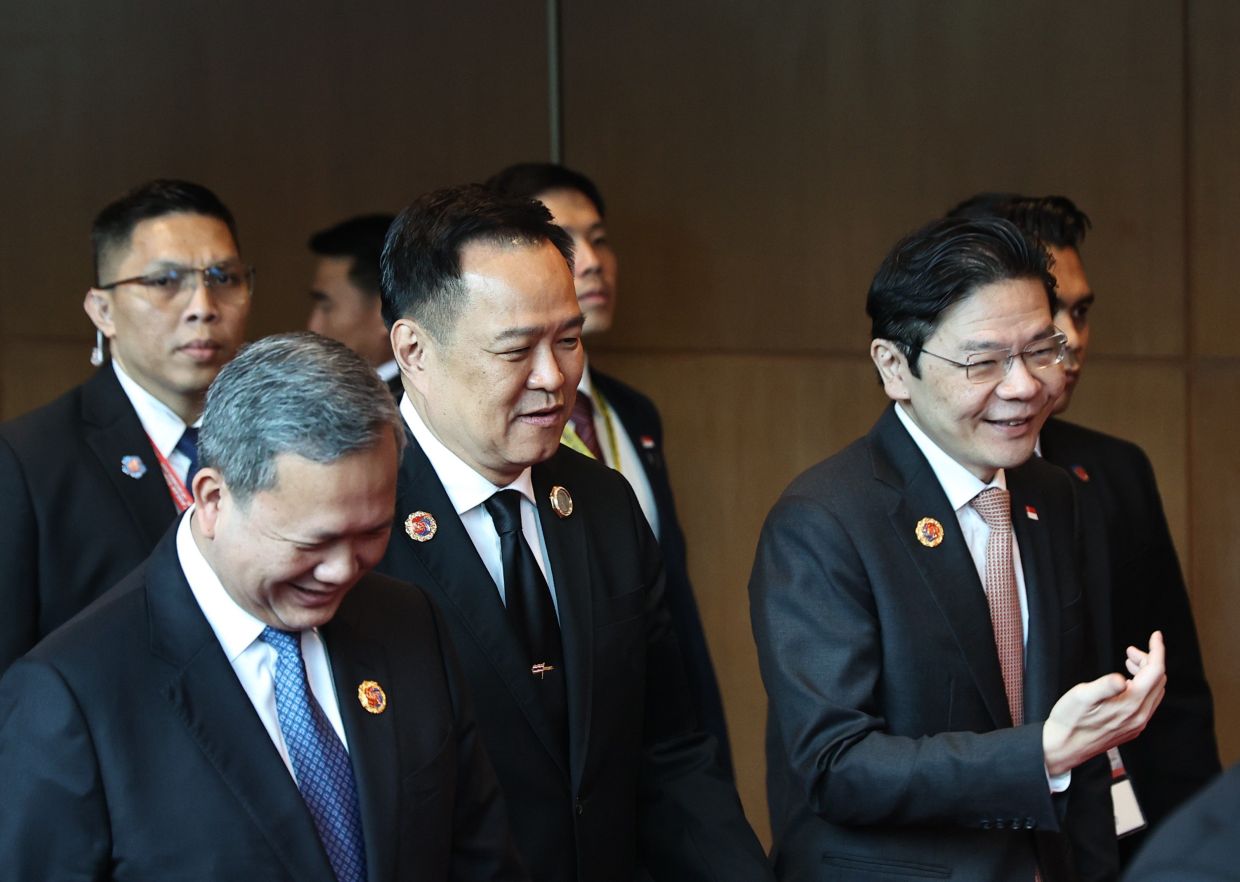
The possibility that China could step into the role of peacemaker between Cambodia and Thailand over their contentious border dispute has crystallized into concrete diplomatic manoeuvring, with both Southeast Asian neighbours currently engaged in carefully calibrated messaging with Beijing. Prime Minister Hun Manet of Cambodia used a meeting with Chinese Premier Li Qiang on July 16 to apprise the leadership in Beijing of developments along the frontier, while simultaneously Thai Prime Minister Anutin Charnvirakul conveyed to Bangkok-based media that Thailand would entertain Chinese assistance if offered. The convergence of these signals, combined with the presence of both leaders in China for the same international conference, suggests an emerging consensus that Beijing's involvement could prove beneficial to regional stability, even if formal mediation has not been requested.
Hun Manet's decision to prioritize the border issue during his discussion with Li represents a notable escalation in how prominently Cambodia has positioned this concern in its bilateral engagement with its most steadfast strategic ally. Beyond the ceremonial affirmation of Cambodia-China ties, the prime minister took the opportunity to restate Phnom Penh's unwavering commitment to resolving the territorial dispute through exclusively peaceful means, grounded in respect for international law and the existing conventions and treaties binding the two disputant nations. This articulation serves a dual purpose: it reinforces Cambodia's official posture of restraint to the international community whilst simultaneously conveying to Thailand, through a trusted intermediary, that Phnom Penh's position remains anchored in legality and non-violence. The decision to inject this topic into a high-level bilateral dialogue underscores how seriously Cambodia regards the ongoing border tensions and the instrumental value it perceives in maintaining Beijing's engagement on the matter.
Thailand's measured openness to Chinese involvement carries its own diplomatic nuance. Rather than formally requesting mediation, which could be construed as weakness or inability to manage the dispute independently, Anutin employed the language of receptivity—framing any Chinese role as contingent upon Beijing's own initiative. By declaring that Bangkok had "not closed the door" to mediation, Thailand preserved its dignity whilst signalling to China that assistance would be welcomed if proffered. Critically, the Thai leader simultaneously reiterated that direct bilateral negotiations remained Bangkok's preferred mechanism, a statement that balances openness to external facilitation with confidence in Thailand's own diplomatic capacity. This rhetorical positioning allows Thailand to benefit from potential Chinese intervention without appearing to abdicate responsibility for resolving its own regional dispute.
China's historical posture on the Cambodia-Thailand border issue reveals a pattern of careful fence-sitting that has gradually evolved toward greater assertiveness. During last year's Asean Foreign Ministers' Meeting, Chinese Foreign Minister Wang Yi articulated Beijing's willingness to "play a constructive role for the harmonious coexistence between Thailand and Cambodia," language that stopped deliberately short of formal mediation whilst creating substantial daylight for future involvement. Since that pronouncement, China has progressively deepened its engagement through hosting trilateral discussions with senior officials from both countries and supporting the implementation of ceasefire mechanisms. This incremental approach allows Beijing to expand its diplomatic footprint without assuming the risks and obligations inherent in formal mediation, whilst simultaneously positioning itself as an indispensable stakeholder in regional peace architecture.
The geopolitical significance of potential Chinese mediation extends beyond the bilateral Cambodia-Thailand relationship. For Beijing, successful intervention would enhance its profile as a stabilizing force in Southeast Asia, reinforcing narratives about China's constructive role in regional affairs at a moment when great power competition with Western nations remains intensely contested. For Cambodia, deepening engagement with China on security matters strengthens the alignment between Phnom Penh and Beijing, consolidating a partnership already characterized by substantial economic and strategic interdependence. For Thailand, Chinese mediation offers an avenue to resolve a costly dispute whilst maintaining strategic flexibility and avoiding perceptions of capitulation to either external pressure or bilateral pressure from Cambodia.
Cambodia's broader strategy regarding the border dispute reflects its preference for multilayered international engagement rather than reliance on any single mediator. Beyond China, Phnom Penh has welcomed Asean observer missions and pursued legal mechanisms under international law, demonstrating a commitment to resolving the dispute through multiple channels simultaneously. This diversified approach distributes diplomatic risks and prevents over-dependence on any single power, whilst simultaneously signalling to the international community that Cambodia views the dispute through a legalistic and procedural lens rather than as a matter of raw power politics. By invoking international law, treaty obligations, and regional mechanisms, Cambodia constructs a framework within which mediation by any power—including China—would operate according to established norms rather than particularistic great power interests.
The absence of announced bilateral meetings between Hun Manet and Anutin during their simultaneous presence in China is conspicuous, yet not necessarily indicative of deteriorating relations. Instead, it may reflect confidence that direct engagement between the two leaders can proceed at more opportune moments, or conversely, a recognition that bilateral talks might complicate the narrative of openness to external facilitation. The decision to keep the border issue within the context of each leader's separate engagement with China rather than addressing it through direct bilateral diplomacy suggests that both Cambodia and Thailand may be testing the waters for Chinese involvement before committing to sustained direct negotiations. This tactical approach preserves maximum flexibility for all parties whilst creating an opportunity for China to observe the parameters of each nation's negotiating position independently.
For Malaysia and other ASEAN members, the possibility of Chinese mediation between Cambodia and Thailand carries important implications. A successful Chinese intervention would consolidate Beijing's position as a primary regional power broker in Southeast Asian disputes, potentially shifting the balance of diplomatic influence away from traditional mediators and toward Beijing. Simultaneously, if Chinese mediation proves ineffective or is perceived as favouring one party over another, it could expose limitations in China's regional diplomatic capacity and create space for other powers or mechanisms to assert influence. The outcome of this incipient process will likely influence how future regional disputes are approached and which external actors are deemed credible facilitators by Southeast Asian nations.
Fundamentally, whilst both Cambodia and Thailand have demonstrated openness to Chinese involvement and China has left multiple doors open to deeper engagement, the formal mechanics of mediation remain nebulous. No official mediation request has been submitted, no mediation offer formally extended, and no structured mediation process has been announced. The current phase represents what might be termed "pre-mediation diplomacy," wherein all parties are signalling receptiveness to deeper involvement without committing to specific modalities or timelines. Whether this informal choreography evolves into formal mediation will depend on evolving threat perceptions, domestic political calculations, and the degree to which direct bilateral engagement between Cambodia and Thailand reaches an impasse. For now, China's role remains that of an attentive stakeholder with demonstrated willingness to facilitate, whilst the two disputants signal openness without dependency.

