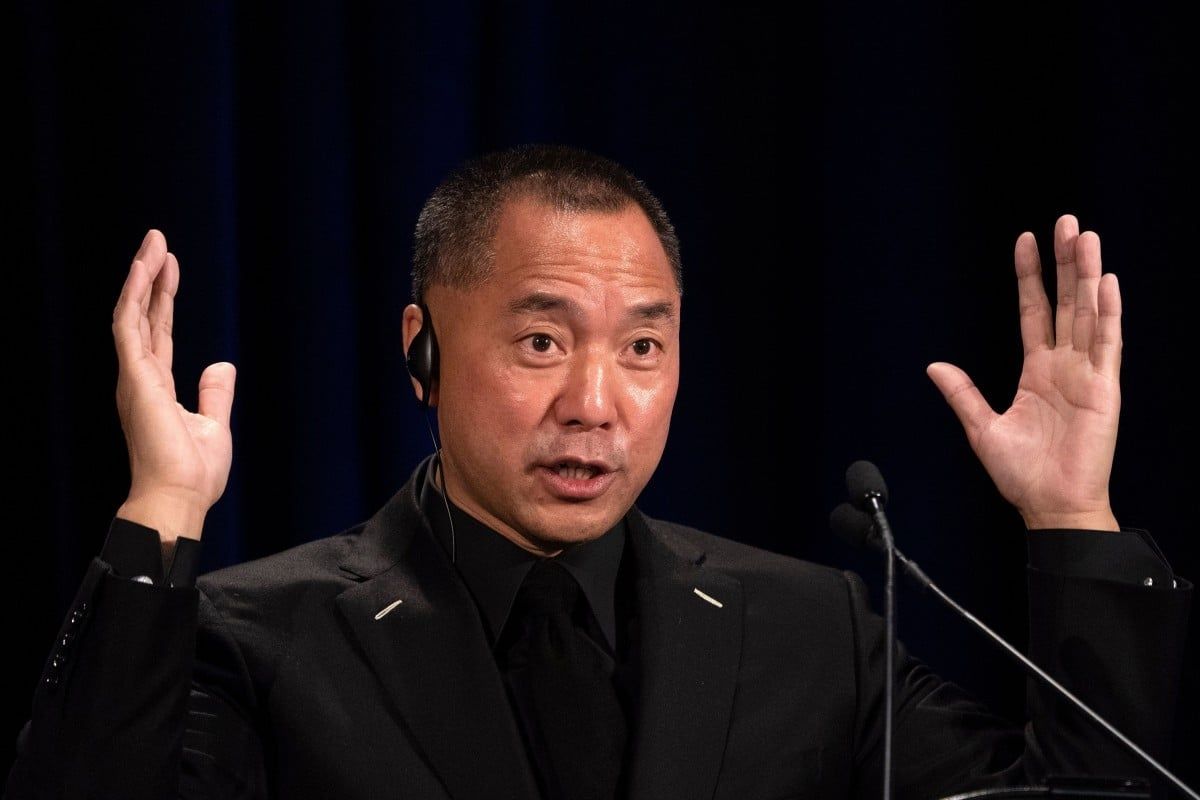
Guo Wengui, a business magnate who reinvented himself as a dissident critic of China's Communist Party after fleeing to America, has been handed a 30-year prison sentence by a Manhattan federal court for orchestrating one of the most expansive financial frauds in recent memory. Judge Analisa Torres imposed the penalty on Monday after finding that the scheme caused catastrophic harm to more than 1,000 victims worldwide, who collectively lost hundreds of millions of dollars in investments they believed would support democratic aspirations in China.
The case reveals how the self-exiled tycoon exploited the hopes and ideological commitments of investors who shared his stated opposition to Beijing's governance. Judge Torres emphasised that Guo specifically "preyed on those seeking to bring Democracy to China," cynically manipulating their political convictions to fund an extravagant lifestyle characterised by Manhattan penthouses, luxury yachts, high-performance vehicles, and designer acquisitions. The court records paint a portrait of deliberate deception spanning from 2018 to 2023, during which Guo persuaded hundreds of thousands of investors to channel more than US$1 billion into various entities under his control, including his media venture GTV Media Group Inc., the Himalaya Farm Alliance, and the Himalaya Exchange.
Victims whose testimonies influenced the sentencing described experiencing devastation that transcended mere financial loss. One investor, Wei Chen, told the court that Guo's fraud "destroyed my life" and that of her entire family, capturing the profound psychological and emotional toll inflicted on the defrauded. Judge Torres received multiple letters from victims recounting how they had exhausted their life savings, experienced severe anxiety and shame, and endured family ruptures as relatives blamed them for poor judgment. These personal testimonies underscored the human dimensions of white-collar crime that statistical aggregates of losses alone cannot convey.
Guo's dramatic fall from prominence reflects his earlier trajectory through American political and social spheres. Before his arrest and detention without bail three years ago, the billionaire had cultivated close associations with prominent conservative figures, most notably Steve Bannon, the former Trump strategist. In 2020, they announced an ambitious joint venture purportedly aimed at orchestrating the overthrow of the Chinese government. His wealth and connections granted him access to exclusive circles, including membership at President Donald Trump's Mar-a-Lago golf club in Florida and residence in a luxury Central Park apartment. These connections and his profile as an anti-communist dissident afforded him considerable credibility within segments of American society concerned with Chinese affairs.
The magnitude of Guo's deception became apparent during a seven-week trial in which prosecutors systematically dismantled his claims of legitimacy. He was convicted on nine of twelve criminal charges, with the government demonstrating how thousands of deceived investors had been promised participation in projects that either did not exist or bore no resemblance to their representations. The prosecution characterised his fraudulent conduct as "astonishing" in both scope and ruthlessness, arguing that it destroyed hundreds of lives and created a trail of financial, emotional, and psychological devastation among victims and their families. Prosecutors had explicitly requested the maximum 30-year sentence, and Judge Torres obliged their recommendation entirely.
Guo presented a markedly different narrative during his sentencing appearance, displaying what observers described as concerning detachment from accountability. He claimed illness on the day of sentencing, reporting episodes of vomiting while being transported to court, though prosecutors disputed whether his complaints were genuine or performative. When finally permitted to address the court, Guo deflected responsibility by reiterating that his migration to America was motivated solely by opposition to Communist Party rule. He notably denied any wrongdoing and insisted, contrary to overwhelming evidence and judicial finding, that his conduct had caused no losses and harmed no one. This absence of remorse or acknowledgment of victim suffering informed Judge Torres's determination that he remained entirely unrepentant.
Guo's defence team mounted arguments attempting to contextualise his offences within a broader narrative of persecution by Beijing. They contended that Guo had suffered physical torture while in China, bearing scars and disfigurements requiring surgical correction between 1993 and 2022. His lawyers characterised the lengthy American prison sentence as validating China's purported campaign against him and potentially emboldening future efforts to silence Chinese dissidents internationally. They pointed to comparable fraud cases in which defendants received prison terms of only two to four years, arguing that disproportionate punishment would serve China's interests rather than American justice. These arguments gained little traction with the court.
The defence narrative also attempted to establish that Guo's initial wealth derived legitimately from his family's controlling stake in China's largest publicly traded securities company. According to his lawyers, he subsequently became a government target after exposing corruption among Chinese officials, prompting his migration first to Hong Kong, then London, before settling in New York in 2017. Chinese authorities have levelled accusations against Guo including rape, kidnapping, and bribery, which he has consistently denied as fabricated. However, these claims formed a minor element in what became primarily an American criminal case focused on domestic fraud rather than international political dynamics.
China's Ministry of Foreign Affairs registered formal notice of the sentencing, emphasising that Guo remains wanted by Chinese authorities and that Interpol has issued a Red Notice requesting his arrest internationally pending extradition proceedings. The confluence of American criminal conviction and Chinese extradition interest creates complex jurisdictional questions about Guo's ultimate destination. Although the United States maintains no extradition treaty with China, American authorities would retain custody and enforcement authority over the 30-year sentence.
Judge Torres ordered Guo to forfeit US$889 million in restitution to victims, though questions persist regarding whether assets can be recovered given his financial circumstances and potential asset concealment. The forfeiture order represents an attempt at partial victim compensation but acknowledges the practical difficulty of recovering funds from someone whose fraudulent scheme generated ill-gotten wealth subsequently dissipated across luxury acquisitions unlikely to yield equivalent value upon liquidation. The sentencing concluded with supporters in the courtroom applauding Guo as he departed, suggesting that despite judicial condemnation and overwhelming evidence of fraud, elements of his constituency continued viewing him through a political lens rather than as an ordinary criminal.
The Guo Wengui case carries implications extending beyond individual accountability in American courts. It exemplifies how geopolitical narratives and anti-communist sentiment can provide cover for predatory financial behaviour, particularly when perpetrators cultivate images as dissidents or democracy advocates. For Malaysian and Southeast Asian observers, the case underscores vulnerabilities within democratic asylum systems that can be exploited by sophisticated operators who leverage ideological sympathies to obscure criminal conduct. The incident demonstrates that careful verification of claims and financial transparency remain essential safeguards regardless of a person's political positioning or stated opposition to authoritarian regimes.

