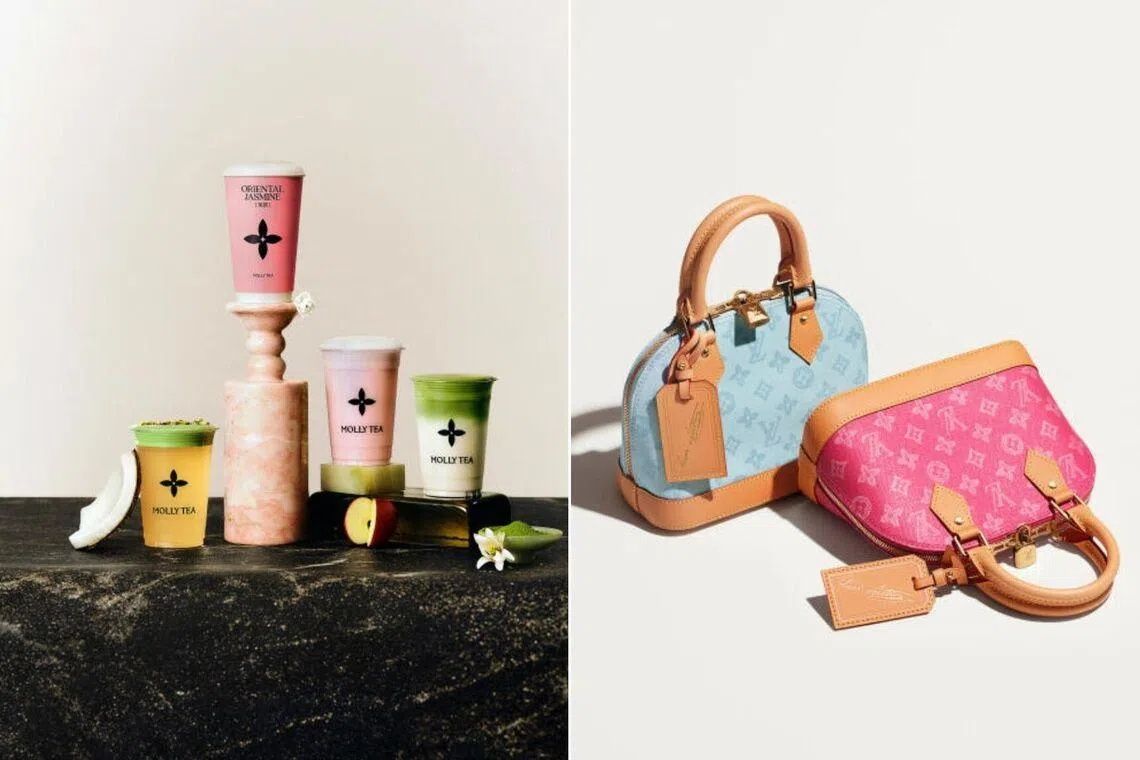
China's Suzhou Intermediate People's Court has dealt a significant blow to Molly Tea, a Shenzhen-based milk tea chain, by ordering it to pay 10.3 million yuan (US$1.5 million) to French luxury brand Louis Vuitton after finding trademark infringement. The ruling, delivered on June 29 following a lawsuit filed in May 2025, centres on the similarity between Molly Tea's four-petal flower emblem and Louis Vuitton's registered graphic trademark designs. The court determined that Molly Tea and a franchise outlet in Suzhou's Wuzhong district had violated seven of the luxury house's protected marks, prompting widespread discussion across Chinese social media about the proper boundaries of intellectual property protection and the use of traditional design elements in commercial branding.
The dispute has crystallised into one of the most prominent trademark cases in recent Chinese legal history, generating over 360 million views on social media platforms when the verdict became public. A related hashtag about the invalidation of Molly Tea's logo design exceeded 18.7 million reads, reflecting the intensity of public interest. Beyond the financial penalty, the court has directed Molly Tea to cease all infringing uses and publish a public apology, cementing what many view as a decisive outcome favouring established brand protection over emerging competitors.
Molly Tea's own trademark strategy provides important context for understanding the court's decision. Since March 2024, the company and its affiliated entities submitted multiple applications to the China National Intellectual Property Administration seeking registration for various floral designs intended to cover restaurant and accommodation services, advertising, and convenience food categories. However, intellectual property officials rejected the vast majority of these applications, permitting only the trademark bearing Molly Tea's Chinese characters to achieve successful registration. This pattern of rejections suggests that examiners had already identified potential conflicts with existing protected marks, yet the company proceeded with its commercial use of the four-petal flower design, ultimately inviting Louis Vuitton's legal challenge.
The case has become a lightning rod for online debate regarding intellectual property law in Southeast Asia's largest neighbour, with notably polarised public opinion. Supporters of Louis Vuitton's position argue that Molly Tea's floral emblem constitutes a deliberate or negligent imitation of an instantly recognisable luxury brand symbol, risking consumer confusion and diluting the French house's hard-earned reputation. Conversely, critics question whether the designs exhibit sufficient similarity to warrant such severe consequences, noting that Molly Tea and Louis Vuitton operate in entirely different commercial segments unlikely to create genuine marketplace confusion. Some commentators have gone further, challenging Louis Vuitton's proprietary claims over floral motifs altogether, suggesting that the brand's signature pattern may itself derive from traditional Chinese cultural imagery that belongs to no single entity.
Kang Lixia, a partner at Beijing Standzer IP Firm, has offered crucial insight into the legal framework governing such disputes. She emphasises that China's trademark system operates on a "first to file" principle, meaning that the earliest applicant to register a mark gains exclusive rights, while subsequent filings for identical or substantially similar marks face rejection. Critically, she notes that Louis Vuitton's earlier registration of its four-petal graphic trademark, combined with its status as a highly recognised international brand, entitles it to protection extending beyond its own luxury goods category. This cross-class protection mechanism means that Louis Vuitton's rights can theoretically shield it from confusingly similar uses across unrelated product categories, creating substantial barriers for later applicants regardless of whether they operate in separate markets.
Yet Kang also acknowledges a crucial nuance that has resonated with many observers questioning the verdict's fairness. Floral patterns and botanical motifs appearing in traditional Chinese cultural heritage constitute public domain material available for use by any individual or business. The tension between protecting genuine commercial intellectual property and preventing monopolisation of traditional cultural elements remains philosophically unresolved in contemporary Chinese law, even as courts increasingly favour established trademark holders. Molly Tea has indicated its intention to appeal the decision to a higher court, meaning the legal dispute is far from concluded and may ultimately clarify the precise boundaries of acceptable trademark design in cases involving cultural imagery.
Liu Bin, an intellectual property lawyer practising at Beijing Zhongwen Law Firm, has articulated the fundamental challenge underlying this case. He stresses that trademark protection for figurative designs does not demand perfect identity between the disputed mark and the registered trademark; instead, courts assess whether ordinary consumers are likely to experience confusion when encountering the designs. This consumer confusion standard has emerged as the decisive factor in the Molly Tea judgment, with the court apparently concluding that the four-petal flower similarity was sufficiently pronounced to mislead purchasers regarding brand origin or affiliation. However, Liu also highlights broader public bewilderment regarding how traditional Chinese cultural patterns ought to be protected and deployed fairly in modern commerce.
The heart of the matter, Liu suggests, involves distinguishing between the cultural heritage itself and the specific brand recognition that companies construct through commercial deployment of cultural elements. Traditional motifs should remain accessible and be carried forward as part of cultural continuity, yet when companies transform these elements into trademarked commercial symbols, those marks must not create market confusion or directly imitate previously registered designs. This perspective attempts to reconcile two competing values: preserving the commons of traditional culture while simultaneously protecting legitimate commercial investments in brand development and reputation.
For Malaysian and regional Southeast Asian readers, the Molly Tea case carries immediate implications. Many local companies, particularly in the food and beverage sector, employ design elements inspired by or directly referencing cultural heritage. The decision signals that Chinese courts will robustly enforce trademark protections even when designs incorporate cultural imagery, potentially affecting how regional businesses approach branding strategies for markets in mainland China. The ruling also underscores the importance of comprehensive trademark searches and clearance procedures before launching new brands, especially when targeting the Chinese market where intellectual property enforcement has become increasingly stringent. Companies cannot assume that cultural heritage elements provide immunity from trademark infringement liability.
Moreover, the case illustrates evolving standards around what constitutes sufficient similarity to trigger trademark protection obligations. Rather than requiring near-identical designs, courts increasingly focus on whether visual similarities are likely to confuse consumers about the source or sponsorship of goods or services. This has profound consequences for businesses seeking to differentiate themselves through floral or traditional design motifs in highly competitive consumer markets. The expansion of cross-class protection principles means that established luxury brands can shield themselves from uses in seemingly unrelated product categories, a consideration that smaller or emerging businesses must carefully navigate when developing market positions in China and potentially elsewhere in Asia.
The broader commercial and legal environment surrounding the Molly Tea decision reveals China's commitment to strengthening intellectual property protections as part of its broader economic strategy. As the country positions itself as an innovation economy and seeks reciprocal intellectual property recognition in international trade relationships, domestic enforcement of trademark rights has intensified. This trend favours established brands and incumbent market players while creating substantial compliance challenges for newer entrants, particularly those in fast-moving consumer sectors like food and beverages where rapid brand proliferation and experimentation with design elements characterise competitive strategy. Businesses operating across Southeast Asia and China will need to calibrate their brand development approaches accordingly, investing in proper legal clearance and differentiation rather than relying on assumptions of immunity or fair use.
Molly Tea's appeal represents an opportunity for clarification of these principles at a higher judicial level. Whether the appellate court sustains the original judgment or provides greater latitude for companies to use cultural motifs in distinct market segments remains to be seen. Regardless of the outcome, however, the case has already established that trademark disputes involving cultural imagery will receive serious judicial attention in contemporary China, and companies cannot discount the risks associated with designs bearing visual similarities to internationally recognised luxury brand symbols, even when those designs draw upon genuinely cultural heritage sources. The intersection of traditional culture and modern commercial trademark law will likely generate further litigation as businesses throughout Southeast Asia continue navigating these complex and evolving legal territories.

