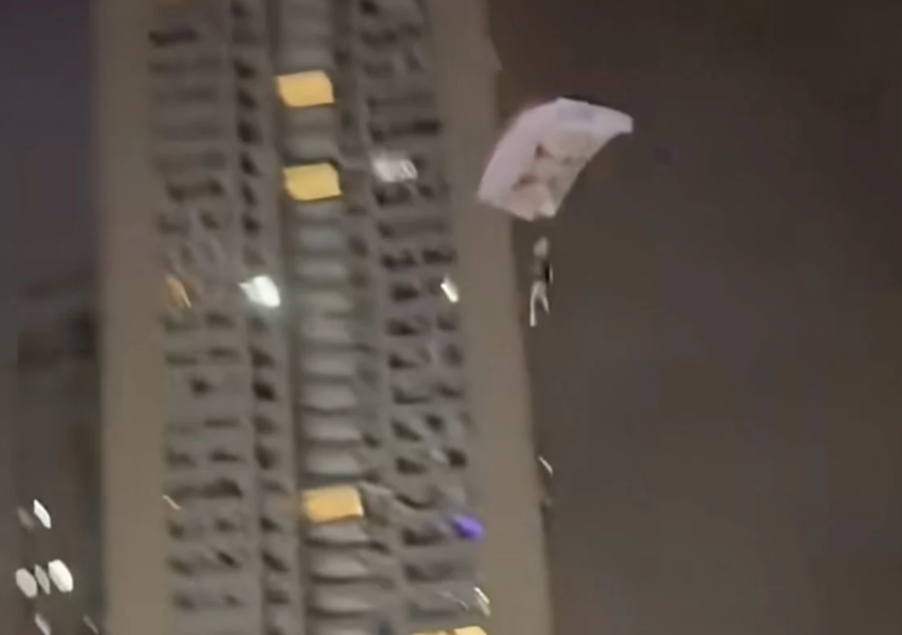
A 23-year-old man identified as Ren has been taken into administrative detention in southwestern China following an illegal skydiving stunt performed from the roof of a residential tower, the latest case highlighting the dangerous lengths to which social media influencers will go in pursuit of online attention and follower growth. The Chenghua district police authority in Sichuan province confirmed that Ren descended from a high-rise apartment building at 11pm on June 30 using a parachute, subsequently uploading footage of the jump to his social media platforms the following day in what police characterized as a deliberate strategy to increase engagement and reach.
The parachute jump itself presented immediate and substantial hazards to the surrounding community, with video evidence showing Ren descending in dangerous proximity to neighbouring residential structures and thick vegetation. The location of the stunt—a densely populated urban residential area—meant that unsuspecting residents faced potential injury from falling equipment or an accident involving the jumper himself. Police determined that such reckless behaviour had fundamentally compromised public order and created unacceptable risks to community safety, leading them to pursue formal action against the individual.
Ren's online presence had already established a significant following prior to the June incident. Operating under the social media moniker "Parachute Coach Kakaxi," he had accumulated approximately 60,000 followers across leading Chinese platforms, leveraging his public profile to promote himself as a parachuting instructor to his substantial audience. However, investigations by law enforcement revealed a crucial deception at the core of his personal branding. Despite marketing himself as an experienced parachute coach qualified to teach the discipline, Ren had not actually obtained the necessary professional coaching licence from relevant authorities, meaning his entire claimed expertise was fraudulent.
This was not the first time Ren had attempted such a dangerous publicity stunt. Police discovered evidence that in May 2024, approximately six weeks before the June incident that led to his detention, he had already performed a similar skydiving jump from another residential building and published that footage online as well. The pattern suggested a deliberate strategy of repeating these illegal acts to maintain audience engagement and build his follower base through increasingly extreme content, prioritizing online celebrity status over legal compliance or public safety considerations.
Following the June 30 incident, authorities handed down a punitive response. Ren was placed under administrative detention for up to 15 days, the standard maximum detention period available under China's administrative law framework for public order violations. Additionally, police imposed a comprehensive ban on his social media activities, effectively silencing his online presence and preventing further dissemination of similar content to his followers. The restrictions represent a significant blow to his ability to monetize his online influence, which had apparently been his primary motivation for executing these dangerous jumps.
Chinese law strictly prohibits parachuting activities outside regulated circumstances and designated locations. Skydiving operations require explicit authorization from relevant government authorities and must take place only in pre-approved venues specifically established for such activities. The legislation explicitly forbids jumps from public locations including downtown buildings, residential towers, bridges, and any areas with substantial population density. Police issued a formal warning that individuals who violate these prohibitions by performing unauthorized parachute jumps in populated areas face severe penalties beyond administrative detention, including potential criminal liability in cases involving significant risk or actual injury.
The incident generated substantial reaction across mainland China's social media landscape, with netizens expressing alarm at both the immediate dangers and the underlying pattern of behaviour. One online commenter highlighted the collision risk to pedestrians below, noting that Ren's actions endangered not only his own life but also that of innocent bystanders who had done nothing to assume such risk. Another observer emphasized the troubling motivation behind the stunt, questioning how social media traffic could justify such recklessness. A third voice called for stricter penalties, expressing concern that insufficient consequences would embolden other social media personalities to replicate similar dangerous acts in their own pursuit of online notoriety.
Ren's case represents part of a broader pattern in contemporary China where online influencers engage in increasingly extreme and illegal behaviour to generate engagement and expand their followings. The previous month had witnessed another high-profile incident in Zhejiang province, where a driver filmed himself operating a vehicle at 152 kilometres per hour on an expressway while simultaneously recording video content on his mobile phone—conduct that violated both road safety laws and regulations prohibiting mobile phone use while driving. That individual received nine demerit points against his annual 12-point driving licence allocation and paid a monetary fine of 250 yuan, equivalent to approximately US$35, representing a more lenient punishment that generated criticism online as insufficiently stringent.
The dangers associated with extreme online content creation extend beyond property damage or traffic violations. In 2017, the death of celebrated blogger Wu Yongning underscored the potentially fatal consequences of pursuing viral content at any cost. Wu had built international recognition through his willingness to scale high-rise buildings without safety equipment, reaching heights of 260 metres while conducting live-streaming sessions. During one such climb in Hunan province, Wu lost his grip and fell to his death, exhausted from the physical exertion required for his death-defying performances. Wu had previously justified his dangerous pursuits by stating he needed earnings to finance medical treatment for his mother's illness, illustrating how personal desperation can combine with social media incentives to produce tragic outcomes.
The Ren case underscores a critical tension in the digital age between freedom of expression and public safety, between individual ambition and community welfare. Authorities across China have begun to recognize that social media platforms can amplify dangerous behaviour exponentially, turning isolated incidents of foolishness into widely replicated trends that endanger entire communities. The response to Ren—detention, social media bans, and public warnings—represents an attempt to signal that online celebrity does not justify criminal conduct, and that algorithms rewarding sensationalism cannot override legal restrictions designed to protect public safety.
For Southeast Asian nations observing these patterns, the Ren incident offers sobering lessons about the regulatory challenges posed by viral content and influencer culture. As social media penetration deepens across the region and younger demographics increasingly aspire to online fame, policymakers and platform operators face difficult questions about how to maintain digital freedoms while preventing the replication of dangerous trends that originate from viral videos and influencer content. The case illustrates why comprehensive legal frameworks, swift enforcement action, and sustained public education about the real-world consequences of extreme online behaviour remain essential components of responsible digital governance.

