A resident of eastern China has been imprisoned following the discovery of an extensive and illegal python breeding operation conducted within his residential flat, a case that underscores both the sophistication of wildlife trafficking networks and the effectiveness of modern investigative techniques in combating environmental crimes. The incident, which came to light in late June through state broadcaster CCTV, involved the breeding and sale of more than 300 protected pythons operating within a standard apartment, marking what authorities characterised as a serious violation of China's endangered species protections.
The investigation began unexpectedly in March 2024 when an elderly resident of Taizhou in Zhejiang province discovered a large python near a local mountain and reported it to authorities. The reptile, remarkably thick and clearly out of place in the region's natural ecosystem, sparked immediate suspicion among police officers who recognised that the species was neither native to the area nor typically active in the wild during that season. This seemingly routine incident would eventually unravel a criminal network operating under the radar of local residents for years.
Police investigators developed an innovative approach to identify the source of the escaped animal, drawing on scientific expertise about python husbandry requirements. Consultation with professional reptile breeders revealed a crucial investigative pathway: pythons require precise environmental controls including consistent warmth and humidity, necessitating substantial and sustained electricity consumption to maintain temperatures between 20 and 30 degrees Celsius. This insight transformed the case from a wildlife mystery into a utility-based detective exercise, allowing officers to systematically screen residents in the area based on their electricity bills and consumption patterns.
The screening process identified a man surnamed Guo as the prime suspect, and his profile aligned suspiciously with the investigation's parameters. Guo lived alone, was unmarried, and reportedly had no formal employment, raising questions about how he sustained his lifestyle. Further surveillance revealed a pattern that sealed the investigation's direction: detectives observed another man named Di making frequent visits to Guo's residence, regularly collecting parcels from courier stations. These packages contained small white mice purchased online, a discovery that police corroborated with sellers who confirmed the mice were consistently destined for reptile enthusiasts and collectors.
Digital evidence provided additional confirmation of Guo's activities. Examination of his social media accounts revealed photographs of snakes alongside oblique references to their sale, while transaction records documented Di's involvement in selling pythons to third parties. One such transaction documented the sale of two pythons for 1,000 yuan, approximately US$150, suggesting a profitable if modest enterprise. With sufficient evidence accumulated, authorities moved to arrest both Guo and Di on charges related to the illegal breeding and trafficking of protected species.
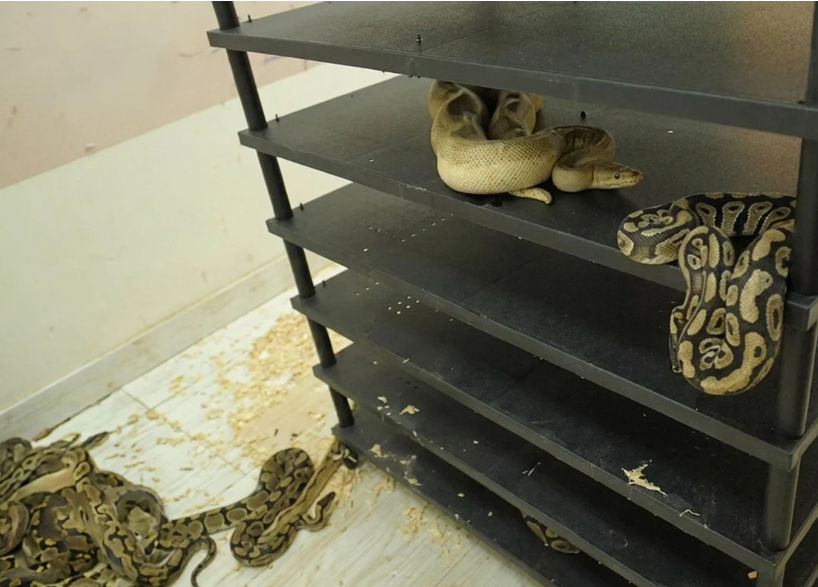
What police officers encountered when they entered Guo's residence proved shocking in scale and organisation. The apartment had been methodically converted into a reptile facility, with Guo restricting his personal living space to a single bedroom while dedicating the remaining two bedrooms and living room to housing his snakes. Numerous plastic boxes were stacked throughout the space, each containing pythons that represented years of selective breeding and careful management. In total, officers seized 309 pythons from Guo's flat, animals that were subsequently transferred to a local zoo for care and potential reintegration.
Guo himself provided insight into his motivations during police interviews, revealing a deep and longstanding personal fascination with snakes that had evolved into an obsessive breeding project. He described purchasing his first four pythons in 2014 and spending the subsequent decade researching and perfecting breeding techniques to produce colour variants and morphs. In a statement that characterised his psychology, Guo expressed that he felt like a "creature creator", a phrase suggesting he viewed his operation as a creative scientific endeavour rather than a criminal enterprise. His lack of fear regarding the snakes and his evident pride in his achievements indicated someone driven by passion rather than purely monetary motives, though the operation clearly generated income.
The investigation's scope extended beyond Guo to encompass his network of collaborators and suppliers. Deng, the shop owner who had sold Guo his original four pythons in 2014, was also arrested when police discovered 47 additional pythons in his home. The three-person network of Guo, Di, and Deng had collectively managed the breeding, maintenance, and distribution of 436 pythons valued at over 30 million yuan, representing a significant operation spanning a decade. Evidence indicated that approximately 80 pythons had been successfully sold through their network before intervention.
China's legal framework governing wildlife protection provides the foundation for prosecuting such violations. Pythons are classified as Grade Two protected animals under Chinese law, a designation that prohibits their purchase, sale, breeding, and transport without explicit government authorisation. Violators of regulations concerning Grade Two protected species face maximum prison sentences of five years, though the court's specific sentencing decisions for Guo, Di, and Deng were not disclosed in initial reports. The case reflects China's increasingly stringent approach to environmental crime, particularly regarding the protection of species with endangered status.
For Southeast Asian readers, this case carries particular relevance given the region's status as both a source and transit point for illegally trafficked reptiles destined for international markets. Python species and other protected reptiles face extraordinary poaching pressure across Southeast Asia, with sophisticated networks operating across national borders to meet demand from collectors and breeders in China and beyond. The case demonstrates that enforcement efforts in China are expanding to include online-enabled breeding operations and domestic networks, which may eventually disrupt supply chains that have traditionally depended on regional sources. However, the significant financial valuations and apparent ease with which Guo's operation functioned for a decade also suggest that enforcement remains inconsistent and that motivated individuals can sustain illegal activities despite regulatory restrictions. The electricity-based investigative approach employed here offers a model that could be replicated by authorities across the region, potentially disrupting similar operations before they reach the scale achieved by Guo's operation.