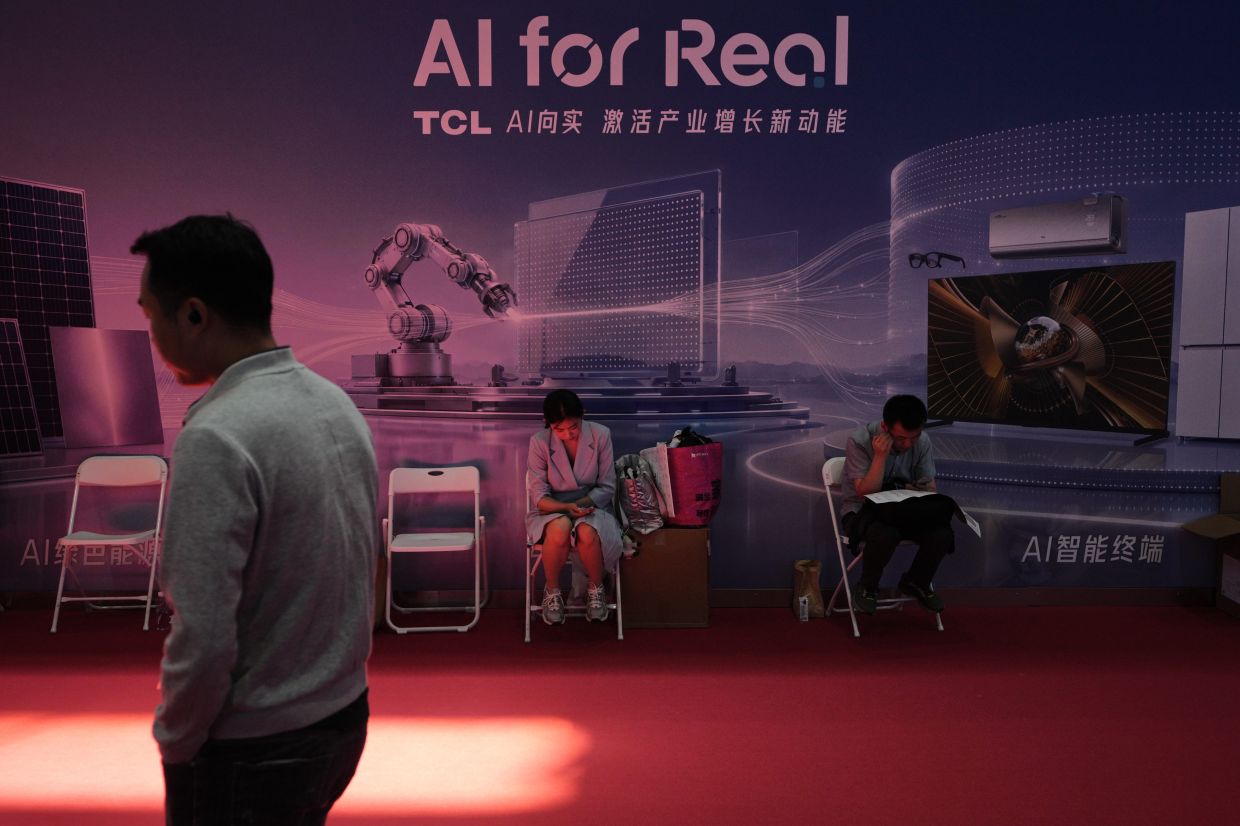
China's accelerating automation represents one of the defining economic challenges of the coming decade, with artificial intelligence now reshaping labour markets across the nation's vast workforce in ways that are simultaneously encouraging resilience and deepening anxiety. The transformation unfolds against a backdrop of government policies explicitly designed to embed AI and robotics throughout the economy, creating a uniquely rapid transition that differs markedly from the more gradual adoption patterns seen in Western nations.
The scope of this shift is staggering. Industrial enterprises using AI models and autonomous agents surged to 47.5 per cent in 2024 from just 9.6 per cent in the previous year, according to market intelligence firm IDC, suggesting an almost exponential acceleration in deployment. This velocity stems largely from Beijing's deliberate "AI Plus" initiative and its technological roadmap extending to 2030, which explicitly targets AI integration across multiple economic domains. Unlike countries where private market forces largely drive technological adoption, China's state apparatus actively encourages and facilitates the diffusion of automation, meaning workers and businesses face collective pressure to implement solutions simultaneously rather than at staggered intervals.
The displacement is already evident across white-collar professions. Mid-level computer programmers, once viewed as immune to automation, now find their core functions replicable by AI systems. Fei, a 40-year-old coder, reluctantly acknowledges that his role has become largely substitutable, noting that "mid-level coders' job are essentially replaceable in most of the cases." Rather than resist inevitable change, he recognises that refusing to adopt AI tools would place him at a competitive disadvantage, creating a perverse dynamic where workers must embrace the very technologies threatening their livelihoods. Similarly, the translation sector has contracted dramatically, with rates falling by more than half as AI-powered tools proliferate. Foreign language university enrolments have declined sharply as prospective students anticipate reduced career prospects.
The blue-collar sector faces equally profound disruption. Humanoid robots now sort parcels in postal facilities, direct traffic, and prepare food, though still at limited scale. More significantly, autonomous food delivery robots are expanding across Chinese cities, posing an existential threat to the millions of workers currently employed in last-mile delivery services. In the entertainment industry, generative AI applications for content creation, production, and distribution have decimated traditional production pathways, with live-action short-form video production collapsing by approximately 75 per cent year-on-year in early 2024.
What distinguishes China's experience is the notably muted public resistance to these changes. Shujing He, a senior analyst at advisory firm Plenum, observes that "there appears to be far less anti-AI sentiment in China (than elsewhere). Most people seem either positive, neutral, or mildly interested in AI." This apparent acceptance masks significant complexity: workers displaced or threatened by automation frequently pivot toward AI-enabled entrepreneurship and independent ventures, suggesting pragmatic adaptation rather than genuine enthusiasm. The cultural and political context matters considerably. In a system where technology is presented as patriotic advancement and collective progress, opposition carries different connotations than in democratic societies with more openly adversarial policy debates.
Yet the human cost manifests in measurable ways. Women face disproportionate displacement risk, according to International Labour Organization research, because they remain overrepresented in roles particularly suitable for automation, such as electronics assembly, while remaining underrepresented in technology and scientific fields. Youth unemployment presents another acute concern: China's overall urban joblessness hovers around five per cent, but for citizens aged 16 to 24 excluding students, the figure approaches 15 per cent, suggesting that entry-level positions have contracted severely. This generational impact compounds existing economic headwinds.
Beyond individual displacement, economists increasingly worry that rapid AI adoption could fundamentally weaken China's macroeconomic trajectory. Eswar Prasad, an economics professor at Cornell University, warns that while automation may boost productivity broadly, "AI is likely to lift productivity across the board but could have a severe disruptive effect on employment, worsening the employment growth problem and resulting in a detrimental effect on social stability." The mechanism is already visible: consumer spending has languished partly because households fear job losses, creating a vicious cycle where economic weakness feeds job anxiety, which further depresses consumption. This dynamic compounds existing challenges from the prolonged housing market downturn that has eroded household wealth.
Some workers have begun repositioning themselves proactively. Wang Zhicheng, a 32-year-old scriptwriter, was laid off when his employer reduced its scriptwriting team by roughly half. Rather than seek traditional employment elsewhere, he established an independent studio producing illustrated children's books, treating AI as a tool for brainstorming and fact-checking rather than as a replacement. He maintains skepticism toward pure AI generation, noting that machine-produced scripts often feel formulaic and repetitive, with inconsistent depth. This experience illuminates a crucial insight: for creative and decision-intensive work, humans retain comparative advantage, but only if they reposition themselves as curators and strategic overseers rather than as direct producers of routine output.
China's specific trajectory diverges significantly from global patterns, partly due to demographic realities that might eventually work in workers' favour. With a population of 1.4 billion now rapidly ageing and declining, China faces a shrinking workforce precisely as labour demand might increase due to demographic support ratios deteriorating sharply. By 2050, demographers project that China will have fewer than two working-age adults supporting each retiree, compared with more than 2.5 in the United States. Under such conditions, automation could shift from representing a threat to employment toward becoming a partial offset for labour scarcity. Xuenan Cao, a professor at San Francisco Bay University, argues that "automation could partially offset a shrinking workforce rather than being purely a threat to it," suggesting that the medium-term employment outlook may stabilise despite current disruption.
The policy implications for Southeast Asia merit careful consideration. Malaysia, Singapore, Thailand, Vietnam, and other regional economies are watching China's experience closely, as they contemplate their own automation strategies. If China's approach demonstrates that rapid, state-coordinated AI deployment generates significant short-term employment disruption without proportional job creation in replacement sectors, Southeast Asian policymakers may consider more graduated adoption pathways with stronger social safety net provisions. Conversely, if Chinese workers successfully navigate the transition through entrepreneurship and skill development, other nations may seek to replicate those facilitating conditions. The coming years will likely determine whether AI-driven disruption emerges as a manageable transition requiring strategic investment in retraining and social support, or as a structural economic shock requiring more radical policy interventions around income security and social stability.

