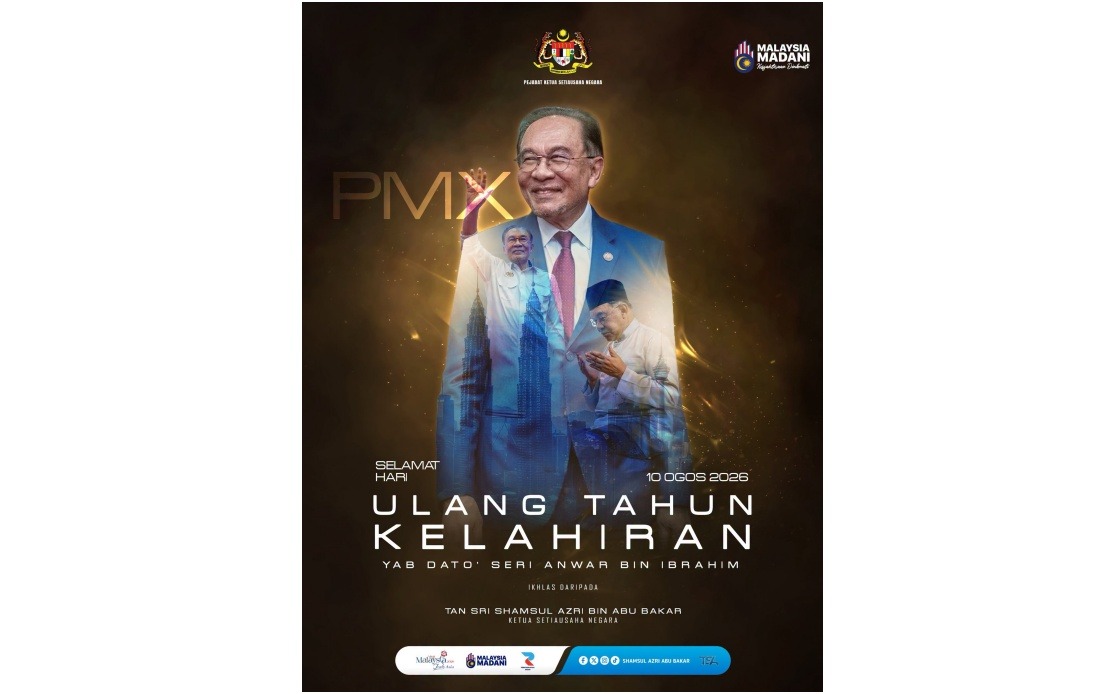
Prime Minister Datuk Seri Anwar Ibrahim reached his 79th birthday on August 10, marked by an outpouring of official good wishes from the country's top civil servant and key government bodies. Chief Secretary to the Government Tan Sri Shamsul Azri Abu Bakar led the tributes, publicly extending his birthday greetings and expressing hopes that the Prime Minister would enjoy sustained good health, physical vigour, and the wisdom required to guide the nation through its ongoing transformation agenda.
The acknowledgement from Malaysia's highest-ranking civil servant carries particular significance given the complex relationship between the executive and the bureaucracy. Tan Sri Shamsul Azri's remarks, shared through a Facebook post, underscored the civil service's commitment to backing the Prime Minister's vision for public sector reform and modernisation. His statement reflected a broader institutional alignment with the administration's reform priorities, signalling continuity in the collaborative efforts between political leadership and the permanent government.
Beyond the ceremonial nature of such birthday tributes, Tan Sri Shamsul Azri's message contained a substantive commitment. He pledged that civil servants nationwide would remain steadfast in supporting what he termed the Prime Minister's aspirations and reform agenda. This framing positioned the civil service not merely as administrators executing policy, but as active stakeholders invested in the government's direction. For Malaysian observers, such language carries weight given ongoing debates about the effectiveness and responsiveness of the public bureaucracy to contemporary governance challenges.
The Prime Minister's Office complemented the Chief Secretary's remarks by releasing its own birthday tribute through video, which circulated on social media platforms. The official message—"Efforts continue, the trust is fulfilled, and to Allah SWT we place our trust"—encapsulated the administration's characterisation of its tenure as one of persistent labour balanced by public confidence and religious conviction. The phrasing reflected the spiritual dimension often woven into Malaysian political discourse, particularly within a government that has emphasised Islamic principles alongside democratic governance.
The Malaysia MADANI initiative, the government's signature policy framework aimed at fostering economic growth, social cohesion, and political stability, also joined the birthday observances through its official social media channels. The MADANI Facebook page extended wishes that the Prime Minister would continue drawing strength to serve the nation with unrelenting dedication. This particular acknowledgement carried programmatic significance, as MADANI represents the administration's blueprint for addressing long-standing challenges related to economic inequality, institutional integrity, and national unity.
At 79 years old, Prime Minister Anwar Ibrahim remains one of Malaysia's older serving leaders, a factor that occasionally surfaces in discussions about succession planning and institutional stability. His advanced age does not appear to have dampened the administration's reform momentum, however. The various birthday tributes collectively emphasised continuity rather than transition, with officials highlighting ongoing initiatives rather than preparing ground for potential leadership changes.
The coordination of birthday messages across multiple government platforms—from the Chief Secretary's personal statement to institutional channels representing different aspects of the administration—suggests deliberate orchestration aimed at projecting unity and forward momentum. Such synchronisation has become standard practice in contemporary Malaysian governance, where social media messaging is carefully calibrated to reinforce key narratives.
For regional observers and Malaysia's international partners, these birthday acknowledgements offer insights into the current state of government cohesion and strategic priorities. The emphasis on reform, public service excellence, and divine guidance reflects the administration's evolving positioning within the broader landscape of Southeast Asian politics, where questions of institutional effectiveness and leadership legitimacy remain perpetually relevant.
The occasion also serves as a minor inflection point for assessing the administration's trajectory. Since taking office, the Prime Minister has navigated substantial political complexities, including managing coalition dynamics, addressing economic pressures, and attempting to address corruption concerns that have long plagued Malaysian governance. The birthday tributes, while ostensibly ceremonial, implicitly affirm institutional support for continuing along the current path.
For the Malaysian public and civil service workforce, such tributes carry practical implications beyond symbolic value. They signal that the government's reform agenda—which touches recruitment, accountability mechanisms, and service delivery standards—remains a central focus rather than a passing initiative. The Chief Secretary's specific mention of continued civil service support suggests that bureaucratic implementation of government policy continues despite the inevitable tensions that arise in any administration.

