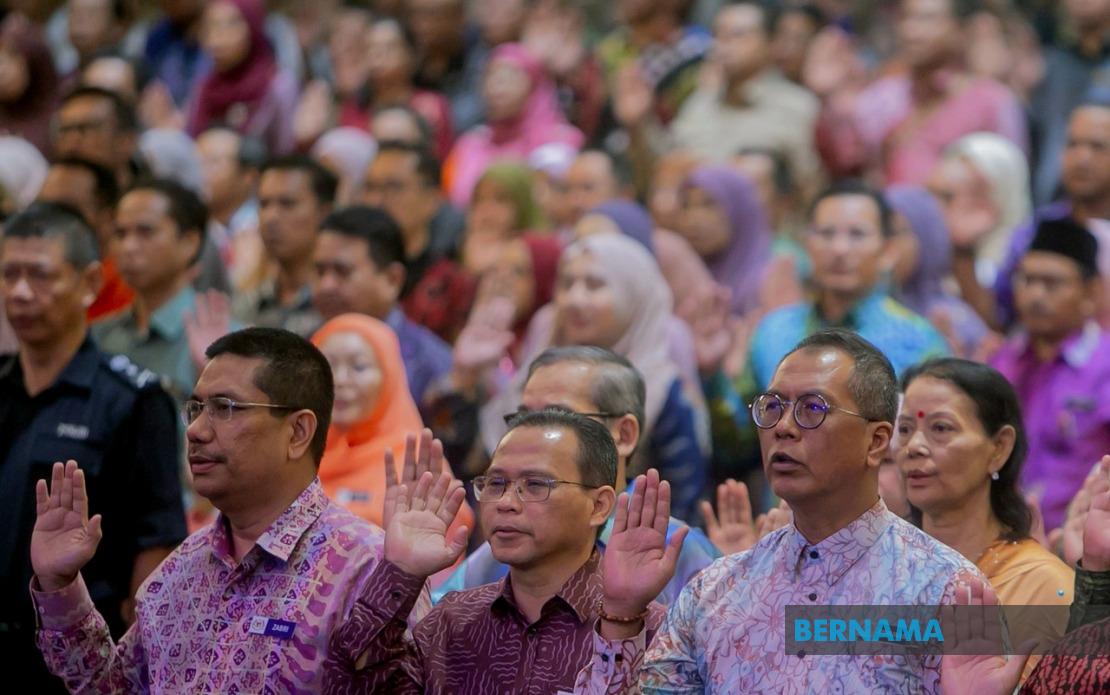
Prime Minister Datuk Seri Anwar Ibrahim has underscored the critical role played by the civil service in maintaining policy consistency and driving national development, arguing that a country's resilience ultimately rests upon the shoulders of committed public servants operating within a framework of accountability and moral leadership. Speaking during the Prime Minister and Chief Secretary to the Government's Session with Civil Servants in the Central Zone held at Universiti Islam Selangor in Bangi on July 20, Anwar articulated a vision of public administration rooted in ethical principles and institutional competence, positioning the bureaucracy as foundational to Malaysia's long-term progress.
The Prime Minister's remarks reflected a broader strategic pivot toward strengthening governmental machinery at every tier, signalling that the administration views civil service reform not as a peripheral concern but as integral to its policy agenda. Anwar's comments carried particular weight given recent discussions about governance efficiency and public sector accountability in Malaysia, where concerns about institutional capacity and corruption have occasionally dominated political discourse. By elevating the importance of the civil service, the government appeared to be signalling confidence in institutional structures while simultaneously placing accountability squarely on officials to merit that trust.
Anwar emphasised that his administration's focus on elevating leadership standards and operational efficiency throughout the public service stems from a fundamental belief in the capabilities that civil servants bring to their roles. This confidence, he suggested, translates into concrete policy decisions about resource allocation, training, and institutional development. The implication was clear: an effective government depends not merely on the decisions made in ministerial offices, but on the quality of implementation delivered by thousands of officials scattered across federal, state, and local authorities.
The Prime Minister articulated a philosophy positioning civil servants not as passive administrators executing orders, but as active agents requiring close engagement with communities and commitment to the administration's development philosophy. This framing suggests an expectation that public servants will internalise governmental objectives and translate them into locally-relevant initiatives that resonate with the populations they serve. For Malaysian readers, this represents a nuanced position: acknowledging that governance effectiveness requires more than top-down directives, but rather demands that bureaucrats understand the reasoning behind policy choices and become genuine advocates for their implementation.
The session convened in Bangi drew senior government figures reflecting the significance attached to the occasion. Selangor Menteri Besar Datuk Seri Amirudin Shari's presence underscored the federal-state coordination dimension, whilst Chief Secretary to the Government Tan Sri Shamsul Azri Abu Bakar and Director-General of the Public Service Tan Sri Wan Ahmad Dahlan Abdul Aziz represented the apex of administrative hierarchy. This gathering of top officials suggests the government is investing effort into direct engagement with civil servants, moving beyond bureaucratic channels to communicate priorities directly and assess morale and understanding across ranks.
For the Malaysian public service, which has historically faced criticisms regarding modernisation, diversity, and responsiveness, the Prime Minister's framing carries both opportunity and expectation. By stressing the importance of integrity-based systems, Anwar was implicitly acknowledging past concerns whilst positioning reform as forward-looking rather than punitive. The emphasis on commitment and understanding of developmental philosophy could be interpreted as laying groundwork for expanded civil service responsibilities in implementing complex policy initiatives across multiple sectors.
The Central Zone session forms part of what appears to be a structured engagement programme between political leadership and bureaucratic structures. Such direct interaction, though sometimes underestimated in political analysis, serves multiple purposes: it allows officials to hear policy priorities directly from decision-makers, provides leadership visibility into actual implementation challenges, and creates opportunities for clarifying expectations. In the Malaysian context, where administrative structures span vast geographical areas and serve diverse communities, such forums facilitate important alignment between vision and execution.
The emphasis on civil servants maintaining close ties with the people they serve reflects broader international trends in public administration toward participatory governance and community-responsive bureaucracy. However, in Malaysia's specific context, this carries particular significance given the country's ethnic and religious diversity, regional disparities in development, and the need for government services to be perceived as equitable and accessible. Civil servants positioned as community-connected figures can potentially strengthen institutional legitimacy and reduce the perception of government remoteness.
The government's positioning of the civil service as a cornerstone of policy continuity addresses a fundamental challenge in democratic systems: ensuring that bureaucratic transitions do not disrupt long-term strategic initiatives. As Malaysia navigates complex economic transitions, geopolitical shifts, and domestic social challenges, maintaining institutional memory and strategic focus across administrations becomes increasingly important. A professional, committed civil service provides continuity whilst allowing for policy adjustments reflecting electoral mandates.
The gathering also implicitly acknowledges that civil service morale and engagement matter for governance outcomes. By bringing leaders directly into dialogue with public servants, the government signalled that their work is valued and that feedback channels remain open. This becomes particularly relevant in contexts where bureaucratic motivation has occasionally been questioned, and where attracting and retaining talent in the public service has become increasingly competitive.
Looking forward, Anwar's emphasis on integrity and commitment suggests the government may be preparing the groundwork for expanded civil service responsibilities in priority areas such as infrastructure development, social service delivery, and economic transformation. The framing positions public servants not as obstacles to reform but as essential partners in achieving governmental objectives, a perspective that could influence both policy design and implementation strategy across multiple portfolios in coming years.

