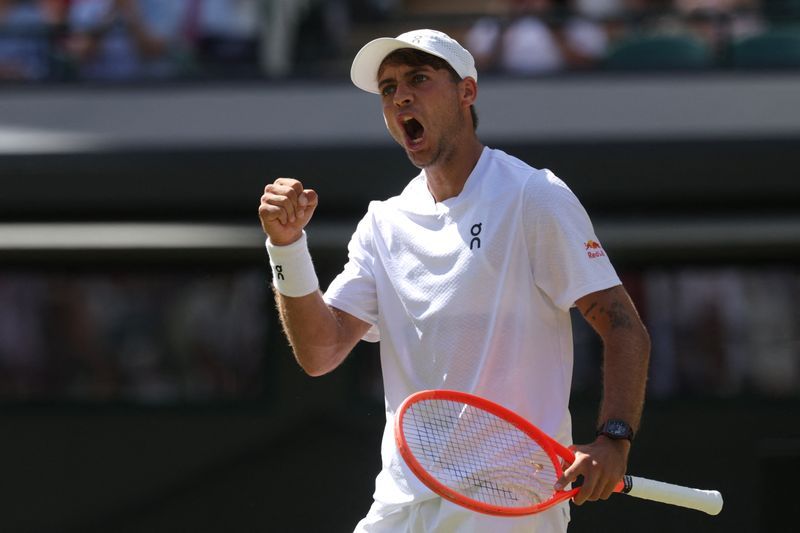
Flavio Cobolli extended his breakthrough Grand Slam campaign with a commanding straight-sets victory over Australian fifth seed Alex de Minaur on Monday, advancing to the Wimbledon quarter-finals as the ninth-seeded Italian continues his remarkable ascent through professional tennis. The 24-year-old's 7-5 7-6(4) 6-3 triumph on Court One marks his return to the last eight at the All England Club for a second consecutive year, a significant achievement given the intensity of his recent performances on the international circuit.
Cobolli's path to this stage has been extraordinary by any measure. Just weeks earlier, he reached the final of the French Open, one of tennis's most prestigious tournaments, establishing himself as an emerging force at the sport's highest level. This Wimbledon run represents a continuation of that momentum, defying the physical and mental fatigue that can plague players moving rapidly between consecutive Grand Slam events. For a young Italian talent, reaching multiple Grand Slam quarter-finals within such a compressed timeframe represents the kind of breakthrough that transforms a career trajectory.
The match against De Minaur unfolded as a battle of contrasting styles and temperaments. Cobolli's breakthrough came in the eleventh game of the opening set when he forced a backhand error to secure the break needed to claim it within fifty minutes. This early success reflected his ability to maintain composure under pressure against a top-ten opponent, a quality essential for sustained success at Grand Slam level. De Minaur, known for his retrieval skills and competitive spirit, found himself unable to match Cobolli's aggressive intent during crucial moments.
The second set transformed into a tense affair marked by two separate stoppages for medical intervention as spectators struggled with the intense heat that has characterised this Wimbledon. The breaks in play tested both players' mental fortitude, requiring them to maintain focus and energy despite the disruptive pauses. Remarkably, rather than creating tension, these interruptions provided an opportunity for professional respect to surface. Cobolli and De Minaur engaged in cordial conversation during one halt, with the Australian graciously warning his opponent to anticipate similar incidents given the oppressive conditions. Despite trailing 2-5, Cobolli demonstrated exceptional composure by reeling off three consecutive games to force the set to a tiebreak, which he won 7-4 to double his set advantage.
The final set saw Cobolli face further adversity when he fell behind 0-2, but his accumulated momentum proved decisive. The Italian's powerful hitting, which had proven instrumental in navigating the tense closing stages of the second set, enabled him to recover from the break deficit and ultimately dismiss De Minaur's challenge with growing authority. This comeback sequence underscored Cobolli's mental resilience and tactical intelligence, qualities that distinguish emerging Grand Slam contenders from journeyman professionals.
Cobolli's path to the semi-finals now depends on the outcome of the fourth-round clash between British hope Arthur Fery and veteran Bulgarian Grigor Dimitrov, both competitors who have accumulated positive records during the early rounds at the All England Club this year. The Italian enters that matchup with considerable momentum and the advantage of knowing he faces either an experienced campaigner or a home favourite, each presenting distinct challenges.
In reflecting on his victory, Cobolli emphasised the importance of energy management in tournaments where multiple matches across consecutive days drain physical reserves. Having already pushed himself to the limit in the French Open just weeks earlier, reaching the quarter-finals in straight sets represented an ideal outcome, allowing him to preserve stamina for upcoming rounds. The Italian's appreciation for his supporters, despite the extreme heat affecting the crowd, revealed a maturity and gratitude that resonates with serious athletes navigating the pressures of elite competition.
When asked about his plans following the match, Cobolli revealed a refreshingly human approach to recovery and rest between intense matches. Rather than obsessively studying footage of his potential next opponent, he intends to seek relief from the heat through ice cream while enjoying homemade pasta prepared by his father—a simple acknowledgement that mental recovery and family connection matter as much as technical preparation. His reference to potentially watching World Cup football between Spain and Portugal indicated a player comfortable stepping away from the immediate demands of competition to maintain psychological balance.
Cobolli's emergence as a Grand Slam contender carries significant implications for Italian tennis, which has struggled to produce consistent male champions at the highest level in recent years. His achievements at Roland Garros and now his sustained performance at Wimbledon suggest the possibility of a player capable of competing for major titles over multiple seasons. For Malaysian and broader Southeast Asian tennis audiences, Cobolli's rise exemplifies how younger players can accumulate success through resilience, tactical sophistication, and mental discipline—qualities transferable across the sport globally.
The Italian's tournament trajectory also highlights an underappreciated dimension of Grand Slam tennis: the importance of seeding advantage and draw position. As the ninth seed, Cobolli has benefited from a manageable path to the quarter-finals, but his performances against De Minaur and earlier opponents have demonstrated that he possesses the quality to compete against higher-ranked players when required. His next opponent will determine whether this Wimbledon represents another stepping stone toward consistent Grand Slam success or a temporary peak that cannot be sustained against stronger competition ahead.

