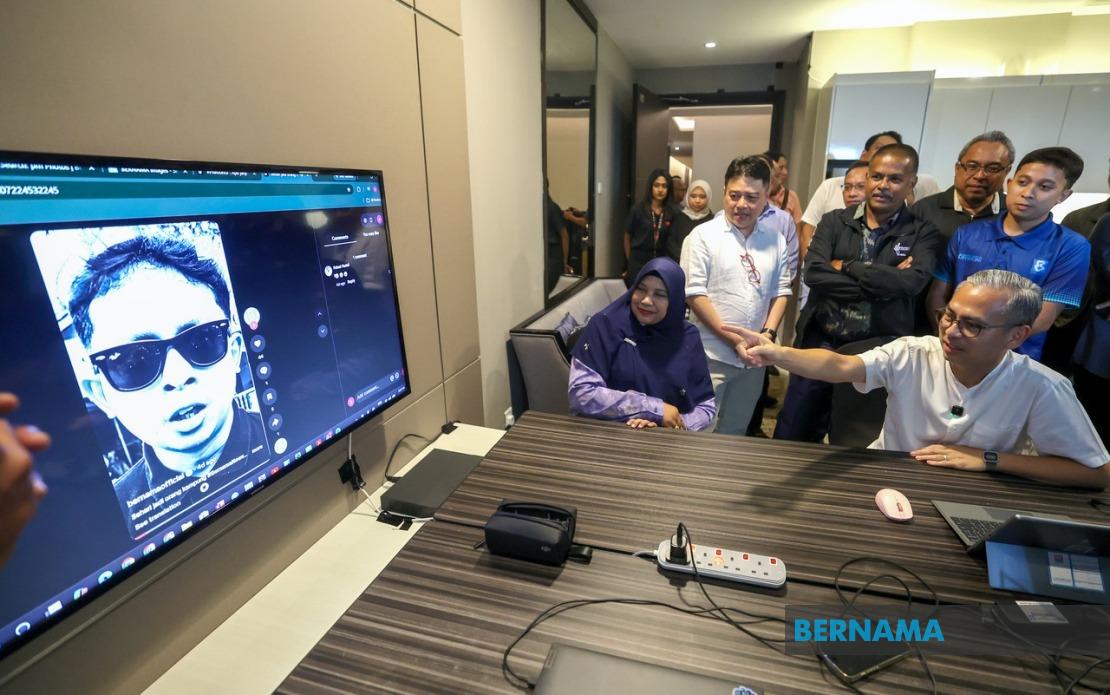
Communications Minister Datuk Fahmi Fadzil has commended the Malaysian National News Agency (Bernama) for demonstrating strong organisational capability and dedication during coverage of the Johor state election, highlighting the importance of reliable media infrastructure during critical democratic processes. His visit to the Bernama Operations Centre in Johor Bahru on July 7 underscored the government's recognition of the news agency's role in keeping the public informed through accurate reporting during electoral cycles.
The minister's inspection revealed a comprehensive deployment strategy, with a total of 44 personnel—including journalists, cameramen, and photographers—stationed across Johor to provide real-time coverage of voting activities. This team was tasked with monitoring developments throughout the entire state, spanning geographic points from Endau in the south to Tanjung Surat and extending northward, demonstrating the logistical scope of Bernama's assignment during the election period.
Fahmi's visit to the operations centre, which lasted more than an hour, allowed him to assess firsthand the working conditions and infrastructure supporting the news-gathering effort. He observed journalists, sub-editors, editors, and broadcast television staff stationed at the facility, evaluating whether resources and facilities adequately supported their duties. His findings indicated satisfaction with the operational setup, suggesting that Bernama had adequately prepared its infrastructure to handle the demands of comprehensive electoral coverage.
The minister extended specific recognition to Bernama Chief Executive Officer Datin Paduka Nur-ul Afida Kamaludin and Editor-in-Chief Arul Rajoo Durar Raj for their roles in coordinating the election coverage strategy. Fahmi emphasized that the preparations undertaken by senior management, combined with the support systems established for journalists on duty, had maintained professional standards expected of a national news agency during significant political events.
The timing of Fahmi's visit reflected the election's critical phase, with early voting having commenced on July 7 and main polling scheduled for July 11. The Johor state election was contested by 172 candidates competing for 56 seats across the state, representing a substantial democratic exercise that required coordinated media presence and reporting. Bernama's deployment appeared calibrated to match this scale of electoral activity.
The Communications Ministry's public acknowledgment of Bernama's efforts carries broader implications for media-government relations in Malaysia. By personally visiting the operations centre and expressing appreciation, Fahmi signalled the government's expectations for professional, comprehensive coverage during elections, while validating the resources allocated to the national news agency. This approach reflects evolving expectations that state-controlled media should deliver factual, detailed reporting that serves public interest.
For Malaysian readers and regional observers, the operational details revealed by Fahmi's visit illustrate the infrastructure requirements for covering sub-national elections in a large state. Johor's geographic expanse—stretching across multiple administrative zones—necessitates distributed reporting teams that can simultaneously monitor polling centres, gather data, and feed information to a central coordinating hub. The 44-person deployment suggests Bernama's assessment of adequate coverage ratios for achieving comprehensive representation of election-day activities.
The minister's emphasis on facilities and support systems reflects growing recognition within government that journalist welfare directly impacts reporting quality. By ensuring that field teams had adequate resources and working conditions at the operations centre, Bernama managers could maintain professional standards throughout a demanding electoral assignment. This attention to operational details distinguishes professional election coverage from rushed or under-resourced reporting efforts.
Bernama's role during state elections also contextualizes the agency's position within Malaysia's broader media landscape. While private news organisations compete for coverage, the national news agency maintains institutional responsibility for comprehensive factual reporting that reaches diverse audience segments. The government's public recognition of this function reinforces Bernama's standing as the primary authoritative source for electoral information during state-level contests.
The election coverage exercise demonstrates coordination mechanisms between government communications infrastructure and electoral processes. Communications ministers typically maintain oversight of media institutions during major political events, ensuring that information flows serve both democratic accountability and orderly electoral management. Fahmi's inspection appeared consistent with this supervisory function, though framed as recognition of professional work rather than direct operational intervention.
Looking at regional media practices, Malaysia's reliance on a state-controlled news agency as a primary electoral information source reflects patterns evident across several Southeast Asian democracies, where national agencies play important roles during competitive elections. The scale of Bernama's Johor deployment—with dedicated operations centres and significant personnel allocation—indicates that such assignments require substantial institutional resources and advance planning.
The public articulation of appreciation for Bernama's work also serves a signalling function to other government agencies and media outlets regarding expected standards during elections. By publicly commending the news agency's professionalism and facilities, Fahmi established a benchmark for election coverage that emphasizes comprehensiveness, accuracy, and adequate resourcing. This implicit standard-setting influences broader media behaviour during electoral periods.
As Malaysia continues holding state elections across its federal structure, the patterns established during the Johor exercise may inform future deployments by Bernama and other news organisations. The minister's validation of the agency's 44-person team, distributed coverage strategy, and centralised operations model suggests institutional frameworks that could be replicated during subsequent state contests, contributing to more consistent media practices across the country's electoral calendar.

