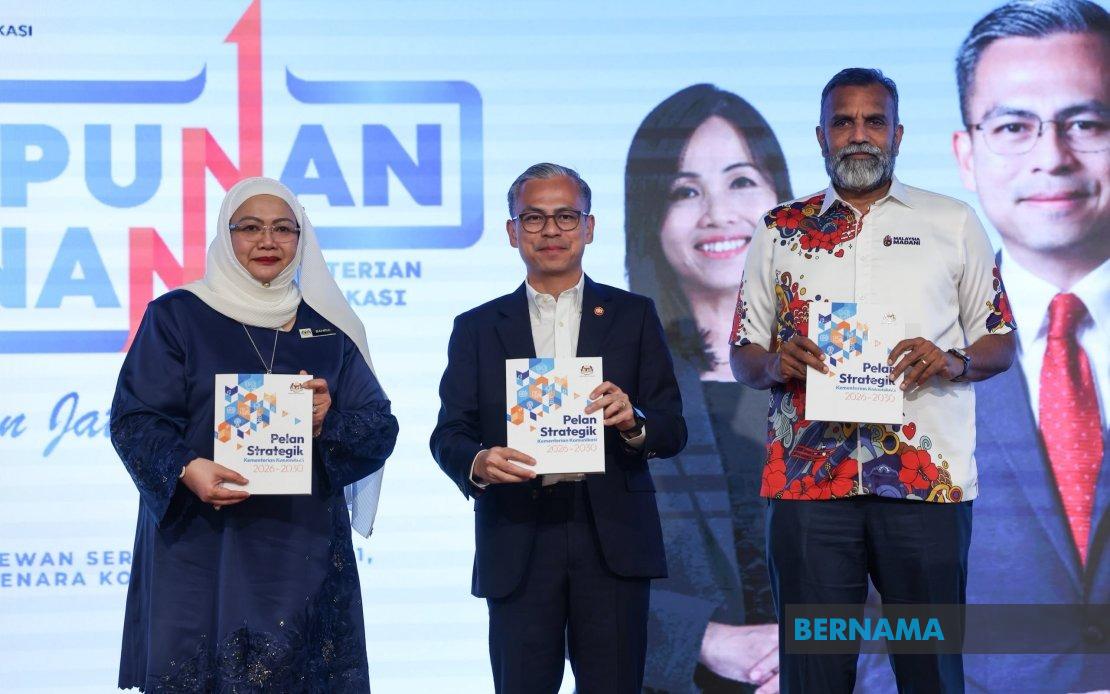
Communications Minister Datuk Seri Fahmi Fadzil has introduced the Communications Ministry Strategic Plan (PSKK) 2026-2030, a comprehensive roadmap designed to guide the ministry's operations and those of its subordinate agencies through the remainder of the decade. Announced at the ministry's monthly assembly in Putrajaya, the plan provides a structured framework for implementing policies and initiatives that directly support Malaysia's broader national development agenda, particularly the 13th Malaysia Plan and the Malaysia MADANI vision.
The strategic plan distils the ministry's ambitions into three fundamental pillars that Fahmi identifies as central to addressing the most pressing public concerns. Enhanced internet infrastructure represents the first priority, reflecting widespread expectations for improved connectivity across urban and rural Malaysia. The second pillar focuses on fostering creative content production, recognising the potential of the creative industries as economic drivers. The third addresses information accuracy, a critical concern in an era of digital misinformation and fragmented media landscapes.
At the heart of the plan lies a unified vision articulated as 'A Connected, Informed and Creative Malaysia'. This aspirational statement reflects an integrated understanding of how telecommunications, media, and cultural development intersect to shape national competitiveness and citizen wellbeing. The realisation of this vision depends on three interdependent missions that collectively address infrastructure, information systems, and creative capacity.
The first mission concentrates on reinforcing Malaysia's communications infrastructure and regulatory architecture. This encompasses strengthening physical networks, improving service quality, and establishing governance frameworks that balance innovation with consumer protection. The second mission targets the creation and dissemination of trustworthy information that reflects the diversity of Malaysian society whilst maintaining editorial integrity. The third pursues the development of a thriving creative sector capable of generating employment, exports, and cultural soft power on regional and global stages.
To operationalise these missions, the ministry has identified four strategic thrusts that represent distinct implementation pathways. The primary thrust involves fortifying the national communications ecosystem to ensure inclusive, high-quality and secure connectivity reaches all Malaysians. This addresses a persistent gap whereby rural and lower-income urban communities often face inferior broadband speeds and reliability compared to affluent metropolitan areas. The second thrust concentrates specifically on enhancing the competitive positioning of Malaysia's film and music industries, sectors that have demonstrated considerable export potential but require strategic support to compete with established regional and international players.
The third thrust centres on transforming how information is delivered across government and public institutions. Rather than siloed departmental communication, this approach emphasises integrated information architecture that serves citizens more efficiently. The final thrust reimagines service delivery mechanisms to ensure government agencies responding to the ministry's oversight become more responsive to policy directives and attuned to citizen preferences. This reflects broader Malaysian administrative reform efforts aimed at modernising bureaucratic processes.
Within these four strategic pillars sit 94 distinct programmes spanning the five-year planning horizon. This substantial number of initiatives demonstrates the ministry's ambition, though implementation capacity and resource allocation will determine which programmes receive prioritised attention and funding. For Malaysian businesses operating in telecommunications, broadcasting, and creative sectors, these programmes signal where government support and regulatory changes are likely to concentrate.
Fahmi's assertion that existing ministry programmes already operate in accordance with this strategic framework suggests that the plan primarily formalises and coordinates activities already underway rather than representing a radical departure. This continuity approach may reduce transition costs and bureaucratic friction, though it raises questions about whether the plan adequately addresses emerging challenges such as cybersecurity threats, the rapid evolution of content distribution technologies, and competition from international digital platforms.
For Malaysian citizens and businesses, the plan's emphasis on connectivity improvements carries particular resonance. Rural broadband expansion remains incomplete, whilst urban areas increasingly demand 5G infrastructure and gigabit-speed fixed networks. The commitment to information accuracy responds to legitimate public concerns about misinformation, though implementation requires careful navigation of press freedom principles. Support for creative industries aligns with Malaysia's diversification strategy to reduce dependence on conventional manufacturing and commodities.
Regionally, the plan positions Malaysia within competitive dynamics involving Singapore, Indonesia, Thailand, and Vietnam, all pursuing similar digital transformation and creative economy objectives. How effectively Malaysia executes these priorities will influence its standing as a digital hub and cultural centre within Southeast Asia. The plan's success ultimately depends on sustained budget allocation, effective inter-agency coordination, and the ability of the ministry to adapt implementation strategies as technologies and market conditions evolve across the 2026-2030 period.

