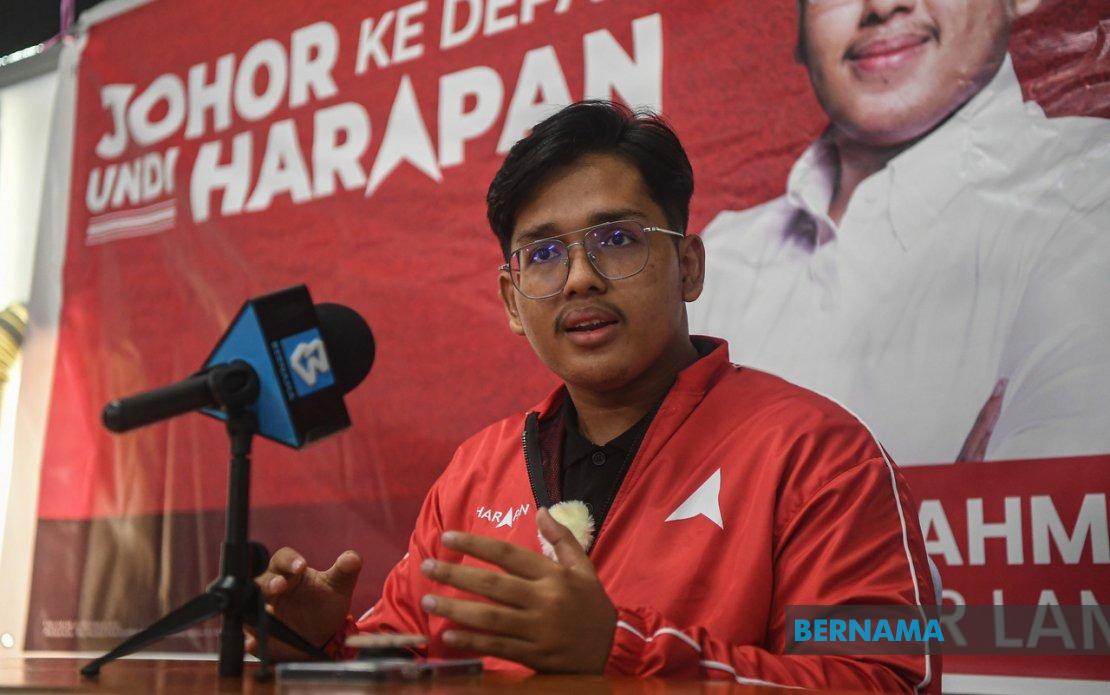
At 23 years old, Danish Hossman Abd Rahman has emerged as the youngest candidate in the 16th Johor state election, bringing a fresh pitch to voters in the Johor Lama constituency. Running under the banner of Pakatan Harapan with the campaign slogan "Wajah Baharu, Johor Lama" (A New Face, Johor Lama), he is positioning himself as a bridge-builder for one of the state's more economically marginalised areas, vowing to redirect development priorities and investment away from the traditional growth corridors of Johor Bahru, Tebrau, and Kulai.
Danish's core argument centres on reversing a persistent pattern of rural depopulation, particularly from Felda settlements where young people have long sought employment opportunities in urban centres or across the border in Singapore. He contends that targeted investment and job creation in Johor Lama would allow residents, especially youth, to remain within their communities without sacrificing economic prospects. This approach reflects growing recognition among Malaysian politicians that economic inequality between urban and rural areas drives migration patterns and social pressures that extend beyond simple employment calculations.
Integration between state and federal government machinery forms a critical pillar of his platform. Danish argues that development initiatives in constituencies like Johor Lama require seamless coordination across levels of governance to ensure policies translate into tangible implementation rather than remaining as campaign promises. This emphasis on administrative coherence addresses a longstanding frustration among rural constituencies, where bureaucratic fragmentation and jurisdictional gaps often result in delayed or incomplete project delivery.
Beyond macroeconomic strategy, Danish is also championing a granular administrative improvement that highlights the practical frustrations of Johor Lama residents. He is advocating for an Immigration Department branch office in Kota Tinggi, a facility that currently does not exist in the constituency. Residents seeking to renew passports or address immigration matters must travel considerable distances to Johor Bahru, Kulai, or Mersing, consuming time and resources. This absence of basic administrative infrastructure represents a form of institutional neglect that disproportionately affects rural communities and exemplifies how development gaps extend beyond economic investment into governance accessibility.
His campaign methodology blends traditional grassroots engagement with digital outreach, a hybrid approach that recognises the demographic heterogeneity of the constituency. With over 32,000 registered voters across Johor Lama, Danish is combining direct community meetings and door-to-door conversations with active social media campaigns. This dual strategy appears to be gaining traction; he reports positive feedback from constituents on social platforms, suggesting that younger voters particularly may be receptive to a candidate who matches their preferred communication channels while maintaining personal engagement.
The electoral contest in Johor Lama is shaping up as a three-way battle. Danish faces incumbent Norlizah Noh from Barisan Nasional, who will be defending her seat, and Aisah Esa representing Perikatan Nasional. The three-cornered fight complicates the conventional urban-rural or left-right political axes, introducing a wild card factor that may significantly influence voter distribution and ultimately determine outcomes.
For Malaysian observers, the Johor Lama contest represents a microcosm of broader challenges confronting the country's electoral politics. The emphasis on rural development and reversing migration patterns speaks to Malaysia's regional inequality, a persistent structural issue that previous administrations have struggled to address comprehensively. The candidate's focus on institutional accessibility through the proposed immigration office suggests that even modest infrastructure improvements remain unrealised in pockets of the country, despite decades of national development planning.
Danish's candidacy also reflects the changing face of Malaysian politics, where younger figures are emerging to challenge established hierarchies. At 23, he represents a generational shift, though whether youth alone translates into electoral support remains uncertain. His ability to articulate specific, actionable proposals—rather than generic development rhetoric—may differentiate him in voters' minds, particularly among pragmatic constituencies concerned more with concrete deliverables than ideological positioning.
The timing of his campaign message carries particular resonance given Singapore's continuing economic magnetism for Malaysian workers, especially from the lower-income segments. If Johor Lama can indeed be repositioned as an economic node rather than a labour source exporting its young to neighbouring regions, it would represent a meaningful shift in the state's development geography. Whether Danish Hossman can translate campaign promises into real investment and employment creation will ultimately determine both his political future and the credibility of rural-focused development agendas within Pakatan Harapan.
Polling for the 16th Johor state election is scheduled for July 11, with early voting commencing on July 7. The constituency will test whether voters in Felda and semi-rural areas prioritise continuity through Barisan Nasional, ideological alignment through Perikatan Nasional, or the promise of renewed focus represented by Pakatan Harapan's young candidate.

