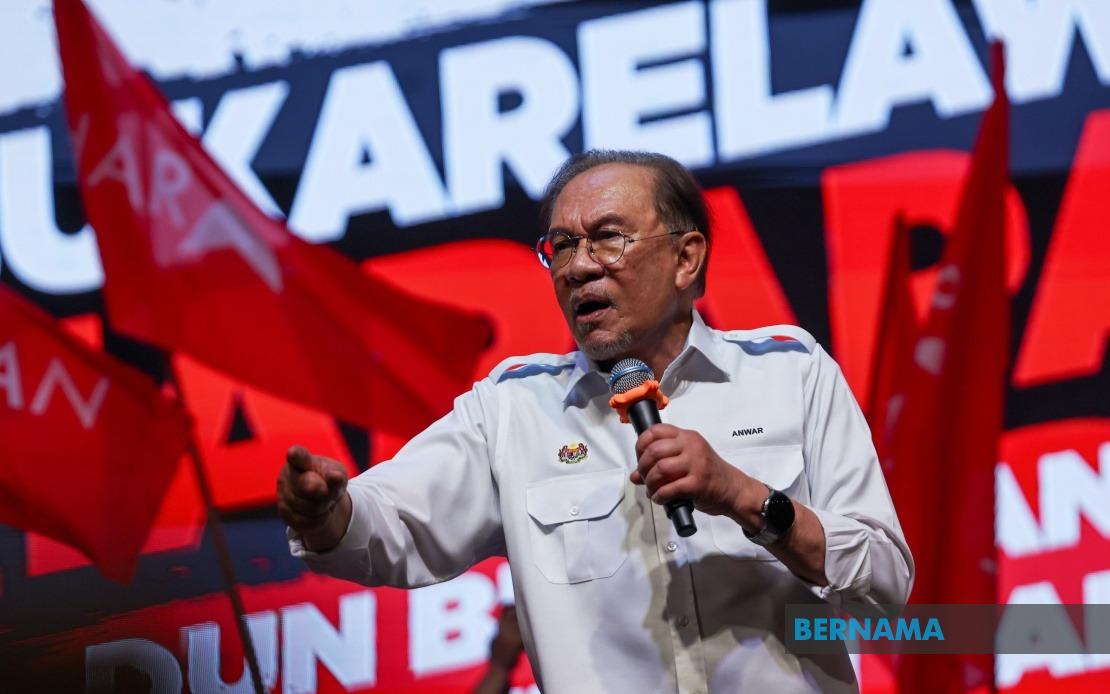
Prime Minister Datuk Seri Anwar Ibrahim moved to quell persistent allegations that the Democratic Action Party harbours anti-Malay sentiments, characterising such narratives as politically motivated distortions designed to undermine the coalition government's credibility. Speaking during a campaign stop in Muar as the Johor state election campaign enters its final week, Anwar presented evidence of DAP's willingness to support measures protecting Malay interests, citing the party's acceptance of plans to gazette 20.23 hectares of land in Bandar Malaysia as Malay Reserve Land as concrete proof of its commitment to constitutional safeguards.
The Prime Minister's remarks represent a calculated effort to address simmering tensions within Malaysia's fractious political landscape, where claims of racial bias continue to dominate discourse despite the formation of the Unity Government spanning the political spectrum. Anwar's dual role as premier and chairman of Pakatan Harapan places him in a delicate position, required to defend coalition partners from ideological attacks while maintaining sufficient political capital to govern effectively across competing interests. His intervention suggests that anti-DAP sentiment, whether from within rival coalitions or from elements within the government's own base, remains potent enough to warrant direct rebuttal at the grassroots level.
Central to Anwar's argument is a distinction between respecting constitutionally entrenched Malay-Muslim privileges and pursuing broader inclusive economic policy. He framed the government's approach as fundamentally reconcilable with constitutional provisions, suggesting that supporting Malay entrepreneurship through expanded allocations to Perbadanan Usahawan Nasional Berhad and other affirmative action programmes need not preclude simultaneous investment in Chinese and Indian communities. This formulation attempts to recast the political debate from a zero-sum competition over ethnic benefits to a framework where rising economic tide can theoretically lift all boats simultaneously.
Yet the apparent simplicity of Anwar's position masks deeper complexities within Malaysia's political economy. The notion that economic growth can be distributed fairly across all communities while maintaining structural advantages for one demographic group continues to generate friction in public discourse. Anwar's emphasis on poverty alleviation across all ethnic lines, coupled with appeals to invest in housing, basic infrastructure, and education quality irrespective of community identity, suggests a pragmatic reorientation toward needs-based rather than ethnicity-based resource allocation—a potentially controversial pivot that challenges conventional Malaysian political thinking.
Anwar's comments come amid campaigning for the 16th Johor state election, scheduled for July 11, with 172 candidates vying for 56 state assembly seats. Early voting commenced on July 7. The timing of Anwar's remarks reflects broader calculations about voter sentiment heading into what observers view as a significant test of the Unity Government's grassroots appeal in a strategically important state. Johor's position as an industrial and commercial hub makes its electoral outcome particularly consequential for shaping perceptions of government stability and coalition cohesion.
The Prime Minister's framing of political leadership as a public trust rather than a vehicle for personal enrichment appears directed at younger voters and civil society concerns about governance quality. By positioning his government as fundamentally committed to equitable development and rejecting the notion that holding office should translate into private benefit, Anwar attempts to elevate the campaign discourse beyond ethnic and religious divisions toward governance competence and material improvement in living standards. Whether such messaging resonates with voters amid persistent cost-of-living pressures and infrastructure deficits remains uncertain.
Anwar's defence of DAP reflects broader anxieties within the Unity Government about sustaining the coalition's fragile equilibrium. The need to repeatedly reassure communities that minority-led parties within the coalition respect constitutional frameworks suggests deep-seated public scepticism about power-sharing arrangements. This dynamic creates ongoing vulnerability, as political opponents can continue deploying racial anxiety narratives to erode support for the government despite Anwar's efforts to demonstrate operational compatibility across ethnic lines.
The emphasis on translating economic growth into tangible improvements—functional housing, improved education, reliable basic services—signals a recognition that campaign messaging focused solely on constitutional protections or philosophical commitments to inclusivity carries limited persuasive power. Voters increasingly demand evidence of material delivery, and Anwar's framing suggests the government intends to make its record on practical governance improvements central to its electoral pitch in Johor and beyond.
Looking forward, Anwar's intervention highlights an ongoing challenge for Malaysia's multiethnic coalitions: bridging fundamental ideological and communal differences while maintaining sufficient trust to govern cohesively. The repeated necessity of defending coalition partners against accusations of ethnic insensitivity suggests that despite three years of Unity Government rule, confidence in intercommunal political cooperation remains tentative. Future electoral contests will likely continue foregrounding such questions, making Anwar's ability to articulate compelling visions of shared prosperity increasingly central to the coalition's political viability.

