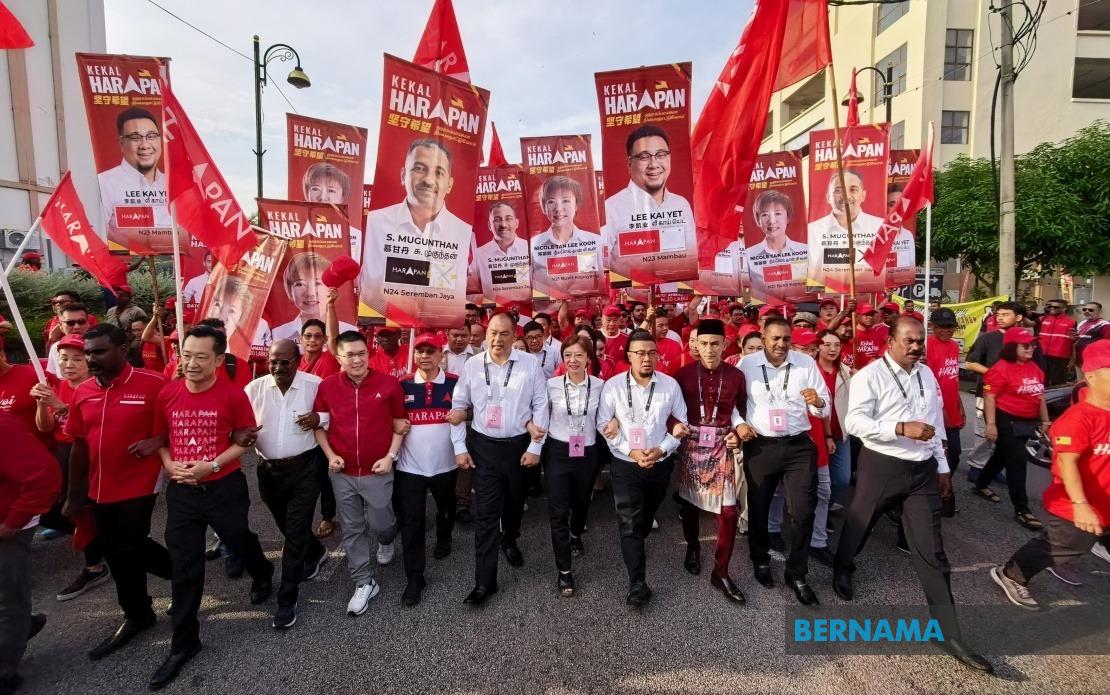
Negeri Sembilan's Rahang constituency has emerged as a genuinely competitive four-way race, with Pakatan Harapan's Siaw Meow Keong, the state DAP treasurer, attempting to retain the seat he has held since 2023 against a diverse field of challengers. The nomination process concluded on July 18 at the Seremban City Council Hall, with candidates from four separate political camps securing their candidacy papers for what promises to be one of the more fragmented contests in the upcoming state election. The emergence of multiple viable candidates across the ideological spectrum signals the contested nature of this historically significant constituency and reflects the evolving political landscape within Negeri Sembilan.
Siaw's principal challenger from the traditional two-coalition framework comes from the Barisan Nasional bloc, represented by Yap Siok Moy, the Wanita MCA chief from Rasah. As the female leadership representative within the coalition machinery, Yap brings organisational backing and the institutional resources of BN's women's wing, positioning her as a credible alternative capable of mobilising cross-gender support. Her candidacy reflects BN's strategic choice to leverage established women leaders in competitive urban-leaning constituencies where demographic patterns favour candidates with strong community networks and visible local presence.
The race has become further complicated by the participation of S. Thinagaran representing Parti Sosialis Malaysia, whose presence introduces an explicitly ideological dimension to the contest. PSM's participation in Negeri Sembilan constituencies has typically involved fielding candidates in constituencies where left-wing or progressive messaging might resonate with specific voter demographics. Thinagaran's nomination underscores how even established state elections continue to provide platforms for alternative political voices beyond the dominant coalition structure, though PSM's electoral performance historically remains modest relative to mainstream parties.
Completing the field is Tang Jay San from Bersatu, the splinter party that emerged from the earlier UMNO-PAS realignment and has positioned itself as an alternative Malay-Muslim political vehicle. Bersatu's presence across multiple Negeri Sembilan seats reflects its strategy of contesting aggressively in state-level elections where it can leverage recent political shifts and dissatisfaction with established players. In Rahang, Tang's candidacy may appeal to voters uncertain about traditional coalition structures, though Bersatu's performance in peninsular state elections outside its strongholds has proven inconsistent.
Beyond Rahang, the broader Negeri Sembilan electoral landscape reveals distinct competitive patterns. In Bukit Kepayang, incumbent DAP Wanita chief Nicole Tan Lee Koon faces a cleaner two-person contest against Perikatan Nasional's Lee Boon Shian, suggesting consolidation in that particular seat. This straight fight contrasts sharply with the fragmentation evident in Rahang and reflects how political dynamics vary significantly across constituencies within the same state, determined by local demographic patterns, incumbent strength, and specific coalition strategies in each district.
Three-cornered contests dominate several other constituencies, particularly in Labu where Pakatan Harapan's Datuk Ahmad Faez Abdul Razak confronts Bersatu's Mohamad Hanifah Abu Baker and BN's Siti Nur Umaira Hasim. These triangular configurations create complex vote-splitting scenarios where the incumbent's ability to consolidate base support becomes critical, as opposition votes risk fragmenting across multiple candidates. The Mambau constituency presents a similar dynamic with PH's Lee Kai Yet competing against Bersatu's N. Sarawanan and Perikatan Nasional's Eric Michael, indicating how the post-2020 political realignment continues reshaping state-level contest structures.
Seremban Jaya represents another three-way battlefield where PH candidate S. Mugunthan must navigate competition from BN's Datuk T. R. Thinalan and Bersatu's R. Mahendran. These suburban constituencies often determine overall election outcomes in state elections, as they typically contain swing voters less rigidly aligned with particular coalitions compared to rural strongholds or urban bastions. The multiplication of viable candidates in these swing areas fundamentally alters campaign dynamics and vote distribution calculations.
The Negeri Sembilan election assumes broader significance for Malaysian politics, coming at a moment when state-level contests increasingly serve as barometers for federal-level sentiment. The Election Commission has scheduled early voting for July 28 and polling day for August 1, providing a compressed campaign window that favours incumbents with established machinery over insurgent candidacies. For Siaw in Rahang, defending against three distinct challengers simultaneously presents material complications, as he must maintain his core PH-supporting base while navigating potential vote leakage to Bersatu or protest votes toward PSM.
The state's electoral mathematics also merit attention, as Negeri Sembilan contains only 36 state assembly seats, making it among Malaysia's smaller legislative chambers. Within this compact playing field, the performance in competitive constituencies like Rahang carries outsized significance, potentially influencing overall chamber control and coalition bargaining dynamics. A four-way split that fractures the anti-PH vote could yield unexpected outcomes, conversely a strong opposition consolidation might overcome PH's incumbent advantages.
For Malaysian political observers, the Negeri Sembilan election exemplifies ongoing tension between coalition-based politics and fragmentation driven by post-2020 realignments. The presence of PSM candidates alongside mainstream alternatives suggests voters at state level still retain capacity to vote beyond the BN-PH-PN framework, even as these three blocs dominate parliamentary discourse. Rahang's four-cornered contest particularly embodies this dynamism, forcing voters to navigate unprecedented choice complexity in a single constituency.
The campaign period will reveal whether Siaw's incumbent advantage and DAP organisational capacity suffice to overcome the divided opposition, or whether fragmentation enables an unexpected breakthrough by one of his challengers. For Negeri Sembilan's political direction over the next five years, these August 1 results will prove instructive regarding how state voters weigh competing visions across an increasingly crowded political marketplace.

