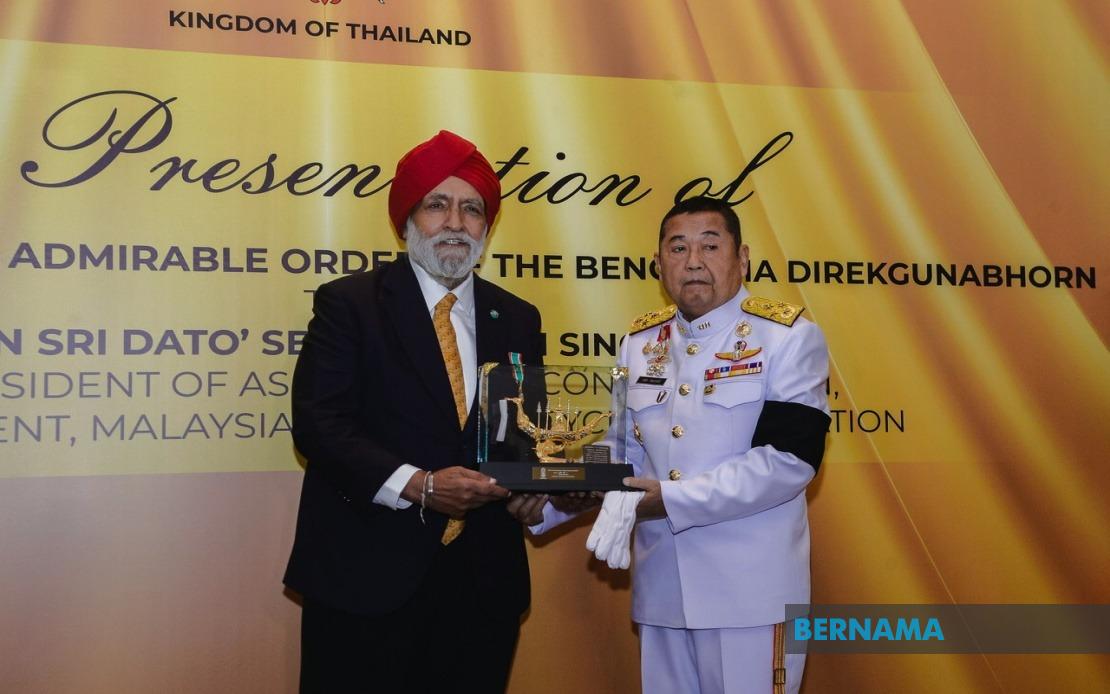
Tan Sri Darshan Singh Gill, who led Malaysian and regional cycling administration for over two decades, has been bestowed one of Thailand's most prestigious honours in recognition of his transformative contributions to the sport across Asia. The distinguished cyclist and administrator received The Most Admirable Order of the Direkgunabhorn (Fifth Class - Benjama Direkgunabhorn) during a ceremony in Kuala Lumpur on August 6. The accolade, originally conferred by the late King Bhumibol Adulyadej The Great of Thailand, was presented by ACC senior vice-president General Decha Hemkasri, underscoring the high regard in which Darshan is held within regional sporting circles.
Darshan's decades-long stewardship of Malaysian cycling shaped the nation's development as a competitive force on the continental stage. He held the presidency of the Malaysian National Cycling Federation between 1988 and 1990, a formative period when the federation was consolidating its structures and building competitive programmes. His influence extended far beyond domestic borders when he assumed the Asian Cycling Confederation presidency from 1996 to 2005, a nine-year tenure during which he guided the continent's cycling governance through a period of significant growth and modernisation. The timing of the honour reflects Thailand's recognition that his work benefited not merely Malaysia but the entire Asian cycling ecosystem.
Reflecting on the recognition, Darshan characterised it as a milestone that transcended personal achievement, positioning it instead as validation of Malaysia's standing in global cycling. He emphasised that the honour represented not only his individual efforts but also the collective progress achieved by Malaysian cyclists and sporting administrators who have elevated the nation's profile internationally. This framing demonstrates an understanding that individual success in sports administration operates within a broader national and regional context, where personal accomplishments become representative of systemic capacity and institutional development.
Darshan drew explicit connections between his era and contemporary cycling achievements, tracing a line of Malaysian excellence from the late twentieth century through to the present day. He referenced M. Kumaresan and Rosman Alwi as foundational figures from the period of his federation presidency, athletes who competed when Malaysian cycling occupied a more modest position within Asian competition. Against this historical backdrop, he positioned the recent performances of Datuk Mohd Azizulhasni Awang as evidence of sustained progress and capacity building. The keirin specialist's gold medal victory at the Glasgow Commonwealth Games just days prior to the honour ceremony provided a contemporaneous example of how institutional investment and administrative stability yield tangible competitive results.
Azizulhasni's Commonwealth Games triumph carried particular symbolic weight within Malaysian cycling discourse. The victory ended a sixteen-year drought for gold medals at the Commonwealth Games, a gap that underscored both the sport's historical challenges in Malaysia and its recent resurgence. Competing at the Sir Chris Hoy Velodrome in Glasgow, Azizulhasni's dominance in the men's keirin event represented not merely an individual athletic achievement but evidence that Malaysian track cycling had developed sufficient technical sophistication and talent development pathways to produce world-class performers. Darshan's invocation of this result during his remarks about the Thai honour illustrated how contemporary success validates and vindicates the administrative and organisational work undertaken during previous decades.
The recognition also encompassed Malaysia's progress at the highest levels of international cycling governance, a dimension that reflects how Darshan's generation of administrators has positioned the nation within global sporting structures. Datuk Amarjit Singh Gill, the incumbent MNCF president, achieved a historic breakthrough by becoming the first Malaysian elected as vice-president of the Union Cycliste Internationale (UCI), the world governing body for cycling. Amarjit secured this position for the 2025-2029 term following the 194th UCI Congress held in Kigali, Rwanda, elevating Malaysia to a seat at the highest levels of global cycling decision-making. Darshan's emphasis on this achievement during his remarks underscored a fundamental reality of modern sports administration: nations with representation in international governance structures possess greater capacity to influence the global agenda and secure resources for development programmes.
The succession of Malaysian administrators into positions of regional and international authority suggests an institutional continuity and knowledge transfer that extends beyond individual tenures. Darshan's work establishing the foundations of Malaysian cycling administration, combined with subsequent leaders' ability to expand Malaysia's global influence, indicates that the nation has developed a cadre of sporting administrators capable of operating effectively at the highest levels. This represents a form of sporting soft power that enhances Malaysia's regional standing and demonstrates institutional sophistication in sports governance. The Thai honour, presented to a Malaysian administrator by an ASEAN neighbour, also reflects the regional respect accorded to individuals who have contributed significantly to continental sporting development.
For the Malaysian cycling community, the honour carries implications that extend beyond ceremonial recognition. Thailand's decision to confer this award signals that Malaysian cycling contributions have been sufficiently substantial to warrant formal recognition from a fellow regional power, enhancing Malaysia's credibility within Asian sporting circles. Cyclists and administrators from nations throughout Southeast Asia observe such honours as indicators of which countries possess genuine influence and institutional capacity. By recognising Darshan, Thailand implicitly validated Malaysia's position as a serious cycling nation, reinforcing the narrative that Darshan articulated regarding the country's progress from a peripheral position to one of considerable standing.
The ceremony itself, held in Kuala Lumpur with presentation by a senior ACC official, performed important symbolic functions. It demonstrated that regional sporting bodies maintain institutional memory regarding significant contributions to their development and possess mechanisms for honouring individuals whose service has shaped organisational trajectories. General Decha Hemkasri's role as presenter, as an ACC senior vice-president, ensured that the honour came not as an isolated gesture but as part of regional institutional recognition. This formality underscores how Malaysian sporting figures maintain standing within regional networks long after their formal administrative tenures have concluded.
Darshan's remarks positioned the honour within a narrative of Malaysia's sporting evolution, from a nation whose cycling achievements were once modest to one now capable of producing world-class athletes and administrators who occupy positions of global influence. The implicit argument embedded in his comments suggests that the investments made during his presidency of the MNCF and ACC, the institutional structures established, and the standards maintained have created lasting value that continues yielding dividends decades later. This perspective offers a counternarrative to sports administration discourse that often emphasises short-term performance metrics, instead highlighting how foundational work in institutional building generates sustained competitive and political advantage.
The timing of the award, arriving as Azizulhasni celebrated Commonwealth Games glory and Amarjit held office as UCI vice-president, created a narrative constellation wherein historical and contemporary achievements mutually reinforced one another. Darshan's era, once viewed through the lens of modest capabilities, could now be reinterpreted as an essential foundation upon which contemporary Malaysian cycling excellence was constructed. For Malaysian sports administrators and policymakers observing the honour, it offered a powerful reminder that the unglamorous work of institutional development, capacity building, and consistent governance standards eventually produces measurable returns in national sporting standing and international influence. The Thai insignia thus represents not merely personal recognition but validation of a particular philosophy of sports administration emphasising institutional development and long-term strategic thinking.

