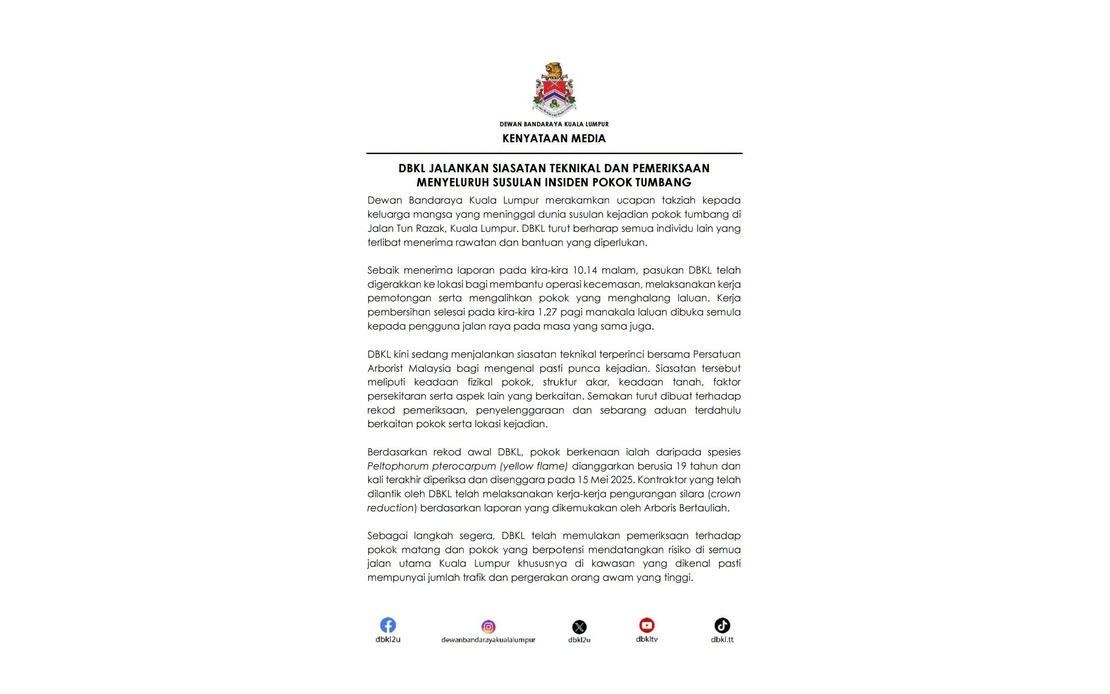
A fatal tree collapse on Jalan Tun Razak has prompted Kuala Lumpur City Hall (DBKL) to launch a comprehensive technical investigation into what caused the incident. The fallen tree claimed the life of a man on the night of July 18, prompting an immediate response from city authorities and triggering broader concerns about urban tree safety across Malaysia's capital. DBKL has partnered with the Malaysian Society of Arborist to conduct the detailed probe, which will examine multiple factors including the tree's structural integrity, root systems, soil composition, and environmental conditions.
The investigation represents a thorough approach to understanding how a mature tree could fail so catastrophically in an urban setting. DBKL stated that the inquiry would also review historical inspection records, maintenance logs, and any previous complaints lodged regarding the tree and its surrounding location. Such documentation can reveal patterns of deterioration or environmental stress that may have accumulated over time. The city authority extended condolences to the victim's family and committed to providing necessary support to those affected by the tragedy.
Emergency response teams demonstrated swift action following the incident. Upon receiving notification at 10.14 pm, DBKL dispatched personnel to the scene to undertake tree removal and clear the roadway of debris and obstructions. The major thoroughfare was successfully reopened to traffic by 1.27 am, restoring normal flow to one of Kuala Lumpur's key arterial roads. This rapid clearance reflected the coordination between multiple agencies working to minimise disruption to the city.
The fallen tree was identified as a Peltophorum pterocarpum, commonly known as Yellow Flame, approximately 19 years old. Records indicated that the tree had undergone inspection and maintenance as recently as May 15 of the current year, suggesting that prior to the incident it was still within DBKL's regular maintenance cycle. A certified arborist had previously recommended crown reduction work, which the appointed contractor had duly executed. Despite these precautions and professional interventions, the tree ultimately failed, raising questions about whether existing inspection intervals and maintenance protocols are sufficiently rigorous for urban forestry management.
In response to the incident, DBKL has initiated an extensive citywide survey of mature and potentially hazardous trees located along major roads throughout Kuala Lumpur. This short-term preventive measure prioritises routes experiencing heavy traffic and significant pedestrian movement, where tree failures pose the greatest public safety risk. Initial inspections are concentrated on Jalan Ampang, Jalan Sultan Ismail, Jalan Raja Laut, Jalan Datuk Keramat, and additional sections of Jalan Tun Razak itself. The assessment programme is expected to require approximately ten weeks to complete, with eight dedicated teams conducting the evaluations, including five certified arborists.
The scale of this inspection effort underscores the significance of the fatal incident and DBKL's determination to prevent recurrence. Eight teams of inspectors working simultaneously across the city's major arterial roads represents a substantial deployment of municipal resources and expertise. The involvement of qualified arborists ensures that assessments are conducted to professional standards, rather than relying solely on general municipal staff. This comprehensive approach should provide a clearer picture of tree health and stability across Kuala Lumpur's urban forest, potentially identifying other specimens at risk.
Looking ahead, DBKL is pursuing a medium-term technological solution that could transform urban tree management in the city. The authority is seeking approval from SIRIM to deploy 400 advanced tree sensors across high-risk locations, rolling out the installation in phased stages. These sophisticated monitoring devices would continuously track critical parameters affecting tree stability, including soil moisture, structural integrity, and movement patterns. The sensors would also capture data on environmental stressors such as heavy rainfall and flooding events, providing real-time insights into conditions that might compromise tree safety.
The strategic placement of these sensors reflects careful analysis of where tree failures pose the greatest threat to public safety. The first phase of installation will focus on four critical locations: Jalan Bangsar, Dataran Merdeka, Jalan Ampang, and Jalan Raja Chulan. These areas likely experience either high traffic volumes, significant pedestrian usage, or have previously demonstrated vulnerabilities in their tree populations. Early warning systems based on sensor data could enable DBKL to undertake preventive maintenance or removal before critical failures occur, potentially saving lives and reducing property damage.
For Malaysian cities beyond Kuala Lumpur, the incident and DBKL's response offer important lessons in urban forestry management. As Southeast Asian cities grapple with rapid urbanisation and climate variability, tree safety has become an increasingly critical public health issue. The Jalan Tun Razak tragedy demonstrates that routine maintenance and periodic inspections, while necessary, may not be sufficient safeguards against catastrophic failures. The deployment of sensor technology and more intensive inspection protocols represents an evolution in how cities approach tree management, moving from reactive response to proactive monitoring and predictive maintenance.
The incident also raises broader questions about the adequacy of current standards for urban arboriculture across Malaysia. Whether inspection intervals, maintenance protocols, and risk assessment frameworks require enhancement to match emerging best practices in developed cities will likely occupy the attention of local authorities and arborist professionals. DBKL's commitment to full cooperation with police investigations and relevant agencies signals transparency in addressing the tragedy and its implications for public safety governance. As the investigation unfolds, findings may catalyse policy discussions about urban greening initiatives and the balance between maximising tree canopy for environmental benefits and maintaining rigorous safety standards.

