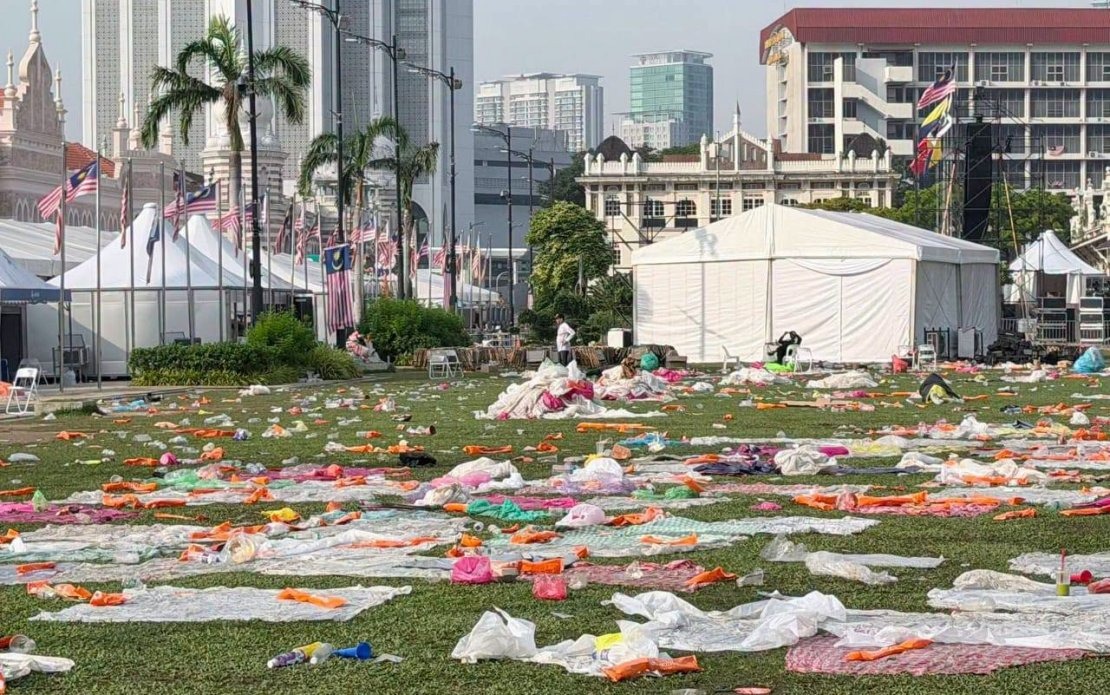
Kuala Lumpur City Hall (DBKL) has initiated a comprehensive cleaning operation at Dataran Merdeka following the early morning broadcast of the 2026 FIFA World Cup final, during which more than 25,000 football enthusiasts descended on the iconic national landmark to watch Spain defeat Argentina 1-0. The gathering, which transformed the open field into a massive outdoor stadium, left behind substantial amounts of litter and debris that required immediate attention from municipal cleaning teams.
Despite the organisational challenge of managing such a large crowd, DBKL's subsequent response highlighted deeper concerns about civic responsibility and public behaviour. Through a Facebook announcement, the city authority acknowledged the scale of the cleanup effort required while simultaneously drawing attention to a troubling pattern: the relationship between public celebration and environmental stewardship. The statement reflected frustration not merely at the logistical burden of waste management, but at what officials saw as a fundamental disconnect between the freedom to gather and celebrate collectively and the corresponding obligation to preserve shared spaces.
The messaging from DBKL went beyond routine municipal announcements. Officials emphasised that maintaining Kuala Lumpur's cleanliness should not fall solely to city workers tasked with restoration after public events have concluded. This observation carries particular significance for a capital city seeking to balance its role as a modern metropolis with the need to maintain historical and cultural dignity. Dataran Merdeka, as Malaysia's independence square and a repository of national memory, occupies special status in the urban landscape—treating it carelessly sends signals about how citizens regard their own heritage and shared institutions.
The authority's framing of the issue moved beyond simple complaints about litter. Officials noted that a truly great city is evaluated not only by the crowds it attracts but by the condition in which those crowds leave public spaces. This principle reflects growing concerns across Southeast Asian capitals about balancing mass public gatherings with environmental and cultural preservation. The implicit argument was that civic pride extends beyond celebration to encompass responsibility, and that revelling in shared joy need not come at the expense of collective dignity.
The World Cup final viewing represented a remarkable cultural moment for Malaysia, demonstrating the nation's enthusiasm for global sporting events and its capacity to organise large-scale public gatherings. Yet it also illuminated recurring challenges with public behaviour and environmental consciousness. Organising spontaneous or semi-spontaneous mass events in urban centres inevitably tests municipal infrastructure and citizen discipline simultaneously. The fact that this particular gathering attracted such numbers—over 25,000 people—suggests genuine appetite for shared sporting experiences in Malaysia's capital.
DBKL's appeal to residents to regard Kuala Lumpur as a collective home requiring careful stewardship touched on broader urban governance questions. Cities across the region face similar tensions: how to welcome vibrant public participation while maintaining standards of cleanliness and order. The cleanup exercise following the World Cup broadcast is unlikely to be an isolated incident; major sporting events, celebrations, and public gatherings will continue to draw crowds to Dataran Merdeka and other public spaces. Each such event presents both opportunities for community bonding and potential challenges for environmental management.
The scale of the cleanup operation—triggered by a single evening's gathering—underscores the resource implications of popular public events. Cleaning teams would need to clear rubbish systematically across the entire field, representing significant municipal expenditure and staff time that might otherwise address other city maintenance priorities. This resource allocation issue remains pertinent for urban planners across Malaysia and Southeast Asia, where public spaces increasingly serve entertainment functions beyond their original designations.
DBKL's statement also implicitly questioned whether future arrangements for such large-scale public viewings should incorporate waste management planning as a core component. The spontaneity that made the World Cup final broadcast appealing—masses of fans gathering organically to share in global sporting spectacle—stands in tension with the logistical realities of managing rubbish removal from such events. Whether cities should impose stricter controls, require advance permits, or implement mandatory waste collection protocols reflects the broader challenge of preserving civic freedom while maintaining public order.
The incident raises questions about public education and environmental consciousness in Malaysia. Despite decades of campaigns promoting cleanliness and civic responsibility, large public gatherings still frequently result in significant littering. This suggests that traditional awareness initiatives may require supplementation with more targeted messaging, perhaps delivered during or immediately before large public events, or enforcement mechanisms that make individuals more accountable for waste they generate in shared spaces.
For Malaysian readers, the Dataran Merdeka cleanup serves as a microcosm of larger national challenges around urban stewardship and civic culture. As Malaysia positions itself as a modern, development-conscious nation, the way citizens treat shared public spaces carries symbolic weight. The World Cup broadcast gathering demonstrated enthusiasm and community spirit, yet also exposed gaps between celebratory impulse and environmental responsibility. Resolving this tension requires both better infrastructure and genuine shifts in individual behaviour—acknowledging that freedom to enjoy public spaces carries corresponding duties of care.
Looking forward, the incident may prompt DBKL and other Southeast Asian municipal authorities to reconsider how they manage major public events. Some cities have experimented with incentive-based approaches, pre-event waste collection systems, or designated cleanup zones staffed during events. The principle underlying such innovations recognises that maintaining beloved public spaces requires designing systems where responsible behaviour becomes easier and more intuitive than careless behaviour. Dataran Merdeka's post-World Cup cleanup thus represents not merely a routine maintenance operation but a moment for reflection on how Malaysian cities can evolve to accommodate mass public participation while preserving the dignity and cleanliness of spaces that embody national identity.

