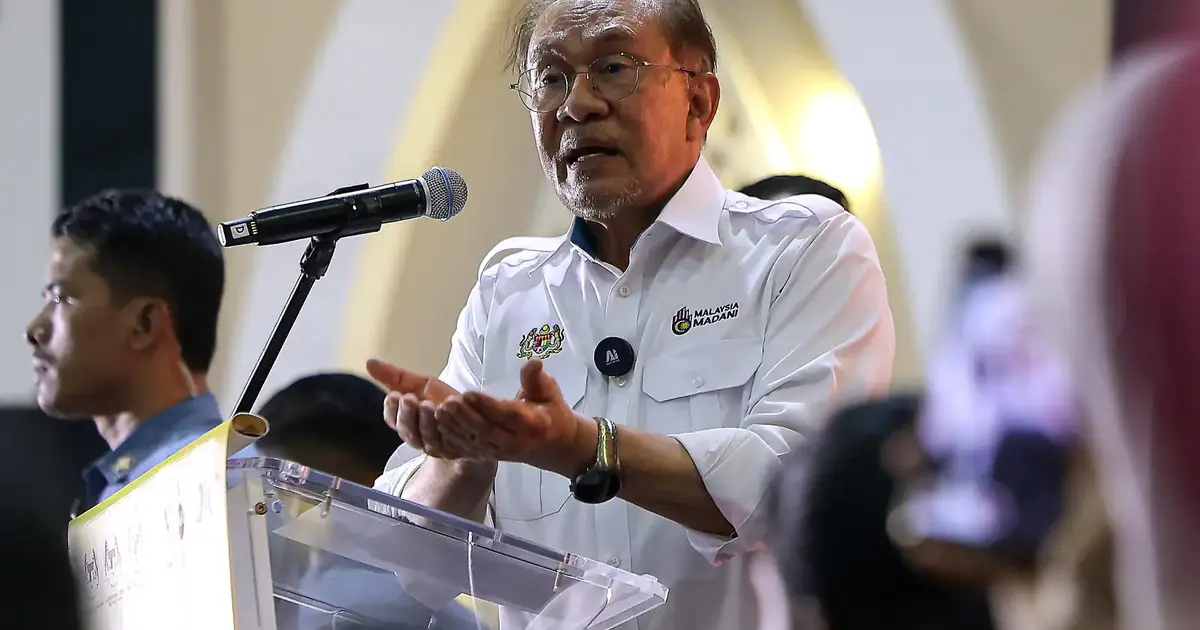
Prime Minister Anwar Ibrahim has sought to address longstanding concerns within Malaysia's Muslim and Malay communities by asserting that championing the interests of Chinese and Indian Malaysians does not necessitate compromising the constitutional framework that safeguards Malay and Islamic rights. This statement reflects an attempt to navigate the delicate balance Malaysia's multiethnic and multireligious society has grappled with since independence, where the social contract between communities has often been portrayed as zero-sum by political actors.
The prime minister's comments arrive at a moment of particular sensitivity within Malaysia's political landscape, where discussions about minority rights frequently trigger resistance from vocal segments of the Malay-Muslim majority. Throughout the nation's modern history, constitutional Article 153 has guaranteed special provisions for Malays and bumiputeras, including reserved positions in education, civil service, and business opportunities. These protections remain central to Malaysia's founding compact, enshrined in exchange for the extension of citizenship rights to non-indigenous communities upon independence in 1957.
Anwar's intervention suggests a recognition that inclusive governance need not entail a zero-sum approach to communal representation and privilege. By framing minority rights advocacy as compatible with rather than antagonistic to constitutional protections for Malays, he attempts to counter narratives that position these two objectives as inherently conflicting. This reframing holds particular importance in Malaysian political discourse, where opponents of inclusive policies have frequently weaponised the argument that advancing minority interests represents an existential threat to Malay-Muslim supremacy.
The timing of the prime minister's remarks underscores broader questions about how Malaysia manages its constitutional duality. The nation's foundational agreement explicitly recognises Islam's position as the federation's religion while simultaneously establishing secular governance principles and extending constitutional guarantees to non-Muslim citizens. This architecture, while providing the framework for Malaysia's relative stability compared to neighbouring countries, has often been strained by competing interpretations of what these protections entail in practice.
Anwar's statement carries implications for how his administration approaches sensitive policy areas that have historically divided communal lines. These include questions around conversion from Islam, the scope of Islamic court jurisdiction, language policy in education, and the accessibility of government resources across religious and ethnic divides. His assertion that minority protection strengthens rather than weakens the constitutional order suggests a willingness to challenge zero-sum framings that have dominated political discourse.
Within Malaysia's coalition politics, the prime minister's position reflects tensions between his own multiethnic coalition partners and a broader political environment where appeals to Malay-Muslim grievances remain potent electoral tools. The previous government's period in office saw attempts to position inclusive policies as threats to communal interests, a narrative that resonated sufficiently to influence voting behaviour across several elections. Anwar's framing attempts to occupy different rhetorical ground, suggesting that constitutional protections and inclusive governance can coexist rather than conflict.
The Chinese Malaysian and Indian Malaysian communities, which together comprise approximately 40 per cent of the nation's population, have historically felt tension between their constitutional citizenship rights and social practices that prioritise Malay and bumiputera interests. From university admissions and business licensing to language policy in schools, these communities frequently navigate systems that embed preferential treatment for bumiputeras. Anwar's assertion acknowledges these lived experiences while attempting to position their recognition as consistent with rather than hostile to established constitutional frameworks.
International observers have occasionally noted that Malaysia's management of majority-minority relations differs markedly from other multiethnic democracies, particularly in the explicit constitutionalisation of group-based privileges rather than individual rights frameworks. Anwar's comments suggest recognition that this model requires ongoing articulation and defence against both those who would eliminate constitutional protections and those who would expand them at the expense of communal cohesion. His framing attempts to present inclusive governance as a strengthening rather than weakening of Malaysia's constitutional foundations.
The statement also carries implications for how the government approaches legislative and policy initiatives that touch upon communal sensitivities. Proposals regarding conversion procedures, Islamic law harmonisation, or educational language policy face the challenge of operating within a constitutional framework that guarantees both Islamic provisions and non-Muslim rights. Anwar's position suggests an administration willing to engage these tensions directly rather than allowing political opponents to characterise progress on minority concerns as inherently threatening to majority interests.
Moving forward, the practical test of Anwar's assertion will emerge through specific policy decisions and how the government balances competing communal claims on state resources and authority. Whether his framing can shift the political discourse around minority rights, or whether entrenched positions will continue to interpret such advocacy as threatening to constitutional protections, remains to be determined. The prime minister's intervention at minimum signals an attempt to challenge narratives that have long dominated Malaysian political debate, even as the fundamental tensions between Malaysia's constitutional duality persist.

