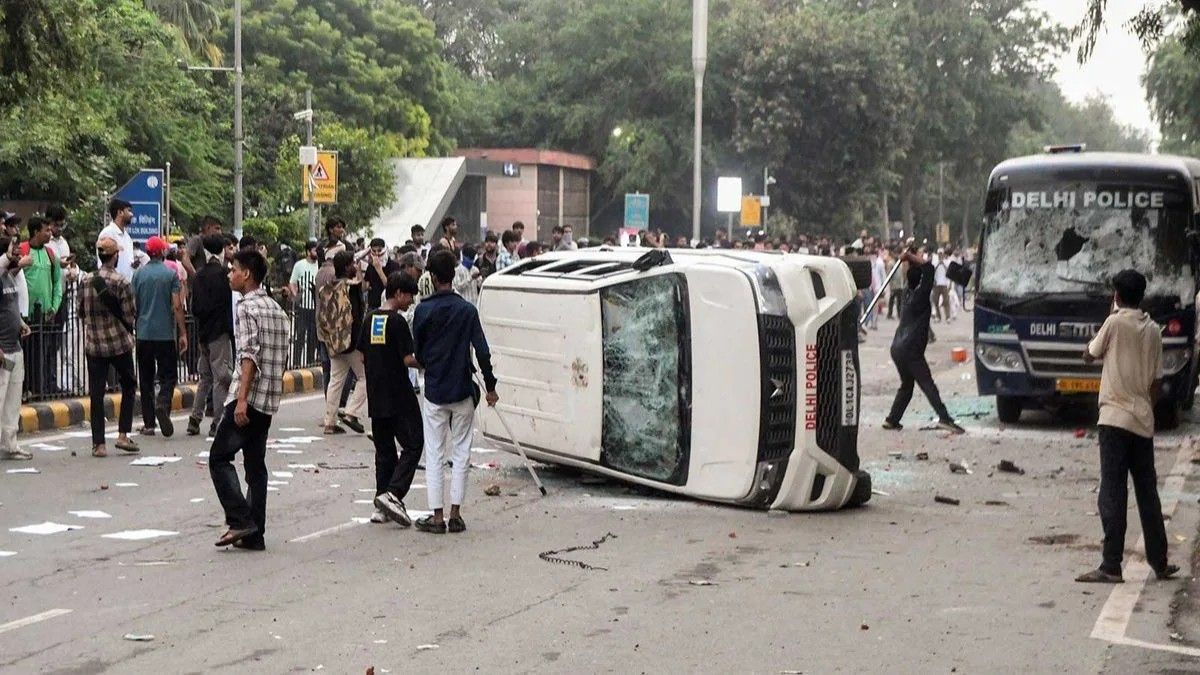
Law enforcement in India's capital has opened multiple investigations into violence accompanying the Cockroach Janta Party's "Sansad Chalo" march, with authorities simultaneously pushing back against online claims of continued clashes at New Delhi's prominent protest site. Delhi Police registered the 10 First Information Reports across several stations within the New Delhi district, formalising charges against unnamed individuals connected to Monday's tumultuous demonstration that targeted Parliament over governance concerns.
The deployment of cases reflects the scale of disruption authorities documented during the march, which descended into confrontation as demonstrators demanded the resignation of Union Education Minister Dharmendra Pradhan amid allegations of examination irregularities. Four separate FIRs were lodged at Parliament Street police station, with three additional cases filed from Connaught Place and individual matters registered at Mandir Marg, Barakhamba Road, and Kartavya Path stations. Police characterised the offences as spanning conspiracy allegations, obstruction of government function, assault on uniformed personnel, and destruction of public infrastructure, invoking the new Bharatiya Nyaya Sanhita criminal code alongside provisions from the Arms Act and property damage legislation.
Among the charges is an allegation of a life-threatening assault on a Rapid Action Force operative during Monday's confrontation, alongside an accusation of unauthorised drone operation over the New Delhi district during parliamentary sessions. These specific charges suggest authorities are treating the protest as potentially involving coordinated elements and surveillance activities that transcend typical demonstration conduct. The breadth of allegations indicates investigations are proceeding along multiple investigative tracks rather than treating the incidents as spontaneous crowd behaviour.
Despite these active prosecutions, Delhi Police issued a pointed statement on social media denying claims that fresh stone-throwing or police interventions occurred on Tuesday at Jantar Mantar, where demonstrators maintained a sit-in occupation. The Deputy Commissioner of Police for New Delhi characterised circulating videos purporting to document Tuesday's violence as "false and misleading," urging citizens to trust only official law enforcement communications. This defensive posture highlights the information warfare dimension of contemporary protest coverage, where social media amplification of contested claims can outpace official narratives and shape public perception independently of verified facts.
Meanwhile, investigators are sifting through more than 250 video recordings to identify specific individuals involved in the violence and establish whether Monday's confrontations represented spontaneous reactions or reflected pre-arranged planning. This investigative scope demonstrates how modern protest documentation—through citizen smartphones and surveillance systems—creates comprehensive digital records that authorities can subsequently weaponise for identification and prosecution purposes. The threshold for distinguishing genuine security threats from political dissent thus hinges significantly on how investigators interpret and present this visual evidence.
Protestors, who initially retreated after security personnel dismantled tents and staging structures, returned to Jantar Mantar on Tuesday to reinvigorate their demonstration. A substantial presence of Delhi Police and Rapid Action Force personnel maintained positions at the location, transforming the traditionally open public gathering space into a contested zone of negotiated occupation. Cockroach Janta Party spokesperson Ashutosh Ranka vowed continued agitation until authorities acceded to demands for the education minister's departure, indicating leadership commitment to sustaining momentum despite legal jeopardy facing participants.
Ranka simultaneously accused police of deploying excessive force against demonstrators, alleging that numerous participants including students and volunteers sustained injuries during Monday's clashes. He specifically highlighted treatment of female protesters, naming Geetanjali J. Angmo, wife of activist Sonam Wangchuk, among those he claimed experienced mistreatment during police operations. These allegations introduce gender-focused critique into the violence narrative, suggesting that protest documentation extends beyond physical injury to encompassing questions about differential treatment based on demographic characteristics.
For Malaysian observers, this incident reflects recurring tensions across South Asia regarding the boundaries between protected democratic expression and state-enforced order maintenance. The investigative intensity brought to bear on a single protest—spanning drone operations accusations, conspiracy charges, and analysis of hundreds of video files—exemplifies how governments increasingly employ sophisticated law enforcement frameworks to constrain political mobilisation. The dispute over Tuesday's events, wherein authorities deny occurrences that social media users claim to document, raises questions about information control and official credibility that resonate throughout Southeast Asian democracies struggling to balance security concerns with civil liberties protections.
The Cockroach Janta Party's sustained sit-in despite legal consequences suggests ideological commitment transcending conventional cost-benefit calculations that typically dissolve mass movements. This persistence may reflect broader discontentment with educational administration that extends beyond the specific resignation demand, potentially connecting to class-based anxieties about examination equity and meritocratic access—concerns with particular salience across South and Southeast Asia's education-conscious middle classes. Whether this demonstration catalyses broader political realignment or remains confined to a localised controversy will substantially depend on how Indian media and political opposition parties amplify or marginalise its underlying grievances.
Investigations into the protest violence will proceed through Indian courts over extended periods, generating additional legal precedent regarding permissible demonstration conduct and state response calibration. Each FIR represents potential criminal liability for identified participants, introducing prosecutorial risk that may deter future protest participation while simultaneously creating martyrdom narratives that energise committed activists. The information management aspects—particularly authorities' denial of Tuesday's violence claims—suggest that controlling demonstration narratives has become integral to contemporary protest containment strategies alongside physical enforcement operations.

