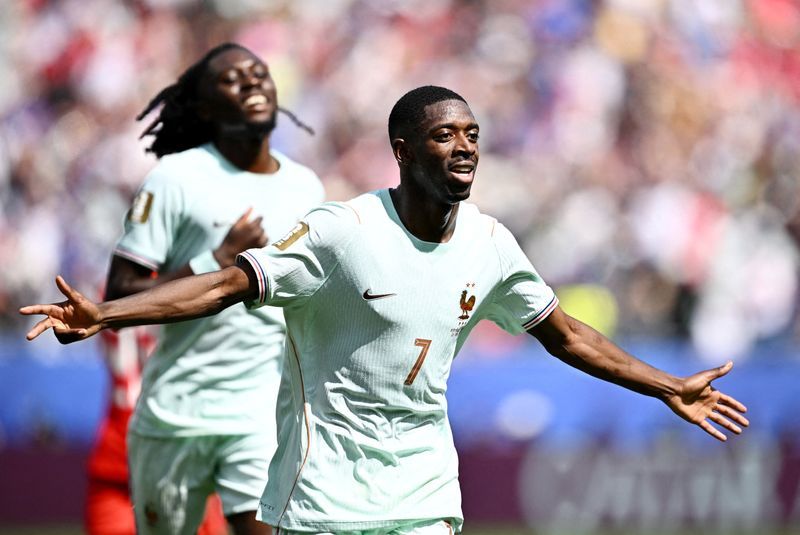
Ousmane Dembele produced a devastating 25-minute display of clinical finishing to lead France to a commanding 4-1 victory over Norway in their World Cup fixture at Foxborough, Massachusetts on Friday. The winger's remarkable performance, which saw him find the net on three occasions during the opening period, propelled the defending runners-up and 2018 champions into the knockout stage with considerable momentum. For Malaysian football enthusiasts following the tournament, this emphatic performance underscored France's credentials as genuine contenders for the title despite the absence of their coaching staff.
The result carried added significance for the French squad, who had collectively pledged to deliver a strong performance as a tribute to their manager Didier Deschamps, who had returned to his home country to attend to a family bereavement. Although both nations had mathematically secured progression before the kickoff, France's determination to finish as group leaders was motivated by strategic considerations regarding their path through the tournament's complex North American scheduling and travel itinerary. Topping their section would afford them a potentially more favourable route to the later stages compared to runners-up finishers.
The gap in intensity between the two sides became apparent from the opening moments, with France's attacking intent evident when Kylian Mbappe tested goalkeeper Egil Selvik's reflexes with an angled attempt after barely 20 seconds of play. Just six minutes into the encounter, Dembele latched onto a perfectly weighted cross-field delivery from Mbappe and, exploiting space created by deft footwork, dispatched a precisely angled shot past Selvik. The Paris Saint-Germain forward doubled his personal tally in the twentieth minute, with another clinical finish showcasing the attacking proficiency that France's squad possesses when functioning at full capacity.
Norway's response came through Thelo Aasgaard, whose opportunistic finish briefly suggested the Scandinavians might mount a comeback despite their handicapped team selection. However, Dembele extinguished such hopes by the thirty-second minute, curling a measured strike into the bottom corner to complete his hat-trick. His three goals arrived in remarkably swift succession, representing only the second-fastest hat-trick in World Cup history—trailing only Austria's Erich Probst, who achieved the feat in 1954 against Czechoslovakia in 24 minutes. Dembele became merely the third French player to accomplish a World Cup hat-trick, joining the illustrious company of Just Fontaine and Kylian Mbappe in that exclusive club.
Norway's capitulation stemmed directly from coach Stale Solbakken's bold decision to rest the overwhelming majority of his first-team players who had featured in the side's midweek clash against Senegal. The absence of talismanic striker Erling Haaland and skipper Martin Odegaard left the visitors significantly undermanned in their attempts to compete with a rejuvenated French outfit. This strategic selection choice, while comprehensible from a rotation and injury prevention perspective, left Norway vulnerable to the kind of sustained attacking pressure that France demonstrated throughout the encounter.
Despite conceding four goals, Norway managed to create occasional threatening moments that indicated France had not exercised complete defensive control. Jorgen Strand Larsen squandered a golden opportunity early in the second period when his unconverted penalty fell to goalkeeper Mike Maignan, who produced a decisive save. Winger Oscar Bobb subsequently forced another save from the French custodian, revealing momentary defensive vulnerabilities in their backline. Nevertheless, these minor incursions proved insufficient to alter the match's trajectory, and France sealed the victory through substitute Bradley Barcola's assist for Desire Doue's late header.
The emphatic victory carried important ramifications for the remainder of the tournament's group stage dynamics and subsequent knockout pairings. By securing first place in Group I, France positioned themselves to potentially face Sweden in their round of 32 encounter, while Norway, despite advancing as runners-up, drew a meeting with Ivory Coast. For Southeast Asian observers of the competition, France's performance illustrated the fundamental gap in squad depth and collective talent between established footballing powerhouses and emerging nations.
Mbappe's own contributions, though overshadowed by Dembele's stunning display, remained consistent with expectations for a player tipped as a potential Golden Boot contender alongside Haaland. The early shooting opportunity that cannoned off the crossbar within seconds underscored the attacking ambition France carried into the match, establishing the tone for their subsequent dominance. His creative contributions, particularly in setting up Dembele's early goals, demonstrated the interconnected attacking system that France continues to develop under Deschamps' stewardship.
As the tournament enters its group stage's latter phases, France's comfortable win offers a template for how elite sides can manage both their progression from the group and their physical and mental preparation for knockout football. The emotional backdrop of Deschamps' absence, combined with the players' visible determination to honour their coach, created an intangible advantage that manifested in their sustained intensity and clinical finishing. For Malaysian football observers and regional enthusiasts, matches such as this highlight the technical attributes and organisational discipline that separate tournament contenders from peripheral participants, elements that domestic clubs and national teams across Southeast Asia continue to strive toward matching.

