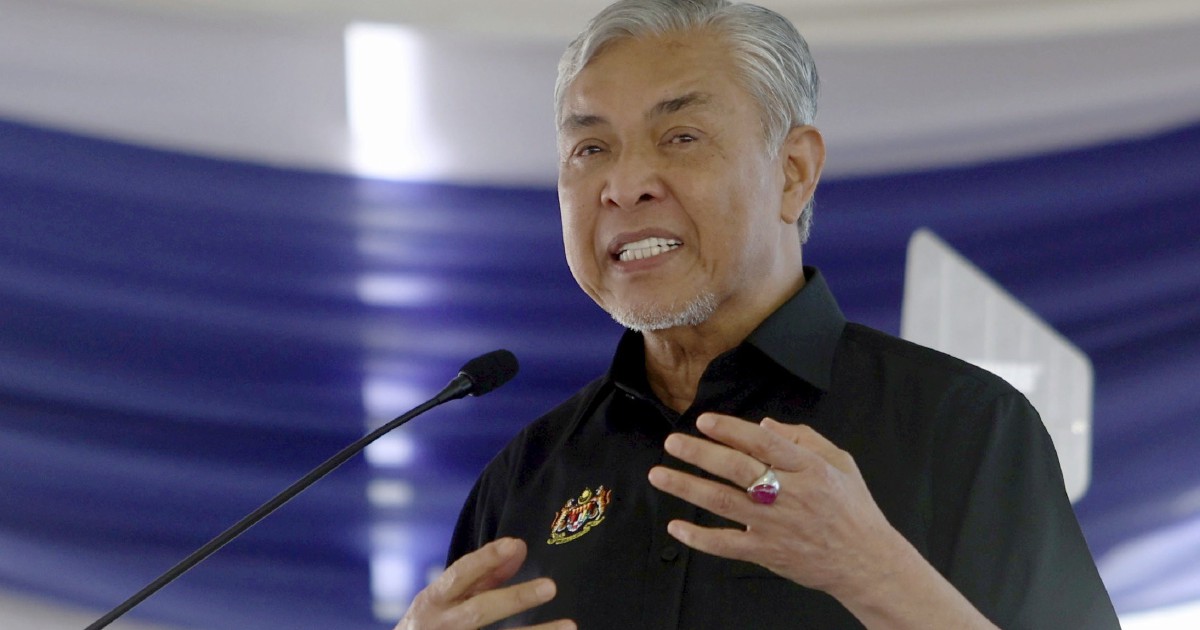
Deputy Prime Minister Datuk Seri Dr Ahmad Zahid Hamidi has moved swiftly to extinguish mounting speculation over the possibility of calling a general election ahead of schedule, clarifying that no substantive discussions on the matter have occurred within ministerial corridors. Speaking in Tampin, the senior government figure sought to provide clarity on what appears to be gaining traction as political gossip in Malaysian circles, where periodic talk of early elections surfaces whenever the political climate shifts.
The categorical denial from the Deputy Prime Minister carries particular weight given his position within the current administration and his visibility as a key figure in government decision-making. His remarks suggest an effort to stabilise market and political sentiment at a time when such speculation could potentially unsettle investors and create unnecessary uncertainty about the country's governance timeline. By explicitly stating that internal government discussions on this subject have not materialised, Zahid appears to be signalling that the administration remains committed to its existing electoral schedule.
The emergence of such rumours, whether genuine or speculative, often reflects the natural ebb and flow of Malaysian political discourse. In a country with a complex multi-party coalition system and shifting alliances, questions about electoral timing periodically surface, particularly when government approval ratings fluctuate or when major policy disagreements emerge between coalition partners. The fact that Zahid felt compelled to address the matter publicly suggests these whispers had gained sufficient momentum to warrant an official response.
Malaysia's current electoral timeline has been established through constitutional and parliamentary procedures, with the next general election scheduled within the parameters set by the current Parliament's five-year term. Any deviation from this schedule would require significant political consensus or extraordinary circumstances, which Zahid's remarks implicitly suggest are not currently present. The stability implied by his statement may be reassuring for various stakeholders including businesses, civil servants, and investors who prefer predictability in the governance calendar.
Electoral timing carries profound implications beyond the political realm. Businesses typically prefer stable and predictable electoral calendars, as early elections can create a caretaker period in which major policy decisions face delays. International investors monitor such developments closely, as they affect long-term policy continuity and economic planning. Zahid's assertion that no early election discussions have occurred may therefore serve to maintain confidence in the administration's commitment to fulfilling its existing term.
Within Malaysia's federal system, the relationship between coalition partners in government also influences electoral speculation. Any signs of internal friction or disagreements on policy priorities can trigger media and public speculation about whether the government remains cohesive enough to complete its term. By publicly denying early election discussions, Zahid effectively sends a message to coalition members that the government intends to function as a unified entity through the established electoral timeline.
The Malaysian political landscape has historically seen numerous instances where early election speculation proved baseless, yet the pattern persists. From a communications perspective, preemptive statements like Zahid's serve to manage expectations and discourage further speculation that could become self-fulfilling. When senior officials repeatedly must deny early election rumours, it can paradoxically lend credibility to speculation; conversely, a single authoritative denial may suffice to dampen further discussion.
Regionally, Malaysia's electoral stability matters to neighbours and international observers who view the country as a significant Southeast Asian economy and the chair of ASEAN in 2025. Any perception of domestic political instability or governmental uncertainty could affect Malaysia's capacity to lead regional initiatives or maintain consistent foreign policy positions. Zahid's reassurance about electoral adherence therefore extends beyond domestic politics into Malaysia's regional standing.
The Deputy Prime Minister's statement also reflects the broader principle of democratic accountability and institutional consistency. Established electoral calendars represent a foundation of democratic governance, and public confidence in the government's commitment to these timelines underpins institutional legitimacy. By confirming that no discussions of deviation have occurred, Zahid reinforces the principle that electoral procedures and constitutional timelines will be respected.
Looking forward, Zahid's remarks establish a baseline position from which the government can operate without the distraction of perpetual electoral speculation. Should no early election occur—which his statement strongly suggests—the government can focus on policy implementation and addressing substantive governance challenges that demand attention. The Deputy Prime Minister's intervention represents an attempt to reset the narrative and refocus political discourse on matters of actual policy substance rather than hypothetical electoral timing.

