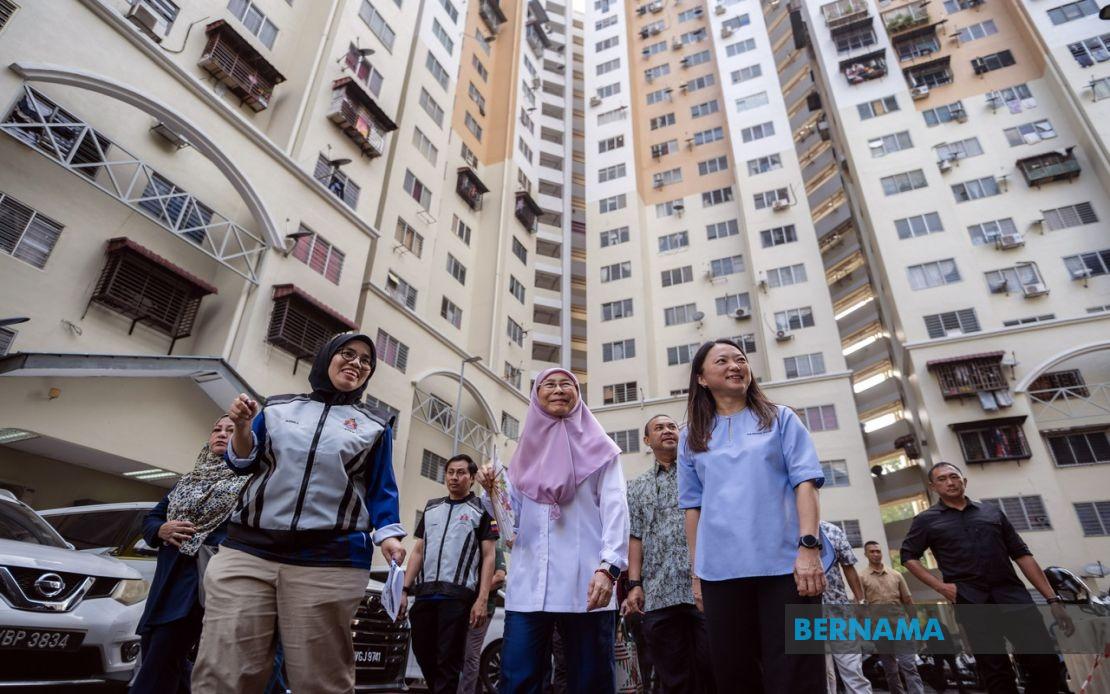
The Desa Tun Razak People's Housing Project (PPR) has crossed a significant milestone with the completion of its RM9.6 million upgrading initiative, bringing the number of finished improvement works across Kuala Lumpur's public housing estates to 22 out of 61 planned projects. The development signals renewed momentum in the government's commitment to transforming the living conditions of residents in these densely populated urban communities, which have historically battled with deteriorating infrastructure and safety concerns.
Minister in the Prime Minister's Department (Federal Territories) Hannah Yeoh emphasised that the completion represents a departure from ad hoc maintenance practices towards a more structured, long-term investment strategy. She disclosed that the government had allocated an additional RM300 million for the fiscal year to drive systematic upgrades across all Kuala Lumpur PPR facilities, a sum that received endorsement from the capital's full parliamentary delegation. This cross-party consensus underscores recognition that public housing maintenance transcends partisan boundaries and requires sustained, bipartisan political backing to succeed.
The Desa Tun Razak estate, which has housed residents since 1998, serves over 8,000 occupants whose daily lives depend on functioning utilities and safe common areas. Yeoh's remarks about the risks of deferred maintenance struck at a fundamental weakness in Malaysia's public housing ecosystem: projects frequently receive capital investment during initial construction phases, but ongoing upkeep budgets remain chronically underfunded, accelerating deterioration. By institutionalising a dedicated maintenance fund rather than treating repairs as one-off expenditures, policymakers aim to arrest the cycle of decay that has afflicted numerous PPR communities nationwide.
The specific works completed at Desa Tun Razak address pressing safety vulnerabilities that emerged from incident patterns in recent years. Comprehensive electrical wiring replacement was undertaken alongside a complete overhaul of fire safety infrastructure, including upgraded fire riser systems. These interventions respond directly to several fire incidents that struck the estate in the previous year, demonstrating how tragedies can catalyse policy corrections when political will aligns with resident advocacy. The emphasis on fire prevention systems reflects growing recognition that densely populated residential towers demand heightened fire safety protocols exceeding those typical in conventional housing.
Kuala Lumpur Mayor Datuk Fadhlun Mak Ujud provided a detailed breakdown of expenditure, revealing that cosmetic improvements absorbed the largest share of resources. Approximately RM7 million of the total budget funded repainting works, presenting residents with freshened common areas and building facades. This investment carries psychological and practical significance; deteriorated paintwork in public housing often signals abandonment and neglect to residents and visitors alike, potentially eroding community morale and encouraging further environmental degradation. The remaining RM1.68 million targeted fire prevention systems and electrical infrastructure, while nearly RM1 million was invested in road resurfacing and drainage system upgrades, collectively addressing the compound infrastructure failures common to ageing public housing complexes.
The timeline for completing the broader RM300 million initiative appears ambitious, with authorities projecting that all 61 PPR improvement projects in Kuala Lumpur will reach completion by year's end. If achieved, this pace would represent substantial acceleration in addressing the municipal housing stock's maintenance backlog. However, such timelines in Malaysian government projects frequently experience slippage due to procurement delays, contractor performance issues, and unforeseen structural complications discovered during renovation works. Realistic assessment suggests that while the trajectory is positive, some projects may extend beyond the stated deadline.
Parking scarcity emerged during discussions as a persistent quality-of-life issue at Desa Tun Razak PPR, reflecting a broader challenge across Kuala Lumpur's public housing landscape where planning assumptions from the 1990s failed to account for current vehicle ownership rates. Fadhlun acknowledged this constraint and committed DBKL to identifying temporary parking zones on available vacant land. This approach offers short-term relief but highlights the need for more comprehensive residential planning solutions, particularly ground-level parking structures or multi-storey facilities that could serve PPR communities without consuming extensive land reserves.
Bandar Tun Razak Member of Parliament Datuk Seri Dr Wan Azizah Wan Ismail articulated a crucial counterpart to the government's infrastructure investment: resident stewardship of upgraded facilities. Her appeal for residents to prioritise maintenance and property care recognises that government outlays cannot succeed without corresponding community responsibility. Public housing outcomes depend critically on this partnership dynamic; without resident engagement in safeguarding improvements, facilities deteriorate rapidly despite substantial initial investment. This cultural dimension often receives insufficient policy attention in Malaysia's public housing discourse, which tends to emphasise capital spending while underestimating behavioural and communal factors.
The Desa Tun Razak completion demonstrates tangible progress on an issue that has plagued Malaysian public housing for decades. The PPR programme, conceived as an affordable housing solution for urban workers and low-income families, expanded rapidly through the 1990s and 2000s without corresponding maintenance provisions. Consequently, many estates descended into disrepair despite their social significance. The RM300 million allocation and structured upgrade programme represent acknowledgment that addressing this legacy requires sustained commitment and adequate resourcing, not merely rhetorical support during election campaigns.
For Southeast Asian observers monitoring Malaysia's approach to inclusive urban development, the Desa Tun Razak initiative offers both encouraging signals and cautionary lessons. The commitment to systematic maintenance rather than crisis-driven repairs reflects improved governance thinking. Yet the sheer magnitude of catching-up required—with 39 of 61 projects still pending completion—underscores how substantially public housing investment was deferred during previous years. As Malaysia's urban population expands and housing affordability pressures intensify, the sustainability of this maintenance model will depend on whether adequate annual budgeting becomes institutionalised or reverts to political whim.

