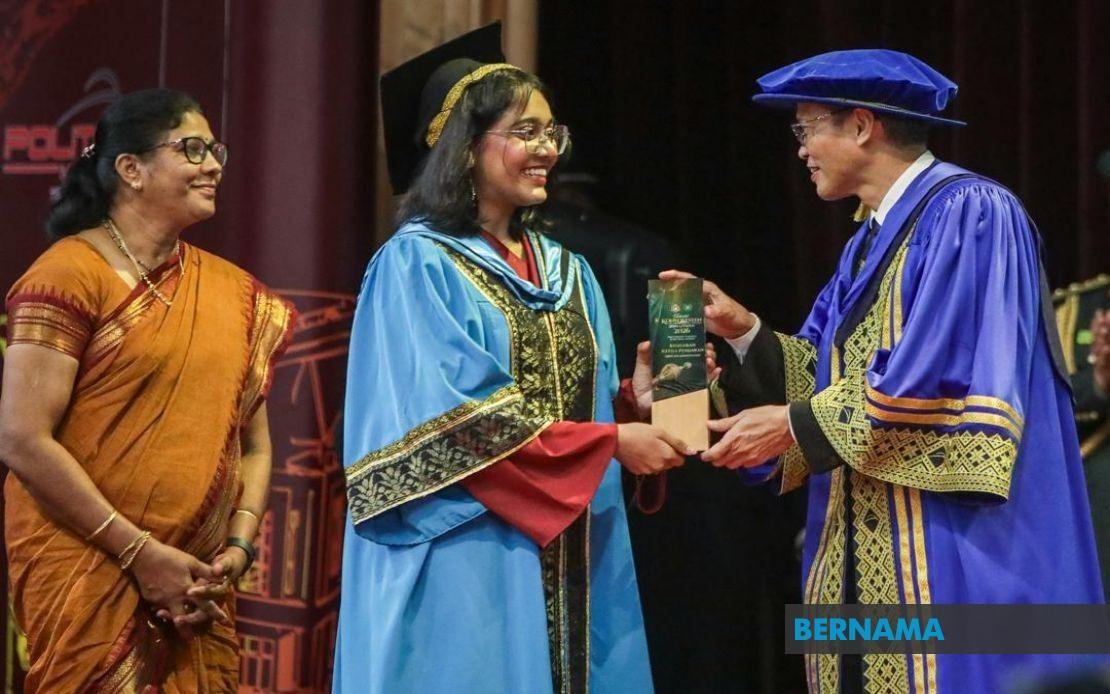
Teerti Ganapathi Rao's path to academic success was marked by an ordeal that might have derailed lesser students. The 22-year-old Diploma in Digital Technology graduate from Politeknik Tuanku Syed Sirajuddin (PTSS) in Arau faced an unimaginable setback when her father passed away in 2023 while she was in the midst of Semester Two examinations. Yet rather than withdraw from her studies, she found the inner strength to push forward, ultimately achieving a cumulative grade point average of 3.61 and earning recognition as one of her institution's most accomplished graduates.
The accolades came at the first session of the 2026 Northern Zone Polytechnic and Community College Convocation Ceremony, held at PTSS this week under the patronage of the Raja of Perlis, Tuanku Syed Sirajuddin Jamalullail. Teerti received both the Director-General's Award and the Academic and Co-Curricular Excellence Award, cementing her place among the northern region's top-performing graduates. The convocation itself was a significant event, honouring 6,104 graduates from polytechnics and community colleges across Perlis, Kedah and Penang—a testament to the vital role these institutions play in regional skills development.
What makes Teerti's achievement particularly poignant is her candid admission that she initially doubted whether she would ever be selected for such recognition. Speaking to reporters at the ceremony venue, she expressed genuine surprise and gratitude upon learning of her selection. The weight of her circumstances—grieving her father while juggling academic demands—makes her conviction to complete her studies all the more remarkable. Her honesty about her doubts reveals not a weakness but a deeply human response to trauma, one that she channelled into determination.
The foundation of Teerti's resilience lies in her relationship with her late father. As the youngest of four siblings, she had initially considered abandoning her diploma to pursue a foundation programme instead. However, her father's consistent encouragement to complete the diploma became her psychological anchor during the darkest period of her studies. Rather than fading after his death, his words seemed to gain power, transforming from advice into a guiding principle that sustained her through the grieving process and the remaining semesters of her course.
Beyond the emotional narrative, Teerti distinguished herself through consistent academic performance and active institutional involvement. She garnered the Head of Department's Award in three separate semesters—the first, third and fourth—demonstrating that her overall achievement was not a one-off success but rather the result of sustained effort. Her role as a member of the Student Representative Council (MPP) exposed her to leadership and communication challenges that extended her development far beyond the classroom, building the interpersonal competencies that employers increasingly value in digital technology professionals.
During her three years at PTSS, Teerti also gained practical experience in the field beyond routine coursework. She represented the polytechnic at a collaborative programme and seminar paper presentation at Universiti Putra Indonesia, earning exposure to the regional academic community and international perspectives on technology and innovation. Her final-year project, the Koop Printing System, was a practical application of her learning—a platform designed to streamline the management and operations of cooperative printing services, suggesting a pragmatic mindset oriented toward solving real-world problems.
Teerti's intellectual profile extends well beyond her primary discipline. She is a multilingual individual proficient in Mandarin, Tamil and Telugu alongside Bahasa Melayu and English, with foundational competency in French, Japanese and Korean. This linguistic versatility, increasingly valuable in Malaysia's diverse, globalised economy, hints at her cultural awareness and adaptability. In a region where cross-border collaboration in technology sectors is accelerating, such language skills position her advantageously for future opportunities across Southeast Asia.
Looking ahead, Teerti has set her sights on further academic advancement. She is currently awaiting news of her application to pursue a Bachelor's degree in Information Technology, with Universiti Malaya as her preferred institution. Her ambitions extend even further—she harbours aspirations to eventually attain a Doctor of Philosophy qualification, a goal that seems entirely within reach given her demonstrated commitment and capability. This trajectory, from a polytechnic diploma through university undergraduate studies to doctoral research, represents the kind of upward mobility that regional technical education is designed to facilitate.
Teerti's entry into the technology field followed an unconventional path. Her interest in information technology sparked at age sixteen, kindled through an unexpected source: video games that connected her with friends who introduced her to computers and coding. This organic discovery speaks to how passion can emerge from unexpected places and how informal peer learning can illuminate career possibilities. She now understands the field as inherently challenging but surmountable through methodical study and conceptual clarity—advice she offers to other young people considering similar paths.
Her story resonates particularly for Malaysian audiences grappling with questions about technical education, resilience and social mobility. Polytechnic graduates like Teerti represent a crucial segment of the nation's workforce, trained to meet immediate industry needs while potentially progressing to advanced qualifications. Her journey demonstrates that excellence emerges not from privilege or ease but from determination meeting opportunity. For policymakers, educators and students alike, Teerti exemplifies why polytechnic education deserves continued investment and recognition—it is in these institutions that transformative personal achievements occur, often against considerable odds.

