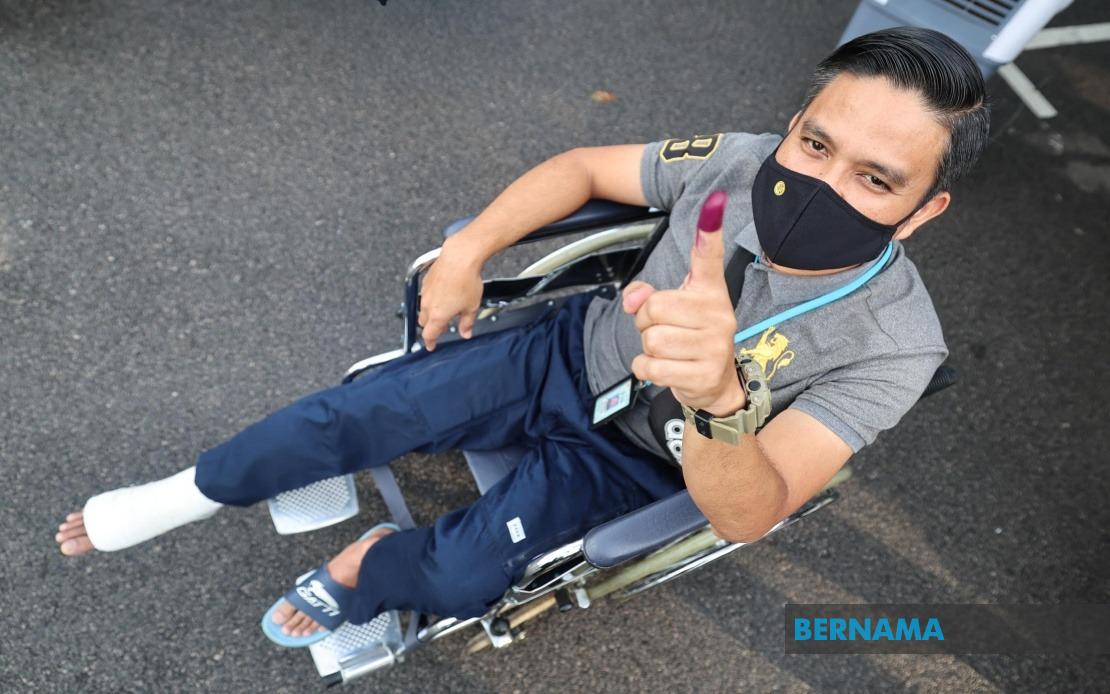
Johor's 16th state election unfolded across multiple voting phases this week, with an early polling round that drew particular attention when Sergeant Syahrizal Musa, a 40-year-old police officer, made his way to cast his ballot from a wheelchair on July 7. The dedicated public servant had suffered a minor tear to his Achilles tendon while playing sepak takraw just days earlier, an injury that would ordinarily confine most people to rest and recuperation. Yet Syahrizal's determination to fulfil his civic responsibility overrode the physical limitations imposed by his medical condition, underscoring a personal commitment to democratic participation that resonates beyond the individual case.
Based at Johor Police Contingent Headquarters in Johor Bahru, Syahrizal works within the Internal Security and Public Order Department, a role that has kept him engaged in public service for more than two decades. His medical leave had been scheduled through mid-July, yet he arranged transport from police quarters in Tampoi with assistance from a colleague to reach the early voting centre. The journey itself represented a small act of determination—navigating mobility challenges to reach a polling booth during a designated window for security personnel voting before the general election date.
The injury occurred during recreational sepak takraw, a traditional sport at which Syahrizal had maintained active participation since youth. His long involvement with the sport had even extended to representing the police contingent in competitive tournaments, reflecting both athleticism and institutional pride. The medical assessment confirmed the tendon damage as relatively minor in the broader context of possible sports injuries, yet sufficient to warrant extended medical leave and mobility restrictions. That he viewed the injury as an insufficient barrier to voting speaks to how institutional identity and civic duty intermingle within Malaysia's security forces.
In conversation with reporters at the early voting centre, Syahrizal articulated his reasoning with straightforward clarity. He framed voting not as an optional activity to be deferred for convenience, but as a personal responsibility that transcended temporary physical circumstance. His 22-year police career had encompassed multiple electoral cycles, and this represented his first experience voting whilst wheelchair-bound—a distinction that seemed to amplify rather than diminish his resolve to participate. The symbolic weight of maintaining electoral participation across two decades of service reflected a particular understanding of police professionalism that extends beyond enforcement duties into civic engagement.
The broader context of Johor's early voting arrangements accommodated security sector participation across multiple constituencies. A total of 64 polling centres opened specifically for early voting, processing 24,751 eligible voters comprising military and police personnel alongside their spouses. This figure broke down into 12,041 Malaysian Armed Forces voters and 12,710 Royal Malaysia Police and General Operations Force voters with family members. The early voting protocol ensures that security personnel deployed across the state can exercise franchise rights despite operational demands that might otherwise conflict with standard polling day participation.
Johor's 16th state election represented a significant democratic exercise for Malaysia's southern region, with 172 candidates competing for 56 state assembly seats. The contest would ultimately determine legislative composition for the state legislature, with implications for both local governance and the broader political architecture of the nation. The 2.7 million ordinary voters scheduled for the Saturday polling day would select representatives across diverse constituencies reflecting varied socioeconomic profiles, demographic characteristics, and political allegiances.
Syahrizal's individual act intersected with systemic questions about inclusive democratic access. His wheelchair-dependent voting raised practical considerations about how electoral infrastructure accommodates citizens with temporary or permanent mobility limitations. Early voting procedures for security personnel effectively created an alternative pathway that addressed scheduling conflicts; extending such accessibility principles more broadly within Malaysia's electoral system remains an ongoing policy conversation. The police sergeant's participation suggested that motivation and determination could overcome infrastructure gaps, though systemic solutions would better serve broader populations facing similar barriers.
The Seri Iskandar, Perak native had established himself within Johor's police hierarchy since 2014, when he transferred to the Johor IPK after nine years at Muar IPD. His geographic mobility within the police service mirrored broader patterns of personnel deployment and career progression within PDRM structures. The transfer represented neither unusual advancement nor static stagnation, but rather standard institutional functioning across Malaysia's federal police system. His institutional roots across multiple Johor locations positioned him as an embedded participant in regional governance processes.
Beyond Syahrizal's personal narrative, his public statements carried implicit advocacy regarding electoral participation among Malaysian citizens more broadly. When addressing reporters, he expressed hopes that other Malaysians would similarly embrace voting opportunities, framing electoral exercise as instrumental to determining both state and national futures. This articulation acknowledged democratic theory's emphasis on broad-based participation as foundational to legitimate governance outcomes. His injury and voting choice became a practical illustration of principles that Malaysian civics education emphasises but citizens must ultimately implement through individual decisions.
The early voting period itself reflected institutional priorities regarding security sector participation in Malaysia's democratic processes. Rather than exempting military and police personnel from electoral participation—a model some nations employ—Malaysian electoral architecture creates dedicated mechanisms enabling their engagement. This choice reflects particular governance philosophy valuing security force participation in democratic legitimation processes. Syahrizal's wheelchair-bound presence at the early voting centre embodied both institutional practice and individual commitment, rendering abstract democratic principles concrete through lived experience.
As Johor moved toward its Saturday polling day, Syahrizal's early vote represented one of thousands cast during the preliminary phase. Yet his particular circumstances—the injury, the wheelchair, the deliberate choice to participate despite physical impediment—created a narrative that media outlets recognised as newsworthy. That determination merited public attention suggested broader social values regarding civic duty transcending personal convenience or circumstance. Whether such individual exemplars genuinely influence broader electoral behaviour remains analytically uncertain, yet the public interest in Syahrizal's choice indicated that Malaysian society continues recognising electoral participation as meaningful civic performance rather than mere administrative procedure.

