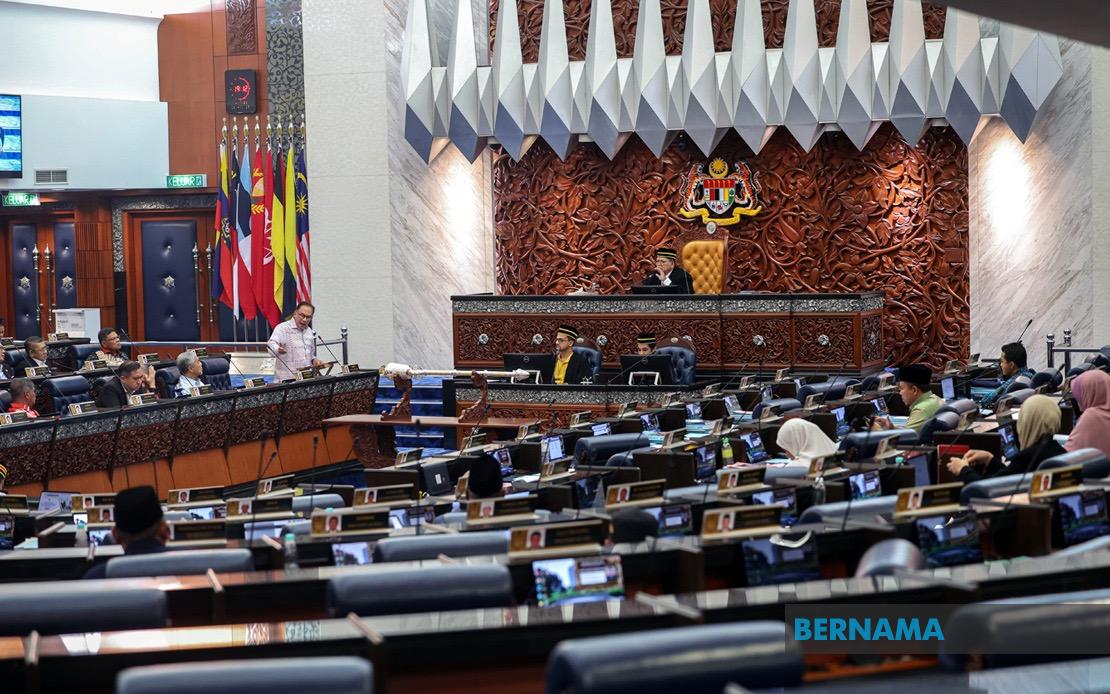
Parliament has formally endorsed the allocation of RM14.5 billion in leftover Malaysian Government Investment Issues (MGII) proceeds to the Development Fund, marking a significant step in the government's capital expenditure planning for 2026. The Dewan Rakyat passed the motion by majority voice vote on July 15 following parliamentary debate, with contributions from Datuk Seri Ismail Abd Muttalib of Perikatan Nasional representing Maran and Datuk Zulkafperi Hanapi, a government backbencher. Deputy Finance Minister Liew Chin Tong presented the technical resolution, providing lawmakers with granular detail on how the nation's borrowing strategy intersects with development spending priorities.
The Development Fund, a cornerstone of Malaysia's capital expenditure architecture, draws revenue from multiple sources including transfers from the Consolidated Revenue Account, the Consolidated Loan Account, repayments of earlier loans, and receipts tied to development projects. This diversified funding base allows the government to ring-fence infrastructure investment even as it manages operational costs through tax revenue and non-borrowing sources. The distinction between funding mechanisms is crucial to Malaysia's fiscal framework: operating expenditure must be covered by government revenue alone, while development expenditure can legitimately be financed through borrowed funds. This separation reflects international best practice in distinguishing between day-to-day government spending and longer-term capital investments that generate future economic returns.
The RM14.5 billion transfer represents the net proceeds from MGII issuances between January and May 2026, after accounting for refinancing obligations. The full MGII issuance programme for 2026 is projected to reach RM95 billion, a substantial government borrowing initiative deployed across multiple strategic purposes. Of this total, RM55 billion will service the maturation of earlier MGII bonds, essentially rolling over existing debt rather than creating new net borrowing. An additional RM2 billion has been earmarked to meet obligations on Malaysian Islamic Treasury Bills (MITB), short-term shariah-compliant debt instruments that form part of Malaysia's sukuk issuance strategy. The remaining RM38 billion directly finances the projected fiscal deficit for 2026, bridging the gap between government revenue and total spending plans.
Liew's breakdown illuminates the mechanics of the January-to-May period specifically. During those five months, MGII issuances generated RM40 billion in gross proceeds. However, RM25.5 billion of this amount was immediately committed to refinancing MGII bonds that had matured, leaving a net position of RM14.5 billion available for new development spending. This net figure—not the gross issuance—represents true additional borrowing capacity, a distinction often lost in public discourse but essential to understanding Malaysia's actual debt trajectory. The refinancing component demonstrates that a portion of the government's borrowing activity represents financial housekeeping rather than expanded spending authority.
The government's legal framework explicitly constrains how borrowed funds may be deployed, a safeguard designed to prevent deficit spending on recurrent expenses. This constitutional guardrail has become increasingly important as nations globally grapple with unsustainable fiscal imbalances. Malaysia's approach reflects a deliberate choice to separate consumption from investment financing, theoretically ensuring that borrowed money supports assets with productive capacity. The framework provides transparency to international credit rating agencies and debt investors, signalling that the government is not using borrowing to finance everyday operations that do not generate offsetting economic returns.
Liew responded to concerns raised by Zulkafperi about potential "crowding out" effects in Malaysia's domestic financial markets, a phenomenon where large government security issuances absorb capital that might otherwise flow to private sector borrowers. The deputy minister acknowledged that excessive government borrowing could theoretically squeeze private investment, but countered with evidence that the government has been progressively reducing new borrowing volumes year-on-year in recent years. This trajectory suggests policy discipline, though economists will scrutinise whether the 2026 figures represent a reversal of that trend.
Major Malaysian institutional investors including the Employees Provident Fund (EPF) and the Retirement Fund Incorporated (KWAP) are substantial purchasers of government securities and MGII. Rather than framing this as crowding out, Liew positioned the securities issuance as providing legitimate investment opportunities for these pension and retirement funds to deploy capital domestically while earning returns for their members. The EPF's substantial domestic holdings of government bonds reflect both the safety profile of Malaysian Government Securities and the relatively high yields available compared to international alternatives. Without viable domestic investment instruments, Liew argued, these institutions might redirect capital offshore, potentially weakening demand for the Malaysian ringgit and complicating exchange rate stability.
The government signalled that MGII issuances will continue through the remainder of 2026, with a proposal to present the transfer of June-to-December proceeds during the next parliamentary sitting. This staged approach to securing parliamentary approval reflects Malaysia's structured budgeting process, where major borrowing and allocation decisions are presented to lawmakers in tranches rather than as a single annual authorisation. The practice allows for course correction if circumstances change materially during the year, though it also creates administrative complexity and requires multiple parliamentary sessions to formalise what is essentially a single-year borrowing and spending strategy.
For Southeast Asian observers, Malaysia's approach to development financing offers instructive lessons in how regional economies balance infrastructure investment with fiscal sustainability. The ringfencing of borrowing for capital projects, the maintenance of an explicit distinction between operational and development spending, and the reliance on domestic institutional investors all reflect institutional maturity. However, the aggregate MGII issuance of RM95 billion warrants scrutiny regarding whether the pace of borrowing can be sustained indefinitely without eventually constraining future fiscal flexibility. The 2026 fiscal deficit that these borrowings partially address reflects underlying pressures on government revenues and expenditure growth that extend beyond any single year's financing decisions.

