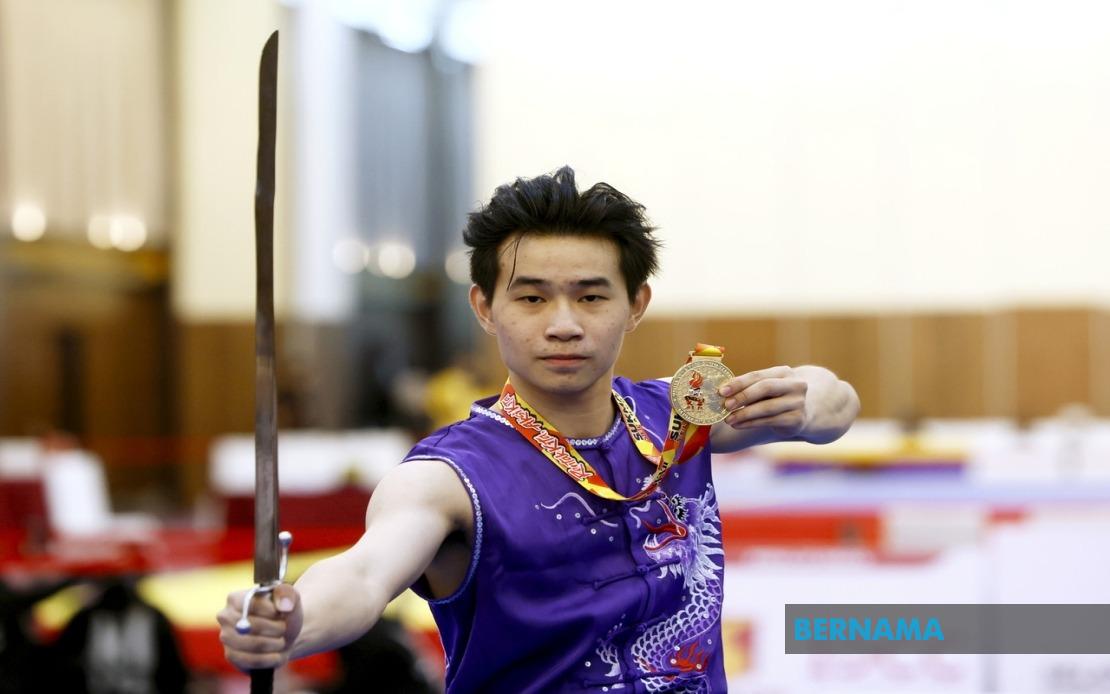
Wee Din Jun's journey to the wushu podium at the 2026 Malaysia Games unfolded against considerable physical odds. The 21-year-old Penang athlete delivered a triumphant performance at the Ideal Convention Centre in Shah Alam on August 21, capturing the men's nandao nangun gold medal with a score of 9.600 points, clinching victory in what represents his final competitive appearance at SUKMA. The achievement carries profound significance given that Din Jun sustained a hip injury merely one month before the Games commenced—a timeframe that would have derailed the preparations of many elite competitors.
Din Jun's winning margin proved decisive in a closely contested field. Sarawak's John Phang claimed the silver medal with 9.563 points, while Selangor's Tan Yu Zhe secured bronze with 9.550 points, demonstrating the razor-thin margins that characterise elite wushu competition where judges assess both technical execution and artistic presentation. The narrow separation between medalists underscores the extraordinary level of precision required in the nandao nangun event, where athletes must demonstrate simultaneous proficiency with two distinct weapons whilst maintaining fluid, flowing movement.
The significance of this victory extends far beyond the individual medal tally. For Din Jun, this gold represents vindication following a turbulent trajectory through successive SUKMA editions that tested his resolve and mental fortitude. At SUKMA 2022 in Kuala Lumpur, the young athlete collected a bronze medal across his competed events, establishing himself as a promising talent within Malaysian wushu. However, his subsequent appearance at SUKMA 2024 in Sarawak proved devastating—he returned home without any medal after executing poorly across the three events he entered, a disappointing outcome that threatened to define his Games legacy.
The psychological dimensions of athletic comeback narratives resonate particularly strongly in Malaysian sports culture, where SUKMA serves as the premier domestic multi-sport competition and a showcase for developing talent. Din Jun's willingness to persist through disappointment and return to competition reflects a determination that transcends individual achievement. For young Malaysian athletes watching his performance, his trajectory demonstrates that early setbacks need not determine ultimate success, particularly when coupled with strategic guidance and emotional resilience.
In reflecting upon his triumph, Din Jun credited his coaching team's guidance in navigating the mental dimensions of competition. He recounted how his coach advised him to remain composed and embrace the performance experience itself, rather than fixating on outcomes or external pressures. This philosophical shift proved transformative—by concentrating solely on executing his technique to the highest standard and avoiding the distraction of competing outcomes or previous failures, Din Jun enabled himself to perform with the freedom necessary for medal-winning execution.
The athlete acknowledged the particular emotional weight carried by his final SUKMA appearance. Throughout his competitive journey across three Games, Din Jun harboured a specific aspiration—to demonstrate capability in capturing a gold medal at Malaysia's premier domestic sports festival. This objective had eluded him through two previous editions, creating an unfinished narrative that motivated his preparation despite physical setbacks. The hip injury sustained weeks before competition threatened to prevent him from achieving this long-held ambition entirely.
Din Jun extended recognition to his former coach, who has since relocated to China and therefore could not witness his medal presentations at previous Games. The athlete characterised this dedication as a form of gratitude toward the mentor who helped establish his foundation in wushu, acknowledging that coaching relationships extend beyond the immediate competition cycle and represent formative professional relationships that shape athletes' development trajectories.
The Bayan Lepas native will continue his SUKMA campaign tomorrow when he competes in the nanquan event, seeking to conclude his final Games appearance with additional medal success. This pursuit extends his competitive engagement beyond the single gold medal, offering the possibility of departing SUKMA with multiple medals that would more comprehensively represent his capabilities. The nanquan event, featuring different technical demands and judging criteria from the nandao nangun discipline, will test Din Jun's versatility within wushu's diverse competitive landscape.
Din Jun's achievement arrives within the broader context of Malaysian wushu's development trajectory. The sport has gradually expanded its institutional support and training infrastructure, with athletes increasingly accessing coaching expertise and competition opportunities that facilitate progression to international standard. Din Jun's success contributes to this developmental narrative, demonstrating that Malaysian wushu competitors can achieve results competitive with their regional counterparts from established wushu nations throughout Southeast Asia.
The victory assumes additional relevance as Malaysia continues positioning itself within the global wushu competition calendar, particularly as the sport gains recognition through international federation structures and potential inclusion in major multi-sport games. Individual medals at SUKMA, whilst primarily domestic achievements, contribute to the athlete development pipeline that ultimately supplies talent for regional championships and international tournaments representing Malaysian wushu on a broader stage.
For Malaysian readers following SUKMA's unfolding competitions, Din Jun's narrative encapsulates several compelling dimensions—the redemptive quality of athletic perseverance, the importance of mental coaching alongside technical instruction, and the capacity to overcome physical adversity through determination. His transformation from disappointed competitor two years ago to current gold medalist illustrates the unpredictable trajectories that characterise sports careers, where progress rarely follows linear patterns and where setbacks frequently precede breakthrough moments.

