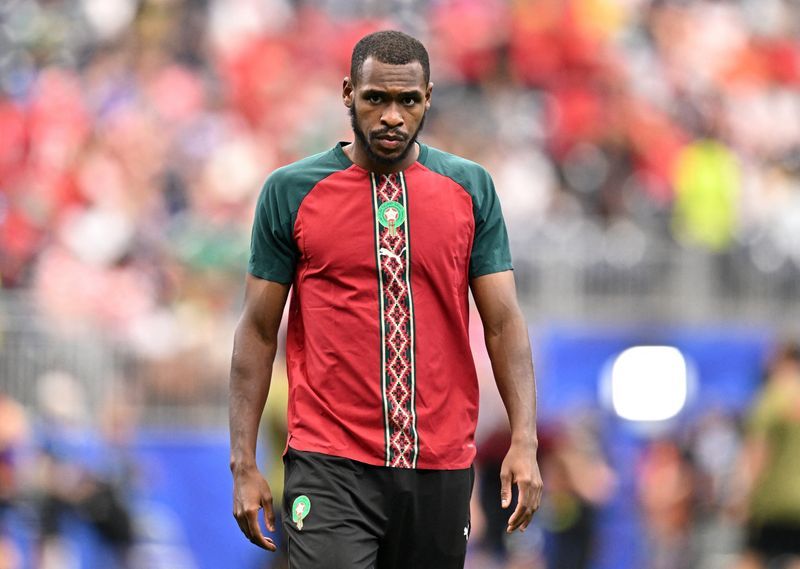
The narrative surrounding Morocco's World Cup quarter-final against France in Boston on Thursday carries an unexpected emotional dimension, centred on one player's unlikely journey from steadfast French allegiance to becoming a linchpin in the North African nation's defensive architecture. Issa Diop, the 29-year-old centre-back, must now confront his former ambition by containing Kylian Mbappé's attacking prowess—a role that encapsulates the dramatic turn his international career has taken in recent months.
Diop's background reads like a geographical puzzle. Born in Toulouse to a Senegalese father and Moroccan mother, he carried credentials that could have aligned him with multiple African footballing traditions. His grandfather's prominence in Senegal's early national team coaching established a continental connection spanning generations. Yet throughout his formative years and early career, Diop never entertained switching from the French pathway, repeatedly declining overtures from both Morocco and Senegal with remarkable consistency and conviction.
His commitment to France remained unwavering even during his time with the national Under-21 programme. Seven years prior to his eventual switch, Diop articulated his position with striking clarity during an interview with Canal Plus, declaring that his birth in France and the country's instrumental role in his development made any departure feel fundamentally dishonest. He characterised alignment with another nation as merely a fallback option, something he would find ethically troubling given his circumstances. Those sentiments reflected a player apparently at peace with his footballing identity.
When Diop finally capitulated and committed to Morocco in March, reversing years of stated principle, the decision ignited considerable social media discourse and criticism. The timing appeared calculated by Morocco's coaching staff to address mounting defensive vulnerabilities ahead of the World Cup, yet it inevitably felt like a reversal that demanded explanation and justification from a player who had so emphatically ruled out such a move.
Morocco's defensive landscape had genuinely shifted in concerning ways. Captain Romain Saiss, a cornerstone of the backline, departed following the Africa Cup of Nations in January, leaving a substantial void in leadership and experience. Simultaneously, Nayef Aguerd suffered a March injury that threatened his availability, creating an urgent need for reinforcement in central defence. Coach Mohamed Ouahbi recognised that Diop's eight seasons in English Premier League football—split between West Ham United and Fulham—offered precisely the calibre and seasoning required to stabilise a vulnerable defensive unit.
Outward tension from Diop's philosophical reversal dissolved dramatically following his contributions during Morocco's knockout progression. His performance against the Netherlands in the round of 32 proved transformative, particularly his stoppage-time equaliser that rescued his team from imminent elimination. The ball arrived via Chemsdine Talbi's cross, and Diop's powerful header cracked into the net at the ninety-first minute, dragging the contest into extra time and ultimately towards the penalty shoot-out victory that followed.
The significance of that goal transcended basic match statistics. It reframed Diop's entire narrative arc—here was a player who once insisted he belonged solely within the French system, now becoming a matchwinner for Morocco precisely when the nation's World Cup ambitions teetered on the edge of collapse. Ouahbi's perspective on the midfielder's integration reflected pragmatism rather than dwelling on historical reservations. The coach noted that Diop demonstrated genuine commitment to Moroccan life, frequently visiting the country and displaying cultural immersion that suggested authentic rather than mercenary attachment.
Diop has since become entrenched as first-choice central defender alongside Crystal Palace's Chadi Riad, forming a partnership that has gradually stabilised Morocco's defensive operations. His debut came during a March friendly against Ecuador, but his trajectory accelerated substantially once the World Cup commenced, with the Netherlands performance confirming that Morocco had acquired a genuinely consequential operator rather than merely addressing an emergency.
What emerges from this sequence of events is a testament to football's capacity to transform personal circumstances and allegiances. Ouahbi deliberately avoided excessive retrospection regarding Diop's long resistance to representing Morocco, instead emphasising that historical positions matter less than present commitment and on-field contribution. The message conveyed reassurance to fans who might have harboured reservations about a player switching colours so late in his career, while simultaneously allowing Diop to move forward without constant reference to his contradictory past statements.
Thursday's encounter presents a different challenge entirely. Unlike his earlier interventions, Diop will be required to concentrate predominantly on defensive responsibilities rather than supplementing the attack. Containing Mbappé's devastating speed, technical refinement, and tendency to exploit defensive vulnerabilities represents the precise test for which Morocco recruited him. The symmetry cannot be ignored—a player who once declared unshakeable loyalty to France must now actively prevent France's most dangerous attacking asset from advancing his nation's World Cup campaign.
The subplot adds psychological texture to what is already a fascinating matchup between African qualification's most persistent World Cup presence and European football's contemporary superpower. For Morocco, reaching the semi-finals would represent successive World Cup tournaments achieving that milestone, an unprecedented achievement for an African nation. Diop's transformation from French allegiance to Moroccan commitment has become inseparable from this broader narrative of African football's growing sophistication and competitive capability.

