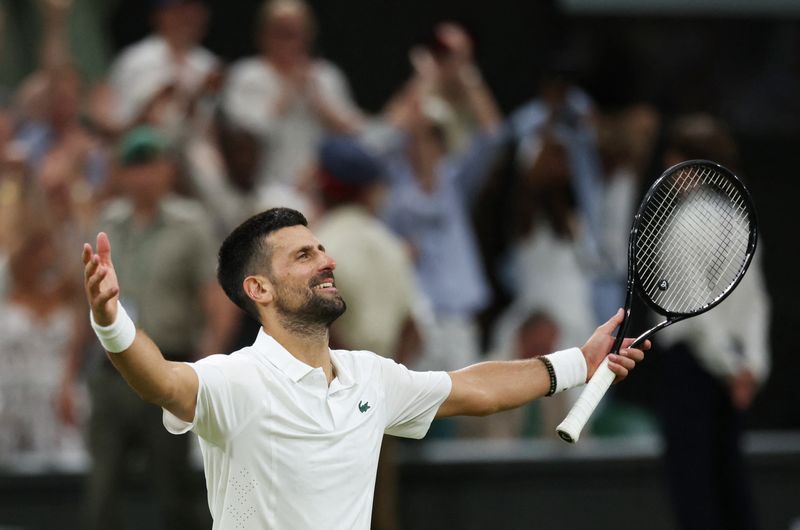
Novak Djokovic has secured a place in the Wimbledon semifinals for the eighth successive year, grinding through a punishing five-hour-and-15-minute encounter against Canada's Felix Auger-Aliassime that stands as the tournament's longest quarter-final on record. The 39-year-old Serbian eventually prevailed 7-6(10) 3-6 6-3 6-7(4) 7-6(10-4) in a see-saw battle on Tuesday that showcased the mental resilience and tactical acumen that have defined his legendary career across three decades of professional tennis.
With this victory, Djokovic has further cemented his legacy as the most successful men's player in Wimbledon history, extending his tournament record to 106 match wins—surpassing Roger Federer's previous benchmark. The achievement is particularly noteworthy given his age and the physical demands of competing at the sport's highest level. More significantly, he became the first male player ever to reach the semifinals in eight consecutive years at any Grand Slam tournament, a record that underscores his sustained excellence and ability to perform when it matters most on grass courts.
The quarterinal itself developed into an absorbing contest where neither player could establish meaningful separation, with Auger-Aliassime proving far tougher an opponent than many pre-match analyses suggested. The Canadian's aggressive baseline game and powerful serving kept Djokovic under constant pressure throughout, particularly in the opening and fourth sets where tiebreaks decided the outcome. In the second set, Auger-Aliassime broke serve decisively to go up 5-3 and momentarily seemed destined to claim the set, only for the match to take several dramatic turns thereafter.
Djokovic himself appeared frustrated at various moments, including when the Centre Court roof was closed around 7:40 p.m. local time following the second set. The seventh-seeded competitor lodged complaints about the closure but regained his composure once play resumed indoors, adjusting his strategy with cleaner striking and improved serve placement that yielded the crucial break in the third set. This capacity to absorb setbacks and recalibrate mid-match remains one of the defining characteristics that separates elite players from their peers, even as physicality and reflexes naturally diminish with age.
Auger-Aliassime's frustrations mounted as the contest wore on, particularly after losing his opening service game in the fourth set. The Canadian's emotional response—striking his chair with his racket in a moment of visible exasperation—reflected the mounting tension of a match where neither player could gain decisive psychological advantage. Yet Auger-Aliassime demonstrated considerable fortitude by recovering to force a final set through a tiebreak that went to 7-5, extending the drama and suggesting the outcome could have tilted either direction.
The decisive fifth-set tiebreak at 10-10, won by Djokovic 10-4, proved to be the crucible where experience and composure prevailed. Having contested countless high-pressure situations across a career spanning multiple decades and 24 previous Grand Slam titles, Djokovic drew on reserves of mental fortitude that Auger-Aliassime, despite his youth and athleticism, could not quite match in that defining moment. The Serbian's victory was greeted with what observers described as deafening applause from the Centre Court crowd, who recognised they had witnessed a match of exceptional quality and drama.
Djokovic himself acknowledged the extraordinary nature of the contest during his post-match interview, describing it as one of the finest matches of his entire Wimbledon career. He attributed his success to managing the extreme tension that accompanies such closely-contested encounters, suggesting that his experience and mental conditioning were ultimately the decisive factors. The victory comes at a cost, however, as Djokovic will now face a tight recovery schedule before confronting world number one Jannik Sinner in the semifinals—a meeting between two of the sport's most dominant contemporary players.
The Sinner matchup adds significant context to Djokovic's achievement, as the Italian reigning champion represents the current standard-bearer of men's tennis and boasts a formidable record at this year's Wimbledon. Their semifinal will pit a veteran still performing at elite levels against the sport's most dominant current force, creating a generational narrative that extends beyond mere tennis statistics. For Malaysian and Southeast Asian tennis enthusiasts, the encounter represents a compelling study in how different eras of excellence manifest on sport's biggest stages.
Djokovic's pursuit of an eighth Wimbledon title to match Federer's tally and a 25th Grand Slam crown to surpass Margaret Court's all-time record remains tantalizingly within reach. However, the physical toll of the Auger-Aliassime contest means recovery becomes critical in the coming days. As Djokovic noted with characteristic pragmatism, having to manage his body's condition between matches poses logistical challenges, though he expressed satisfaction at still competing at the sport's highest level against the world's elite players.
The broader significance of Djokovic's continued success at age 39 extends beyond individual records or trophies. His presence in the latter stages of Grand Slam tournaments challenges conventional narratives about athletic decline and aging, demonstrating that mental fortitude, tactical intelligence, and professional discipline can sustain competitive excellence into the fourth decade of life. This has implications for how sports scientists and athletes globally conceptualise the aging process in elite competition.
Looking ahead, Djokovic's semifinal clash with Sinner will undoubtedly attract massive television audiences across Southeast Asia, where tennis viewership has grown considerably in recent years. The match promises to be a showcase of contrasting styles and eras, with Sinner's aggressive modern game meeting Djokovic's cerebral, defensive excellence. For regional fans, it represents compelling sporting theatre and a rare opportunity to witness two generational talents competing on the sport's most prestigious grass court stage.

