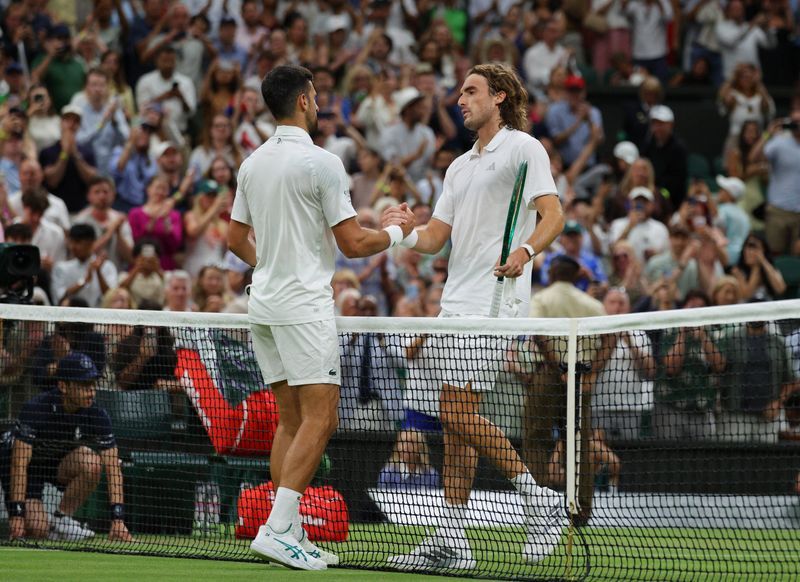
Novak Djokovic demonstrated why age remains merely a statistic at the highest levels of tennis, dismantling Stefanos Tsitsipas on Centre Court at Wimbledon to surge into the third round with a commanding 6-3 6-4 6-2 victory on Wednesday. What had been touted as a potentially competitive heavyweight showdown quickly transformed into a masterclass, with the 37-year-old Serbian pivot controlling almost every facet of play against his 27-year-old Greek opponent.
The turning point arrived during the second set at 4-4, when Tsitsipas faced a critical break point that could have shifted the match's momentum. With two overhead opportunities to end the rally decisively, the younger player inexplicably misfired both attempts. Rather than capitalising on these rare openings, Tsitsipas's errors handed Djokovic the initiative he needed. The Serbian seized the break of serve immediately after, effectively deciding the contest's outcome before it had truly begun. From that moment, Djokovic's control became absolute—he won eight of the final ten games to complete the demolition.
This result extends Djokovic's already remarkable dominance over Tsitsipas to an unprecedented 12 consecutive victories in their head-to-head encounters. The pattern has become brutally familiar for the Greek player: he arrives at major championships with fresh hope and departs with another defeat stamped into his record against a man he simply cannot decode. For Tsitsipas, this latest setback carries particular weight given the circumstances surrounding his arrival at the All England Club.
Tsitsipas entered Wimbledon carrying the baggage of a turbulent period that would test any player's psychological resilience. His ranking has collapsed to 87th in the world, a dramatic fall from grace for someone once heralded as a future Grand Slam champion. Days before arriving in London, he made the extraordinary decision to part ways with his coach—a figure bound to him by family ties, as his father Apostolos has been his primary advisor. This separation represented more than a typical coaching change; it symbolised a desperate attempt to reset a career that appears to have stalled considerably.
These circumstances made his return to Centre Court feel like a redemptive mission. Last year, Tsitsipas had been forced to retire mid-match during the opening round, succumbing to chronic back pain that threatened to derail his career trajectory permanently. Successfully competing through that physical torment represented genuine progress. Yet returning to Wimbledon this year with such chaotic conditions—coaching upheaval, ranking collapse, and the psychological weight of past Grand Slam heartbreak—placed him in an impossible position even before stepping onto the grass.
Djokovic, conversely, appears impervious to the passage of time. Now well into his fourth decade as a professional competitor, the Serbian champion moves with the confidence and precision of someone who has long transcended the usual limitations of athletic mortality. His movement remained fluid, his anticipation razor-sharp, and his execution nearly flawless. Speaking courtside after the victory, Djokovic reflected on the privilege of performing at this level at an advanced age, insisting that his age remains irrelevant provided his body continues responding as required. His presence on grass courts, he suggested, constitutes a gift he never takes for granted.
The victory inches Djokovic closer to matching Roger Federer's men's record of 105 match-wins at Wimbledon—he now requires just a single additional victory to achieve that landmark. More significantly, his path toward an eighth Wimbledon title and a record 25th Grand Slam championship remains uncluttered by serious obstacles. With the seventh seed progressing smoothly, his next opponent, 25th-seeded Frenchman Arthur Rinderknech, provides relatively manageable opposition as he continues his tournament journey.
For Tsitsipas, the narrative remains disappointingly consistent. He had contested two Grand Slam finals—at Roland Garros in 2021 and the Australian Open in 2023—yet lost both encounters to Djokovic. Each meeting with the Serbian deepens his statistical disadvantage and diminishes his confidence in future encounters. Until the Greek finds a way to solve the tactical puzzle that Djokovic presents, his elite ranking and promising potential will continue generating underperformance at the sport's most important stages.
The disparity in quality between these two players when they meet extends beyond mere technique or physical condition. Djokovic possesses an intangible quality—a combination of experience, match-craft, and mental fortitude—that neutralises Tsitsipas's considerable talents. The Greek player's inability to convert the overhead opportunities in the second set encapsulated this broader theme: when facing Djokovic, even the simplest chances become unbearably difficult to convert. For Southeast Asian tennis enthusiasts watching the grass-court season unfold, this decisive performance underscores why Djokovic remains perhaps the most formidable competitor still operating at the sport's highest echelon.

