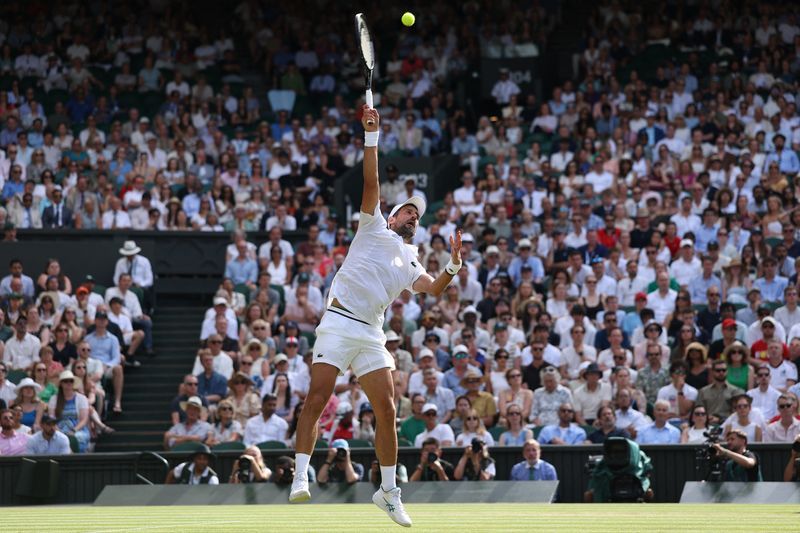
Novak Djokovic added yet another milestone to his storied Wimbledon résumé on Sunday, outlasting Russian qualifier Roman Safiullin 7-6(6) 6-3 3-6 6-3 on Centre Court to claim his record 106th match victory at the All England Club. The triumph moves the 39-year-old Serbian legend beyond Roger Federer on the men's all-time match-wins list at grass court's most prestigious tournament, a distinction that underscores his remarkable longevity and consistency at one of tennis's most demanding stages. With the passage into the quarter-finals, Djokovic now trains his sights on another historic target: equalling the Swiss great's record haul of eight Wimbledon titles, a mark that would cement his position as the tournament's greatest champion.
The contest demonstrated why Djokovic, seeded seventh, remains such a formidable force even as he pursues a 25th Grand Slam crown at an age when most elite athletes have long since retired. Yet the victory came at considerable cost, as Safiullin—ranked a modest 132nd in the world but recently returned from a hip injury that sidelined him for months—provided far more resistance than the seeding suggested. The aggressive Russian challenger forced Djokovic into uncharacteristic service breaks on two occasions and twice brought the Serb to the brink of dropping the opening set, forcing the champion to save multiple set points at 2-5 before ultimately prevailing in a tiebreak that showcased his championship pedigree under pressure.
Djokovic's performance under the blazing sun revealed a player navigating complications rather than controlling proceedings with his usual imperious manner. His struggles from the baseline, particularly his reluctance to sustain long rallies where the wind-assisted conditions favoured his challenger, forced tactical innovation. Rather than imposing his characteristic grinding style, Djokovic repeatedly advanced to the net with serve-and-volley plays, a more aggressive posture that proved unevenly effective. The approach worked brilliantly in stretches, particularly when he seized momentum in the second set to open a commanding 4-2 lead before consolidating the advantage. However, Safiullin's refusal to capitulate—evidenced by his break of serve that delivered him the third set—extended the match beyond what might have been expected from a player of Djokovic's calibre.
In acknowledging his challenger's credentials after the match, Djokovic offered candid assessment of his own vulnerabilities on the day. He conceded that Safiullin's powerful groundstrokes and willingness to attack forced him into a reactive posture uncommon throughout his career. The seventh seed admitted that sustaining baseline exchanges presented genuine difficulty, prompting his shift toward net-rushing tactics designed to shorten points. Yet he also highlighted the crucial role played by serving accuracy, particularly in the decisive fourth set, where enhanced precision with his first delivery proved instrumental in escaping danger and dictating play. This candour reflected both respect for an opponent who nearly engineered one of the tournament's major surprises and recognition that his path forward would demand increased consistency and aggression.
Djokovic's trajectory through the first week has illustrated a pattern of struggle that would concern many observers. He has relinquished sets in three of his opening four matches, suggesting that the grass-court surface—though historically his domain—presents fresh challenges at this late stage of his career. The notion that he must "survive to thrive," his own characterisation of his opening week, carries implicit acknowledgment that advancing simply through matches, regardless of aesthetic quality, remains his paramount objective. For a player accustomed to dominating opponents and controlling entire tournaments through sheer superiority, this grittier, more uncertain approach marks a subtle but significant evolution in his Wimbledon methodology.
The quarter-final matchup awaiting Djokovic pits him against the winner of the encounter between third-seeded Canadian Felix Auger-Aliassime and Spanish challenger Alejandro Davidovich Fokina. Both opponents present contrasting challenges that may test Djokovic's capacity for adjustment. Auger-Aliassime brings explosive serving and athletic movement that could prove problematic should Djokovic continue to experience the baseline difficulties evident against Safiullin. Davidovich Fokina, conversely, epitomises the aggressive, rally-intensive style of modern tennis that has forced older champions to become more creative tactically. Either pairing promises to reveal whether Djokovic's capacity for in-match adaptation and veteran resourcefulness suffices to overcome opponents who represent the emerging generation.
The broader significance of Djokovic's record extends beyond mere statistical achievement, resonating throughout Southeast Asia where his matches command enormous viewership and inspire the region's emerging tennis talent. His pursuit of Federer's Wimbledon championship record carries particular poignancy, as both champions have defined their era through sustained excellence across decades. For Malaysian and regional audiences who have witnessed Djokovic's dominance since his breakthrough as world number one more than a decade ago, this incremental accumulation of records represents something deeper than record-chasing: it epitomises the relentless pursuit of improvement that underpins elite athletic achievement.
Djokovic's record-breaking achievement also underscores the transformation of Wimbledon's competitive landscape. The tournament's historical emphasis on serve-and-volley tennis and rapid grass-court dispatch has yielded to more grinding baseline exchanges. Djokovic's 106 victories represent matches fought across an era when the grass courts have become slower, when rallies have lengthened, and when sustained pressure has replaced quick-point finishes as the dominant tactical approach. This evolution makes his milestone particularly impressive, as it reflects success not merely through tactical superiority but through capacity to adapt to fundamental changes in the sport's strategic foundations.
Moving forward, observers will scrutinise whether Djokovic's struggles against Safiullin represent temporary volatility or signal diminishing reserves of dominance. The gap between seeded expectation and match reality, which narrowed considerably against the Russian qualifier, threatens to narrow further against higher-ranked opponents who possess superior consistency and mental fortitude. Yet the Serb has repeatedly demonstrated throughout his career an uncanny ability to elevate performance at crucial junctures, leveraging experience and tactical flexibility to overcome younger, more athletically gifted opponents. Whether that capacity remains undiminished remains the central question as he pursues both his eighth Wimbledon crown and an unprecedented 25th Grand Slam title.

