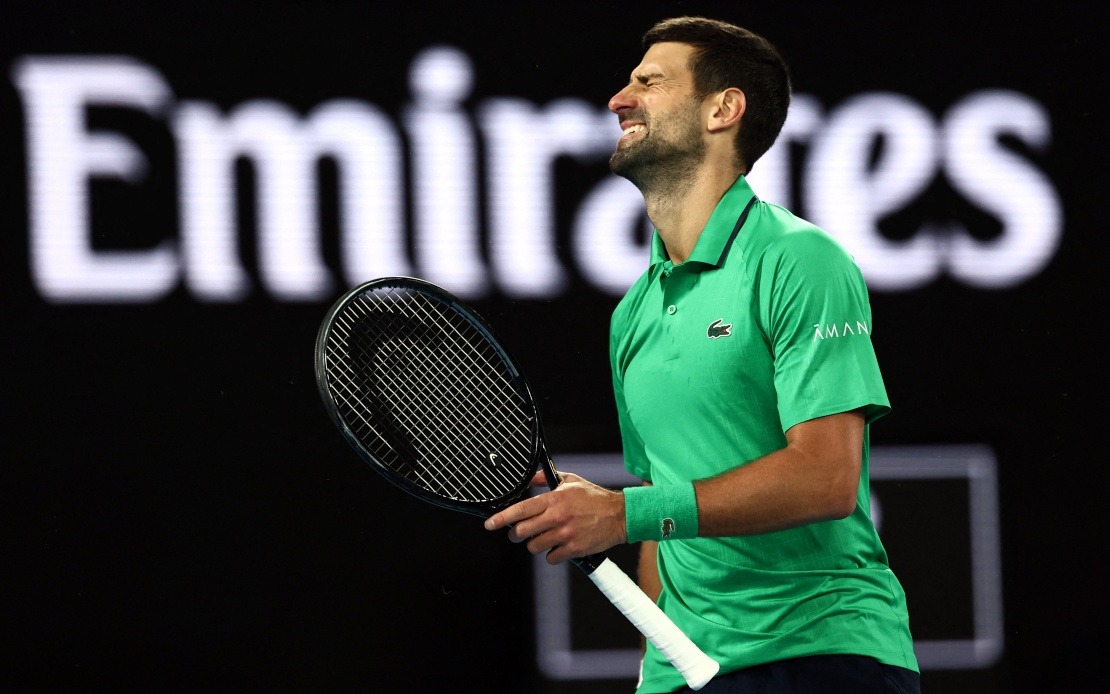
Novak Djokovic inscribed his name deeper into tennis history on Friday by capturing his 105th singles victory at Wimbledon, a milestone that places him level with the legendary Roger Federer and underscores his extraordinary longevity at the sport's most prestigious grass-court tournament. The 39-year-old Serbian defeated France's Arthur Rinderknech in a compelling four-set encounter on Centre Court, advancing to the fourth round and cementing his status as one of the greatest players ever to grace the competition.
The match itself proved a stern examination of Djokovic's endurance and court craft. Against the 25th-seeded Rinderknech, he needed nearly three hours to secure a 7-5, 6-4, 1-6, 7-6 (7-4) victory, a scoreline that reflected both his capacity to grind through difficult moments and his opponent's refusal to yield easily. The loss of the third set demonstrated that even at this stage of his career, Djokovic remains susceptible to pressure, though his ability to recalibrate and recover remains largely undiminished. This triumph marked his 18th appearance in the last 16 at the All England Club, a statistic that reveals the consistency underpinning his excellence across decades of professional play.
When addressing journalists after the match, Djokovic responded to the historic milestone with characteristic wit, suggesting that he and Federer should play one final match to determine who would ultimately hold the record outright. Yet beneath the humour lay evident reverence for both the achievement and the journey that delivered it. The seven-time Wimbledon champion acknowledged the profound privilege of making history in a sport he has dominated, while emphasizing that his focus remained fixed on winning individual matches rather than chasing numerical milestones. His comments reflected a philosophical maturity about legacy—recognizing its weight while refusing to be enslaved by it.
Djokovic's next challenge arrives in the form of Roman Safiullin, a Russian qualifier who has navigated an improbable path through the early rounds. This encounter offers Djokovic the opportunity to advance toward the latter stages, where the calibre of opposition will intensify considerably. As a 24-time Grand Slam champion, Djokovic enters the quarter-final phase as a favourite for the title, though grass-court tennis harbours surprises for even the most decorated competitors.
In the men's draw, defending champion Jannik Sinner continued his commanding progression by dispatching American Jenson Brooksby with consummate ease, winning 6-4, 6-3, 6-4. The Italian world number one's performance underscored why he has emerged as the game's dominant force in recent months, extending a flawless record at the third-round stage of Grand Slam tournaments. His 20th consecutive victory at this juncture of major championships sets an Open Era record for male competitors, a distinction that places him alongside Djokovic and other titans in terms of consistency at crucial tournament moments. The crowd's vocal support appeared to energise Sinner, highlighting the psychological edge that home advantage or popular backing can provide in tennis.
The women's draw witnessed compelling developments that have set up a tantalising confrontation between contrasting styles. Aryna Sabalenka, the top seed from Belarus, advanced through a relatively controlled encounter against Jelena Ostapenko, the former French Open champion, winning 6-4, 6-4. Sabalenka's movement and power proved decisive, as Ostapenko, despite her own formidable credentials, could not generate sufficient rhythm to threaten an upset. The victory keeps alive Sabalenka's aspirations for a maiden Wimbledon title, a significant prize that would enhance her already glittering resume comprising Australian Open championships.
Sabalenka will now confront four-time Grand Slam champion Naomi Osaka in the fourth round, an encounter that promises to deliver compelling tennis and considerable narrative intrigue. Osaka's path to this stage included a commanding 6-1, 6-3 victory over Russia's Daria Kasatkina, performed with the kind of controlled aggression that has characterised her Grand Slam performances. Notably, this represents Osaka's first appearance in a Wimbledon fourth round, suggesting that the Japanese star may finally be rediscovering the consistency that marked her earlier dominance in women's tennis. For Malaysian and Southeast Asian followers, Osaka's resurgence carries particular resonance given her cultural connections and the interest her career trajectory generates across the region.
Sabalenka's characterisation of Osaka as another aggressive, powerful opponent revealed her respect for an adversary who has neutralised most challengers when firing at full capacity. Both players share a propensity for explosive strokeplay and the ability to dictate points through sheer intensity, which suggests the match could feature extended rallies punctuated by swift conclusion rather than protracted baseline exchanges. Sabalenka's willingness to embrace the challenge and her stated determination to fight with maximum commitment indicated she recognises the magnitude of the test ahead. The psychological dimension of their encounter—two players accustomed to bearing the burden of expectation—could prove equally consequential as the technical execution on court.
These developments at Wimbledon's mid-tournament stage demonstrate the tournament's capacity to generate compelling narratives across both the men's and women's competitions. Djokovic's achievement, while significant, pales beside the broader context of competitive excellence and generational transitions currently reshaping professional tennis. The emergence of figures like Sinner, the resurgence of Osaka, and the continued ambitions of established stars like Sabalenka suggest that tennis remains a sport capable of delivering surprise and spectacle. For regional observers, these storylines provide both inspiration and entertainment as the sport continues its evolution on its most revered stage.

