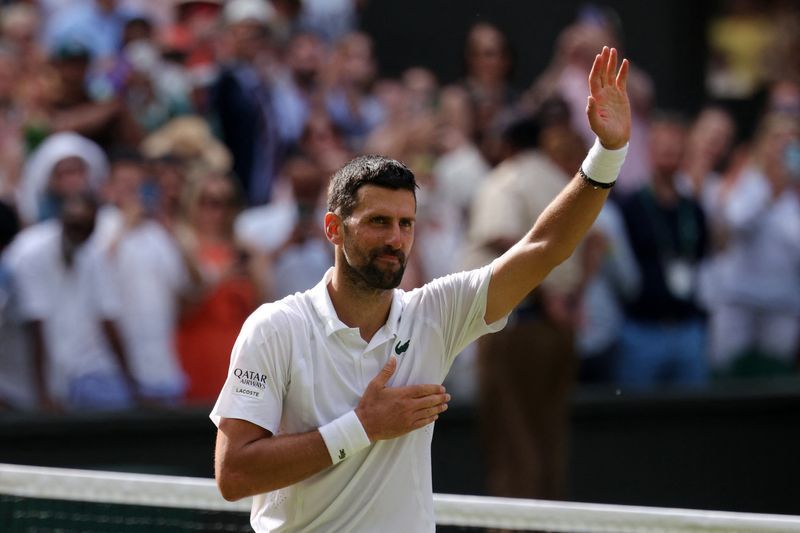
The All England Club's quarter-final stage commences Tuesday with compelling narratives across both men's and women's draws at Wimbledon. Novak Djokovic, the 39-year-old Serbian defending his legacy, squares off against third seed Felix Auger-Aliassime in pursuit of an unprecedented 25th Grand Slam title, whilst Japanese 14th seed Naomi Osaka seeks further glory following her impressive demolition of world number one Aryna Sabalenka in the previous round. The quartet also includes defending champion and world number one Jannik Sinner, Italian four-time major winner, alongside emerging challenge from German Jan-Lennard Struff.
Djokovic's passage to the quarter-finals has been harder won than his storied record suggests. His round-of-16 triumph over Roman Safiullin, whilst securing his milestone 106th victory at the All England Club—a new Wimbledon record—came through a gruelling three-and-a-half-hour struggle that revealed the physical toll mounting against younger opposition. The four-set victory marks his second consecutive match extending beyond three sets, presenting a narrative of a veteran competitor grinding through adversity rather than gliding past challengers. At an age when most of his peers have long retired from professional tennis, Djokovic continues excavating reserves of resilience and tactical acumen, yet the deepening physical demands hint at the mountain still to summit.
The Serbian reflects candidly on these grinding contests, acknowledging the paradox of enjoying conflict whilst preferring to avoid it. His post-match commentary reveals a seasoned operator who has learned to embrace suffering as integral to competitive longevity. This psychological framework—transforming discomfort into advantage through grinding determination—has characterised his entire career, particularly in recent seasons as age compresses his window for further historical achievement. His opponent, the 25-year-old Canadian Auger-Aliassime, represents a generational bridge between Djokovic's dominance and the emerging talent reshaping professional tennis.
Auger-Aliassime enters the encounter with measured optimism tempered by awe at the historical weight of facing a living legend. The third seed's prior head-to-head record against Djokovic shows parity—each won once in their 2022 meetings—suggesting competitive equilibrium rather than hierarchical domination. However, Auger-Aliassime's articulated admiration for Djokovic's career workload underscores the psychological burden of confronting a player whose entire career trajectory towers above most contemporaries. For Asian and Southeast Asian tennis followers, this matchup represents a generational moment where emerging powers attempt breaking through established empires that have defined the sport's landscape.
On the women's side, Osaka has emerged as an unlikely championship contender following her categorical dismantling of Sabalenka. The 28-year-old Japanese star, seeded 14th and making her Wimbledon quarter-final debut, reanimated aspects of the dominant player who claimed Grand Slam titles in 2018 and 2021. Her blistering forehand and serve command neutralised Sabalenka's considerable weaponry comprehensively, suggesting the mental resilience that defined her earlier career may be returning after extended struggles with focus and consistency. Osaka's fashion presence at the championships—generating substantial media commentary around her off-court profile—adds another dimension to her narrative, positioning her as a multidimensional cultural figure beyond pure tennis competency.
Osaka's reframing of her Sabalenka encounter as practice, despite the high-stakes quarter-final context and enormous crowd, demonstrates the psychological reorientation necessary for tournament progression. This mental framing device—treating monumental matches as developmental exercises—represents sophisticated emotional management that separates elite performers from the merely talented. Her opponent, Czech 10th seed Karolina Muchova, brings the disadvantage of never progressing beyond Wimbledon's quarter-finals despite three prior appearances at this juncture. Muchova and Osaka have split their recent head-to-head record, though the Czech player's solitary grasscourt victory occurred last month at Bad Homburg, providing tangible evidence that recent form rather than career narrative determines outcomes.
Muchova's strategic preparation preceding Wimbledon—competing in two warm-up tournaments to accumulate grasscourt match repetition—underscores the technical complexity of grass court tennis, which demands distinct technical adjustments and court familiarity compared to harder surfaces. Her dispatch of fellow Czech and former champion Barbara Krejcikova validates this preparation philosophy. For Malaysian and Southeast Asian observers, these strategic decisions by touring professionals illustrate the meticulous planning extending far beyond match day itself, encompassing tournament selection and preparation sequencing across months.
In the men's draw, defending champion Sinner navigates what appears a manageable quarter-final against Struff, whom the Italian has defeated in all three prior meetings. Yet Sinner's measured language regarding past results holding no predictive weight suggests healthy respect for Struff's achievement in reaching his first Grand Slam quarter-final at age 36. The German's journey itself constitutes a remarkable story in an era dominated by younger players. Struff claimed his quarter-final berth when opponent Hubert Hurkacz withdrew due to hip injury whilst trailing 4-2 in the fifth set, a circumstance that may complicate Struff's psychological approach despite the fortunate advancement. Sinner's acknowledgment of heightened quarter-final tension—distinct from earlier rounds—reveals the escalating mental demands as tournaments compress toward their conclusions.
The Tuesday quarter-final schedule distributes matches across two premier venues, with Centre Court hosting the marquee men's encounter between Djokovic and Auger-Aliassime from 1230 GMT, preceded by American 4th seed Jessica Pegula against compatriot 7th seed Coco Gauff. Court Number One begins earlier at 1000 GMT with Sinner-Struff, followed by the Osaka-Muchova clash. This scheduling reflects the tournament's hierarchical valuation of players, with Djokovic's presence commanding the Centre Court's primacy despite Sinner's recent dominance of the sport. For Malaysian audiences, these matches air at evening-to-night hours, providing accessible viewing windows that have gradually shifted international tennis toward markets increasingly consuming European championships across Asian time zones.
The narrative threads converging at these quarter-finals encompass Djokovic's pursuit of historical immortality against mortality itself, Osaka's personal resurrection following professional wilderness, Sinner's consolidation of supremacy against unexpected resistance, and Struff's belated arrival at tennis's apex. Collectively, these storylines illustrate how professional sport transcends mere competition, encompassing redemption, legacy-building, generational transition, and the temporal arbitrariness separating triumph from obscurity. The quarter-finals will determine not merely Wimbledon's winners, but reflect broader patterns about longevity, resilience, and the mechanics through which excellence sustains across years and decades in a sport demanding extraordinary athleticism and psychological resilience.
For Southeast Asian tennis enthusiasts and Malaysian readers specifically, these matches offer windows into the philosophies and preparation methods distinguishing elite professional competitors. The detailed insights into Djokovic's grinding mentality, Osaka's psychological reframing, Muchova's tournament preparation strategy, and Struff's unexpected late-career breakthrough illuminate dimensions of championship-level sport extending beyond match highlights and tournament brackets. These quarter-finals represent not merely tennis spectacle but repositories of insights regarding human performance, competitive psychology, and the sustained excellence that defines champions across domains beyond sport itself.

