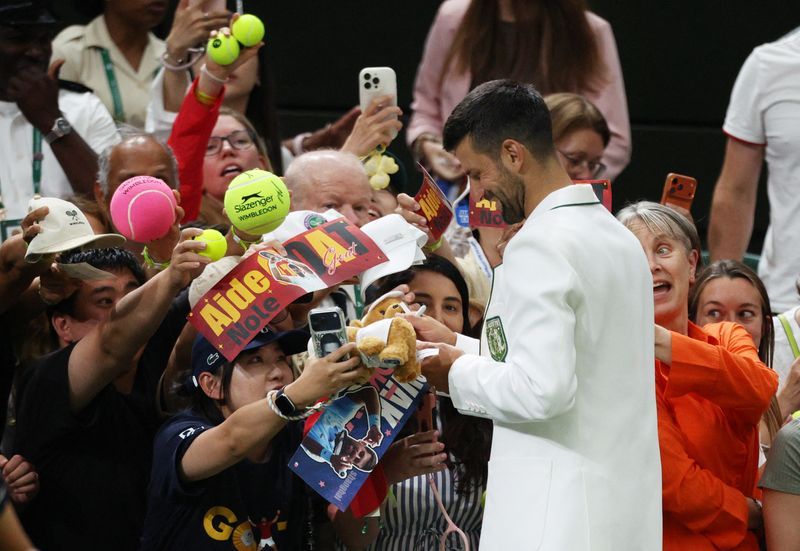
Novak Djokovic's commanding performance against Stefanos Tsitsipas at Wimbledon on Wednesday revealed a champion so thoroughly in control of his match that his attention turned to entertaining the crowd and testing the composure of courtside staff. The Serbian maestro's 6-3 6-4 6-2 demolition of the Greek rival set the stage for an afternoon of playful moments that underscored his comfort on the grass courts at the All England Club.
Early in the match, Djokovic orchestrated a carefully executed prank involving a ball girl tasked with trimming black tape from his right shoulder using scissors. As she prepared to make the cut with the tennis great standing before her, Djokovic suddenly cried out in apparent agony, instantly triggering a moment of genuine panic. The young ball girl visibly recoiled, clutching her chest as the realisation of what she believed to have happened washed over her—that she had just seriously injured one of tennis's greatest players in front of millions of viewers worldwide.
The tension dissipated within milliseconds when Djokovic erupted into laughter, his genuine amusement immediately putting the staff member at ease. She too dissolved into relieved giggles as the nature of the deception became apparent. It was a calculated moment of levity, the kind that surfaces only when a competitor feels completely assured of victory and can afford the mental space for such playfulness. The exchange perfectly captured the psychological state of a player who recognised early that his opponent posed no significant threat on that particular afternoon.
When addressing the crowd during his post-match interview, Djokovic acknowledged the prank with characteristic humility, noting that such behaviour emerges primarily when matches unfold decisively in a player's favour. "These kinds of things surface when you are two sets to love up rather than two sets to love down, but ... I'm sorry if I scared her... it made me a bit more relaxed on the court. I was just having some fun," the 24-time Grand Slam champion explained, justifying his moment of mischief to the watching audience.
Beyond the playful interaction with ball-side staff, Djokovic's victory against Tsitsipas provided further opportunity for on-court banter when his eyes spotted a particularly recognisable figure in the Royal Box. Rory McIlroy, the Northern Irish golfer and twice Masters champion, was present at Centre Court wearing his distinctive green jacket—the iconic garment associated with victory at Augusta National. Djokovic, dressed in his personalised cream blazer that has become a fixture throughout his championship campaign this year, seized the moment to engage the sporting celebrity in good-natured conversation.
Djokovic's comment about the jacket broke the formality of the traditional on-court interview, drawing McIlroy's attention with genuine admiration expressed towards the golfer's prestigious garment. When confirmation came that the jacket was indeed the Masters trophy piece, the tennis champion immediately proposed an unconventional wager. The suggestion came with characteristic Djokovic charm and the kind of cross-sport banter that appeals to the tennis crowd's broader sporting sensibilities.
The proposition involved a direct swap of jackets, contingent upon a match between the two athletes—though with a crucial twist. Djokovic insisted that rather than playing golf, where McIlroy held obvious advantage, they would contest the challenge on the tennis court, thereby reversing the natural hierarchy of sporting excellence. The suggestion reflected Djokovic's confidence in his own abilities and his understanding of the entertainment value inherent in such friendly competition between champions from different sports.
McIlroy, known for his own sense of humour and approachability within the sporting world, responded with evident amusement to the proposition. The bemused crowd roaring its approval provided audible testament to how Djokovic had successfully shifted the afternoon's narrative beyond the straightforward narrative of a dominant tennis victory. What might have been remembered simply as another comprehensive win against a seeded opponent instead became a memorable encounter distinguished by personality and wit.
The interplay between the two athletes highlighted an evolving dimension of professional tennis, where personality and entertainment value increasingly complement technical excellence. Djokovic's willingness to engage in such moments, coupled with his obvious dominance on the court, demonstrates how the sport's elite practitioners have recognised that winning alone no longer constitutes the complete measure of success in the modern sporting landscape. The ability to entertain, to connect with audiences, and to transcend the sport itself has become integral to legacy-building among the game's greatest champions.
Djokovic's performance and conduct throughout the Wednesday encounter revealed a player entirely at ease with his position atop world tennis. The balance he achieved between ruthless competitive pursuit and genial entertainment reflected a maturity that comes from sustained excellence across more than a decade of dominance. His interactions with ball staff and fellow sporting icons served as reminders that even the most intensely focused competitors occasionally find space for humanity and humour.

