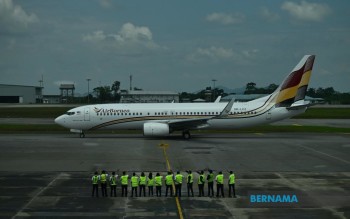
Deputy Prime Minister Datuk Seri Fadillah Yusof formally received AirBorneo Airways' inaugural flight at Kuala Lumpur International Airport Terminal 1 today, signalling federal support for Sarawak's ambitious push to establish greater control over its own air connectivity. The historic flight MY5005 from Kuching carried Sarawak Premier Tan Sri Abang Johari Tun Openg alongside state ministers and key stakeholders, underscoring the political significance of this milestone for the East Malaysian state.
The launch represents a watershed moment for Sarawak's aviation sector, as the state-owned carrier transitions from regional turboprop operations into the commercial jet arena with two wet-leased Boeing 737-800 aircraft. AirBorneo chairman Datuk Amar Mohamad Abu Bakar Marzuki, who also serves as Sarawak state secretary, positioned the development as central to the state's long-term economic strategy. The twin roles he occupies reflect how closely the airline is integrated with Sarawak's governance and developmental priorities, a structural arrangement that distinguishes this venture from conventional commercial ventures.
Connectivity between Kuching and Kuala Lumpur has long been dominated by established carriers, making AirBorneo's entry into this critical domestic corridor a significant competitive development. Mohamad Abu Bakar articulated a vision extending beyond simple airline operations, framing aviation as an economic enabler that binds people, sustains business activity, and creates pathways for prosperity. This rhetoric positions AirBorneo not merely as a transport provider but as an instrument of state policy aimed at reducing Sarawak's dependence on external carriers and capturing greater value from its connectivity needs.
Starting from July 21, 2026, AirBorneo will deploy double-daily service on the Kuching-Kuala Lumpur sector, ensuring consistent capacity and operational redundancy. The pricing structure—RM375 for economy and from RM736 for business class—suggests competitive positioning against incumbent operators while maintaining reasonable margins befitting a new entrant establishing market presence. These fares reflect a calibrated strategy to attract price-sensitive leisure travellers whilst securing premium revenues from business passengers accustomed to full-service offerings.
The federal government's visible endorsement of this initiative, demonstrated through DPM Fadillah's attendance alongside Tourism Minister Datuk Seri Tiong King Sing, Women, Family and Community Development Minister Datuk Seri Nancy Shukri, and Deputy Transport Minister Datuk Hasbi Habibollah, illustrates Putrajaya's commitment to supporting regional economic development through aviation infrastructure. Such high-level turnout signals that the federal government views AirBorneo's success as aligned with broader national objectives around inclusive growth and federalism.
AirBorneo chief executive officer Megat Ardian Mohd Aminuddin framed the launch as a transformative inflection point, pledging unwavering focus on safety standards, operational reliability, and passenger experience quality—hallmarks of professional airline management. His emphasis on stakeholder confidence reflects the challenges inherent in launching a new carrier in a competitive market where consumer trust must be earned through consistent performance. The language deployed suggests management understands that reputational capital, once lost, proves difficult to recapture.
The Kuching-Kuala Lumpur corridor serves as the foundational building block for broader domestic expansion. This deliberate sequencing—establishing a strong primary route before radiating outward—follows proven principles of airline network development. The route offers sufficient traffic density, established airport infrastructure, and time-zone alignment to facilitate operational reliability and revenue generation simultaneously.
International expansion remains a strategic horizon, with Singapore identified as the intended first overseas destination. This progression reflects Southeast Asia's regional connectivity dynamics, where Singapore serves as a crucial hub for onwards connections to other Asian centres and global markets. By anchoring initial international operations in Singapore rather than attempting more distant long-haul routes, AirBorneo adopts a measured approach that respects operational constraints while positioning the airline for future growth.
For Malaysian aviation markets, AirBorneo's emergence introduces a new competitive variable at a time when domestic connectivity faces competing pressures from low-cost carriers and network consolidation among full-service operators. The state ownership model distinguishes AirBorneo from purely commercial competitors, potentially allowing longer time horizons for profitability and greater tolerance for strategic losses during market penetration phases. However, this advantage must be balanced against the operational disciplines and market-responsive agility that private operators can deploy more readily.
Sarawak's aviation aspirations reflect broader federal devolution principles embedded within Malaysia's constitutional framework, whereby states increasingly seek control over assets and revenues that impact their territorial economies. Successful execution of AirBorneo's business plan could strengthen arguments for expanded state autonomy in aviation policy, particularly if the carrier achieves sustainable profitability and delivers measurable economic benefits throughout Sarawak's regions.
The timing of this inaugural service carries additional significance, arriving during a period when Southeast Asian aviation markets are experiencing recovery and rationalization following pandemic disruptions. AirBorneo's entry introduces fresh capacity and choice precisely when travellers value enhanced options and competitive pricing. The carrier's success will likely depend on sustained operational excellence, intelligent network planning, and retention of the political-administrative support that enabled its establishment.

