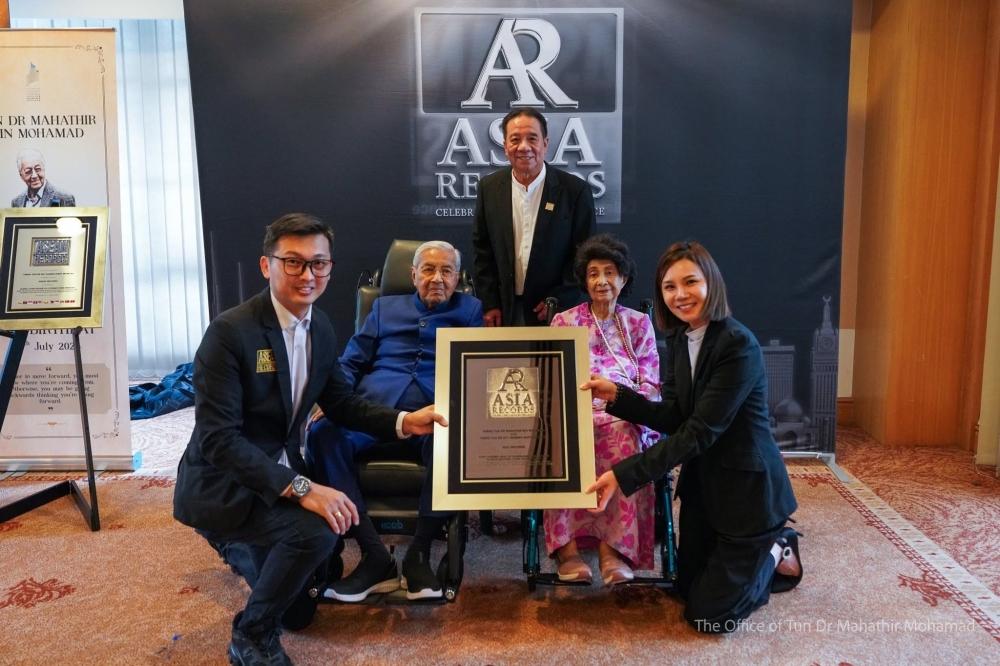
Tun Dr Mahathir Mohamad and his wife Tun Dr Siti Hasmah Mohd Ali have crossed a significant threshold rarely achieved by public figures, entering the centenarian ranks and simultaneously earning recognition from Guinness World Records for their historic milestone. The couple's dual achievement has garnered three separate world record designations, highlighting not only their individual longevity but also the exceptional nature of their combined legacy in Malaysian society.
The Guinness World Records acknowledgement underscores the rarity of such longevity, particularly within the context of political leadership in Southeast Asia. Dr Mahathir's century-long life has spanned Malaysia's entire existence as an independent nation, from the country's formation in 1957 through decades of political leadership. Meanwhile, Dr Siti Hasmah's parallel journey represents an equally remarkable arc of public service and personal achievement, positioning the couple as contemporary symbols of vitality and purpose extending well into advanced age.
For Malaysia, the recognition carries symbolic weight beyond mere statistical achievement. Dr Mahathir remains a polarising yet undeniably consequential figure in the nation's modern history, having served as Prime Minister across two non-consecutive periods that fundamentally shaped the country's economic trajectory and regional standing. His tenure witnessed Malaysia's transformation into a newly industrialised nation, the implementation of the Vision 2020 development blueprint, and numerous infrastructure megaprojects that continue to define the urban landscape. Dr Siti Hasmah, for her part, has maintained a distinguished career as a medical doctor and social advocate, contributing substantially to public health discourse and women's empowerment throughout her life.
The Guinness World Records designations reflect different dimensions of their achievement. The records likely encompass categories such as longevity among political figures, the age of a spouse couple combined, or other relevant metrics that acknowledge their exceptional status. Such official recognition from an internationally respected authority provides validation that extends beyond Malaysia's borders, positioning the couple within a global context of centenarian achievements. This international dimension resonates particularly in Southeast Asia, where development narratives often focus on youth and dynamism rather than celebrating enduring vitality.
The significance of reaching age 100 cannot be understated within Malaysia's healthcare and social context. While life expectancy has improved substantially over recent decades, attaining a century of life remains statistically uncommon. The achievement becomes even more noteworthy when considering the demands of public service and the stresses associated with political engagement at the highest levels. Both Dr Mahathir and Dr Siti Hasmah have maintained cognitive sharpness and continued involvement in public discourse well into their later years, challenging prevailing assumptions about capability and relevance in advanced age.
From a public health perspective, their longevity offers valuable case studies for Malaysian researchers and gerontologists. Questions naturally emerge regarding lifestyle factors, healthcare access, familial genetics, and social engagement that may have contributed to their extended vitality. These enquiries hold practical implications for Malaysia's ageing population, which demographic projections suggest will expand significantly in coming decades. Understanding the pathways to healthy ageing becomes increasingly pressing as the nation's population structure shifts and healthcare systems prepare for elevated demands from elderly citizens.
The couple's sustained prominence in national discourse also reflects broader questions about elder statesmanship and the role of former leaders in contemporary politics. Dr Mahathir has remained remarkably active in political commentary and occasional involvement in governance discussions despite his age, occasionally returning to cabinet positions even after retiring multiple times. This pattern exemplifies how individuals of exceptional vigour may continue contributing to nation-building across their lifespans, though it has also invited discussion about appropriate transition of power and generational renewal in Malaysian political leadership.
Regionally, the recognition of Dr Mahathir and Dr Siti Hasmah as centenarian record-holders positions Malaysia within a broader Southeast Asian narrative about development and modernisation achieving measurable health improvements. While individual achievements remain exceptional, they reflect wider improvements in nutrition, healthcare availability, and living standards that have benefited the population more broadly. The Guinness World Records serve as a capstone to these systemic improvements made across Malaysia during their lifetimes.
Looking forward, the couple's milestone invites reflection on legacy and historical assessment. Dr Mahathir's decision-making during critical national junctures—including the Asian financial crisis management, the Petronas Twin Towers construction, and more recently his role in post-2018 political developments—continues generating debate among economists, political scientists, and policymakers. Reaching 100 years provides a vantage point from which Malaysians can assess his contributions with temporal distance, whilst he remains available for dialogue and clarification. Dr Siti Hasmah's quiet but consistent dedication to medical practice and social causes exemplifies an alternative model of public contribution beyond electoral politics.
The Guinness World Records recognition ultimately represents a formal acknowledgement of an era in Malaysian history. Both figures embody particular approaches to development, governance, and nation-building that characterised the late twentieth century and early twenty-first century. Whether viewed as visionary architects of modern Malaysia or more critically as implementers of contested policies, their existence and contributions remain undeniably woven into the nation's fabric. Their centenarian status provides an occasion for Malaysians to engage comprehensively with their historical significance, examining both triumphs and controversies with the clarity that temporal distance permits.

