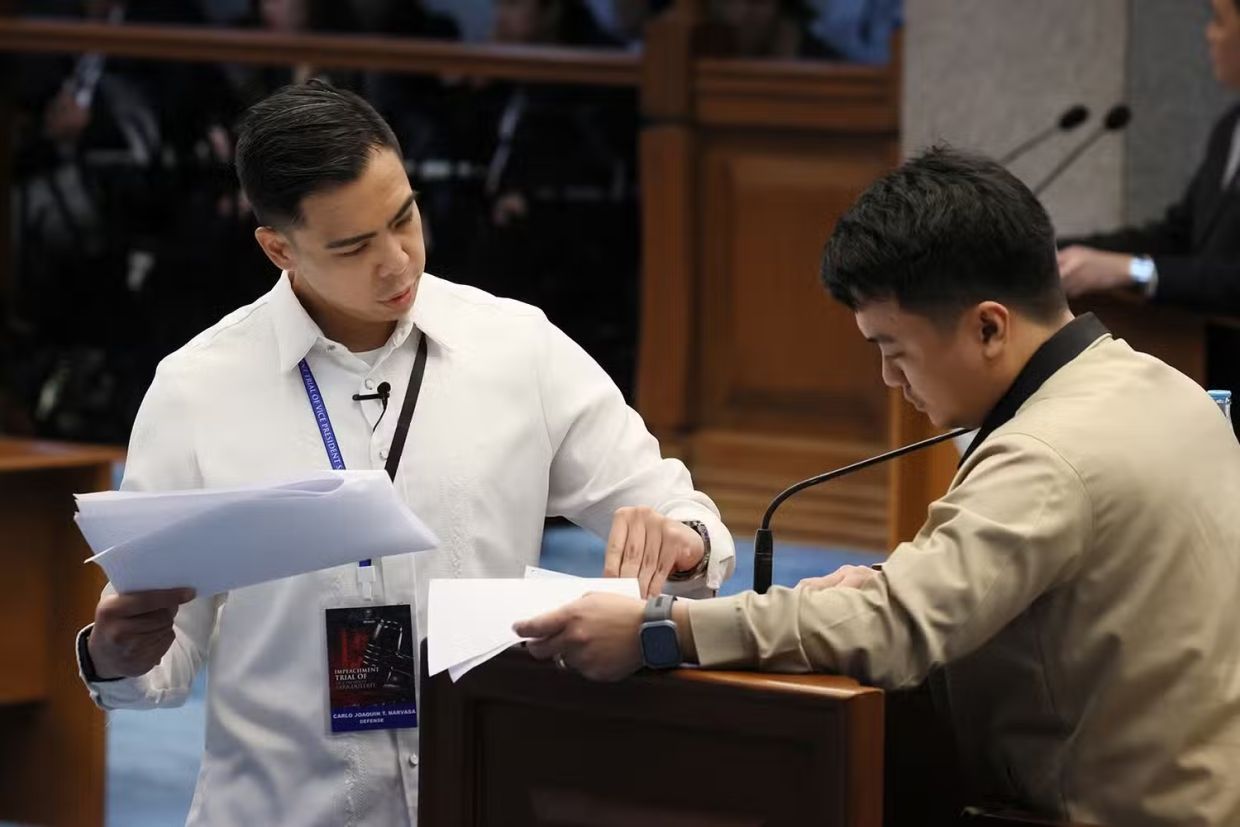
The defence strategy for Philippine Vice President Sara Duterte took shape during the third day of Senate impeachment proceedings on Wednesday, with her legal team launching a frontal assault on the prosecution's characterization of her November 2024 remarks as grounds for removal. Rather than disputing what she said, Duterte's lawyers contended that her statements, regardless of their tone or content, did not meet the constitutional threshold required to remove a sitting vice president. The argument represents a significant tactical shift, moving the battleground from factual dispute to legal interpretation of the 1987 Philippine Constitution's impeachment provisions.
The core of the defence rested on Article XI, Section 2 of the Constitution, which lists specific grounds for impeachment including culpable violation of the Constitution, treason, bribery, graft and corruption, and betrayal of public trust, alongside the catchall category of "other high crimes." Defence counsel Mark Vinluan persistently hammered this point, arguing that the House prosecutors had failed to demonstrate that Duterte's remarks satisfied any of these categories. By distinguishing between what constitutes a grave statement and what constitutes an impeachable offence, the defence attempted to erect a barrier between popular outrage and constitutional mechanism, suggesting that not every controversial utterance by a public official warrants the extraordinary remedy of impeachment.
Cross-examination of National Bureau of Investigation senior agent John Mark Calilung revealed significant evidentiary gaps that the defence swiftly exploited. Calilung acknowledged that none of the three stated targets of Duterte's threats—President Ferdinand Marcos, his wife Liza Araneta-Marcos, and former Speaker Martin Romualdez—had personally filed criminal complaints with the NBI or appeared before the agency. The NBI had instead proceeded motu proprio, or on its own initiative, without a formal complainant. This procedural peculiarity troubled the defence, which noted that the investigation lacked sworn statements from the alleged victims or even from journalists present at Duterte's November 23 press briefing. Narvasa's pointed question to Calilung—"Did you really investigate this case?"—appeared designed to plant doubt about the thoroughness of law enforcement's approach.
The defence's most potent argument centred on context and personal motivation. Vinluan reframed Duterte's controversial statements as the desperate response of a woman protecting her family rather than the calculated threat of a sitting official. He cited what he characterized as "unauthorised intelligence and surveillance operations" allegedly conducted against her by government agents, claiming that her residences in both Davao and Manila had been profiled and that trusted security personnel had been removed. This narrative, if accepted, transforms Duterte from alleged aggressor into alleged victim, suggesting that any harsh words she uttered were reactive rather than deliberate ministerial acts. The defence linked her statements directly to the detention of her chief of staff Zuleika Lopez, who had been cited in contempt that same day by a House committee investigating confidential funds, presenting video evidence of Lopez's emotional distress during her transfer.
The timing of events on November 23 proved crucial to the defence strategy. By showing courtroom footage of Lopez breaking down as she objected to her planned transfer to the Correctional Institution for Women in Mandaluyong City, the defence attempted to establish that Duterte's subsequent remarks were provoked by what she perceived as persecution of her staff and herself. Lawyer Carlo Narvasa went further, alleging "systematic oppression" by the House committee led by Representative Joel Chua, who now serves as one of the House prosecutors. This line of argument cuts two ways: it humanizes Duterte while simultaneously implicating the prosecution itself in the very abuse of power they accuse her of perpetrating. The implication was that proper judicial process had already been compromised by political antagonism predating the formal trial.
Prosecution counsel Amando Ligutan faced a difficult moment when Senator Risa Hontiveros directly asked whether Duterte's recorded statements proved she had actually contracted an assassin. Ligutan's acknowledgment that the recordings did not conclusively establish such a contract, while arguing they demonstrated intent through a pattern of statements, gave the defence precisely the opening it needed. Vinluan seized on this concession repeatedly, emphasizing that the prosecution itself could not prove the most serious implicit accusation underlying the entire case. The defence noted that the word "assassin" itself had been supplied by others interpreting Duterte's remarks out of what they considered their proper context, raising the possibility that prosecutors were reading accusations into ambiguity rather than responding to unambiguous statements.
The constitutional definition of impeachable offences presented an inherent obstacle for House prosecutors that the defence exploited methodically. "Other high crimes" is deliberately vague, inviting dispute over its meaning and scope. The defence argued that mere inflammatory speech, however inappropriate for a sitting official, does not automatically qualify. Vinluan conceded that Duterte's response was "unconventional," but insisted it was "justified" given the circumstances her legal team described. This framing attempts to move the discussion away from whether Duterte said something terrible toward whether saying something terrible, even if true, constitutes grounds for removing her from the second-highest office in the land.
Senator Francis Escudero's intervention to clarify the central issue—whether Duterte's acts amounted to impeachable offences—acknowledged a fundamental problem facing the Senate impeachment court. The trial cannot simply investigate whether Duterte made threats; it must determine whether those threats, assuming they occurred, meet specific constitutional criteria. This is not a criminal trial where the burden of proving guilt beyond reasonable doubt applies, but neither is it a pure political judgment unmoored from law. The presiding officer's guidance that senator-judges should avoid questions requiring legal conclusions, reserving such matters for closing arguments, also constrained the prosecution's ability to draw connections between evidence and impeachability in real time.
The absence of participation by the alleged victims raises additional procedural complications that extend beyond the immediate trial. Neither Marcos, Araneta-Marcos, nor Romualdez filed complaints or submitted themselves for examination, choices that may reflect political calculation, genuine lack of concern, or confidence in House prosecutors' ability to proceed without them. This absence also deprives the Senate impeachment court of direct testimony about how the alleged victims experienced the threat or what impact it had on their safety or sense of security. The defence has weaponized this silence, suggesting it contradicts claims that the threat was serious enough to warrant constitutional remedy.
The broader political implications for Southeast Asia's second-largest democracy extend well beyond Duterte's immediate political future. The impeachment mechanism, relatively unused in Philippine history compared to other democracies, faces its most serious test since former President Joseph Estrada's removal in 2001. The defence's constitutional minimalism—its insistence that impeachment requires more than wrongdoing—could establish precedent limiting the mechanism's future application. Conversely, if the Senate votes to convict based on the prosecution's intent-and-pattern theory, it would expand the scope of impeachable conduct considerably. Either outcome reshapes how future Philippine officials, and indeed regional leaders watching closely, understand the boundaries of acceptable speech and conduct while in office.
The trial's trajectory now depends largely on closing arguments and senator-judges' assessment of whether Duterte's constitutional role as vice president demands a higher standard of conduct than applies to ordinary citizens, and whether her statements crossed a line from political discourse into criminal threat. The defence has methodically established reasonable doubt about prosecutorial competence, evidentiary sufficiency, and the applicability of constitutional grounds. Whether these doubts prove sufficient to prevent conviction, or whether the Senate prioritizes political accountability over strict constitutional interpretation, remains the trial's unresolved central question.

