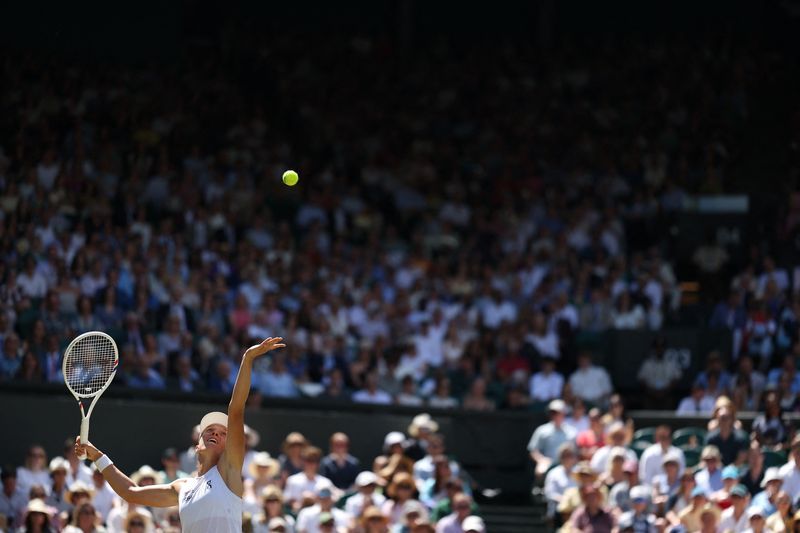
Alexandra Eala's remarkable ascent in professional tennis reached a new peak on Saturday when the rising Filipino star dismantled defending Wimbledon champion Iga Swiatek in a thrilling third-round encounter at the All England Club. The Polish third seed succumbed 7-6(9) 6-2 in a contest that showcased Eala's growing prowess on grass and exposed mounting doubts about Swiatek's consistency on the sport's fastest surface.
Swiatek's title defence began under a cloud of uncertainty. Though last year's triumph appeared to have settled longstanding questions about her grass-court credentials, her preparation for this year's tournament proved troubling. An early exit at the Bad Homburg warm-up event suggested the 25-year-old remained vulnerable, and questions persisted about whether she could replicate her previous success. Her path through the opening rounds offered modest encouragement—successive victories over Taylor Townsend and Karolina Pliskova indicated improving form. Yet her meeting with the inspired Eala exposed fragilities in her game when matched against an opponent executing a comprehensive tactical approach.
The opening set epitomised the contest's intensity and Eala's tactical superiority. Both competitors engaged in a bruising baseline exchange under blazing afternoon conditions, with neither conceding easy points. The tiebreaker proved particularly competitive, with Swiatek managing to reach 9-9 before succumbing at 9-7. The psychological shift proved significant. Swiatek's demeanour visibly deteriorated after the setback—she directed frustrated comments toward her coaching team in the stands and famously struck her chair with her racket in a moment of frustration, while Eala's composed demeanor and the crowd's overwhelming support created an increasingly one-sided dynamic.
The second set witnessed Eala's superiority become unambiguous. The left-handed Filipino leveraged her powerful baseline shot-making to establish immediate control, breaking Swiatek's serve twice in succession to construct a commanding 3-0 lead. Her aggressive groundstrokes—particularly a forcing forehand—consistently troubled Swiatek's defensive capabilities. The Pole managed one break-back in the middle of the set, suggesting a potential comeback, but Eala's poise under pressure never wavered. Swiatek's attempt at a late rally proved insufficient as Eala secured a decisive break and sealed victory with a precisely struck forehand winner that symbolised her dominance throughout the encounter.
This victory carries additional significance beyond the immediate tournament context. The two competitors had previously met in Miami, where Eala recorded a memorable victory that subsequently prompted Swiatek to gain revenge on the clay courts of Madrid. That earlier triumph established Eala's credentials as a competitor capable of competing at the highest level despite her relative youth and experience. The Wimbledon victory, however, represents a more comprehensive statement. Grass-court tennis demands rapid court coverage, quick adjustment to low bounces, and an ability to dictate rallies from the baseline—precisely the qualities Eala demonstrated throughout Saturday's encounter.
For the broader Southeast Asian tennis community, Eala's breakthrough carries profound implications. Filipino tennis has historically occupied a peripheral position in professional women's tennis, and Eala's emergence as a genuine Grand Slam contender represents a watershed moment for the nation's sporting aspirations. Her performances at Wimbledon underscore the region's growing capacity to produce world-class competitors capable of competing against established European rivals. Malaysian tennis observers will particularly recognise the significance of one nation producing a legitimate Grand Slam threat, setting benchmarks that regional competitors can aspire toward.
Eala's fourth-round opponent—Jasmine Paolini of Italy, who reached the Wimbledon final as the 2024 runner-up—represents a formidable challenge. Paolini's clay-court success and recent grass-court improvements make her dangerous opposition. Yet Eala's composed execution and tactical maturity demonstrated against Swiatek suggests she possesses the temperament and technical capacity to trouble any opponent. The Italian's experience at the highest level remains an advantage, but the momentum and confidence flowing from defeating the previous year's champion provides the Filipino considerable psychological ammunition.
Swiatek's departure represents a significant turning point in this year's championship narrative. The defending champion's early exit opens the women's draw for other contenders and raises questions about her ability to maintain consistency across different surfaces. Her continued struggles on faster courts despite last year's triumph suggest that grass-court excellence may represent an outlier in her career trajectory rather than evidence of fundamental adaptation. The Pole's reliance on heavy topspin and baseline dictation—techniques less effective on low-bouncing grass—explains her vulnerability against players like Eala who can generate pace and control through groundstroke power rather than spin emphasis.
Eala's progression through the draw also reflects evolving dynamics in women's professional tennis. The traditional dominance of clay-court specialists has waned, and competitors demonstrating versatility across surfaces increasingly emerge as genuine contenders for major titles. Eala's baseline power, court coverage, and willingness to attack align with contemporary technical demands. Her victory over Swiatek validates tactical approaches centred on aggressive baseline play and serve-and-volley options rather than grinding rallies from the baseline.
The crowd's reaction at Centre Court on Saturday illustrated shifting audience preferences as well. The overwhelming support for Eala, particularly evident after the opening-set conclusion, demonstrated recognition of compelling tennis played by an emerging talent against an established champion. In a sport occasionally criticised for predictability, such upsets provide narrative interest and remind audiences why professional tennis remains compelling theatre. Eala's journey from emerging talent to Grand Slam threat has accelerated considerably, and her Wimbledon campaign promises further complications for established competitors accustomed to predictable draws.

