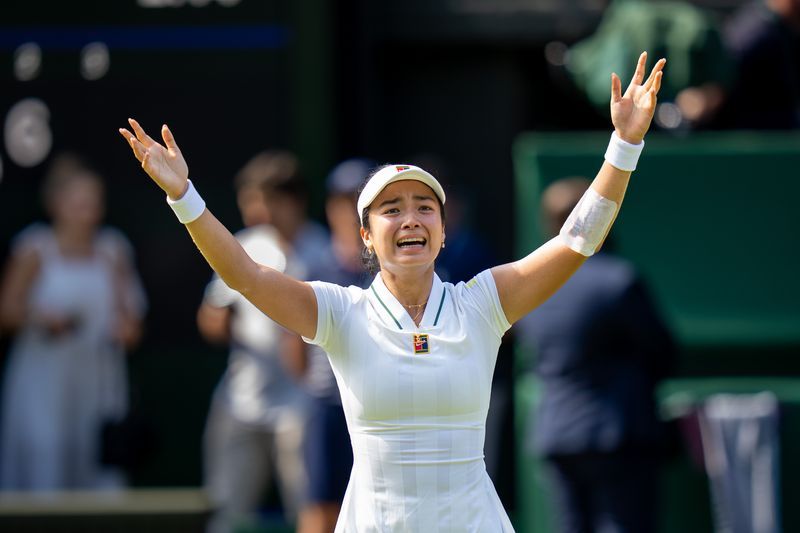
Alexandra Eala delivered a career-defining performance on Saturday at the All England Club, dismantling defending champion Iga Swiatek in a gripping fourth-round encounter that sent shockwaves through the women's draw. The 29th-seeded Filipino triumphed 7-6(9) 6-2 in a match that showcased her exceptional composure under pressure, establishing herself as a genuine contender in what has become an increasingly unpredictable tournament. Eala's breakthrough represents a watershed moment for Philippine tennis, marking the first occasion a player from the island nation has advanced to a Grand Slam quarterfinal.
The opening set epitomized the quality of play on display, with both competitors locked in an absorbing struggle that stretched beyond the hour-and-a-half mark. Swiatek, visibly frustrated by Eala's fearless brand of tennis, found herself unable to impose the controlling game that has defined her dominance across clay courts. The tiebreaker proved decisive, with Eala saving a set point when her opponent's forehand drifted into the net—a moment that prompted an exasperated laugh and animated gesticulation toward her coaching box from the Polish star. Rather than wilting, Eala maintained her intensity through the second set, where she accelerated her game and raced to victory with impressive authority.
Swiatek's exit represents a troubling turn in her season, coming just weeks after her bid for French Open supremacy ended in disappointment. Speaking to reporters afterward, the world-ranked player revealed the psychological toll of chasing results, acknowledging that her fixation on outcomes has compromised her ability to perform at the required level. Her struggle at the grasscourt fortress underscores the mounting pressure she faces to deliver on the considerable expectations that surround her game. The loss also creates a significant opening in the women's draw, with several unseeded and lower-ranked players now positioned to capture the championship.
The damage to the tournament's upper seeding extended beyond Swiatek's upset. Elena Rybakina, seeded second and bidding to reclaim the title she won in 2022, encountered a determined Belgian challenge from Elise Mertens that proved insurmountable. After a competitive opening set resolved in Mertens' favor via tiebreaker, Rybakina's game deteriorated markedly, surrendering the second set by an embarrassing 6-1 margin. The result represented a sobering reminder that Rybakina, who claimed the Australian Open title earlier this year to reach two Grand Slam crowns, remains vulnerable on grass despite her elevated ranking. A quarterfinal run would have positioned her to assume the world number one ranking, making this defeat particularly consequential for her career trajectory.
Eala's emotional address to the Centre Court crowd following her victory provided insight into her journey to this watershed moment. Speaking from the heart about her childhood in the Philippines, she recalled training alongside her brother and grandfather daily after school, equipment as humble as ruffled socks and light-up shoes. That narrative resonates powerfully across Southeast Asia, where young athletes from smaller sporting nations rarely achieve such prominence on the global stage. The inscription on her cap—rendered in Tagalog with the meaning "once it grows, it cannot be stopped"—encapsulates both her philosophy and her ambition to continue breaking new ground for her country.
The American contingent experienced decidedly mixed fortunes on July 4, the nation's independence day anniversary. Serena Williams, whose return to competitive tennis after four years generated immense anticipation, was compelled to withdraw from her scheduled doubles pairing with sister Venus due to injury, disappointing a crowd eager to witness the legendary siblings competing together. Williams had already exited the singles draw following a loss to Maya Joint, truncating what many had hoped would be an extended farewell campaign. However, other American competitors delivered on the occasion, with 26th seed Madison Keys producing a commanding display against sixth seed Amanda Anisimova, prevailing 3-6 6-2 6-3 in an all-American quarterfinal duel.
Keys arrived at Wimbledon riding momentum from her title triumph in Eastbourne the previous week, and that confidence translated into aggressive grass-court tennis that overwhelmed Anisimova across the latter two sets. The American's resurgence follows a period of inconsistency, and her performance suggests she has rediscovered the form that positions her among the world's most dangerous competitors. Qualifier Ashlyn Krueger added to American success by dismantling Ukraine's Daria Snigur 6-3 6-2, though 23rd seed Emma Navarro fell to compatriot Marta Kostyuk in a three-set encounter. The mixed results reflected the volatile nature of grass-court competition, where subtle variations in court conditions and player form exert outsized influence on outcomes.
The men's draw remained largely stable, suggesting that the established hierarchy retained its resilience against the upheaval affecting the women's competition. Alexander Zverev, the newly crowned French Open champion and second seed, advanced with clinical efficiency, dispatching American Marcos Giron 6-2 7-6(4) 6-4 and maintaining his impressive progression through the tournament. Jannik Sinner, the defending champion, has already secured his berth in the last 16, positioning Italy to potentially achieve a historic milestone. Should the Italian contingent continue advancing at current rates, the nation would accomplish the remarkable feat of having four men represented in the Grand Slam round of 16 for the first time since the 1947 French Open—a span exceeding 75 years.
Flavio Cobolli, the ninth seed and French Open runner-up, endured a rollercoaster contest against Russia's Karen Khachanov before ultimately prevailing in five sets. After surrendering the opening set with a dispiriting 6-0 scoreline, Cobolli demonstrated considerable mental fortitude by rallying through a protracted affair that extended to 0-6 7-6(4) 6-7(5) 6-2 6-2. His resurrection from such an inauspicious beginning speaks to the psychological resilience required to contend at the highest echelon of professional tennis. Lorenzo Sonego proved unable to join the Italian surge, however, succumbing to sixth seed Taylor Fritz despite fashioning a strong opening, losing 4-6 6-3 6-4 7-6(5) in a closely contested battle that could easily have tilted in either competitor's direction.
Alex de Minaur advanced past American Zachary Svajda with a comfortable 6-2 5-7 6-2 6-4 victory, positioning himself to face Cobolli in a potentially compelling round-of-16 encounter. The Australian's progression represents his continued evolution as a grass-court competitor, an area where his game has become increasingly formidable. Former Wimbledon finalist Matteo Berrettini remained in contention, with his late Centre Court match against Bulgaria's Grigor Dimitrov pending completion as the day's matches concluded.
In an extraordinary display of resilience and determination that captured crowd affection on Court 18, British player Arthur Fery mounted an improbable comeback against Belgium's Zizou Bergs despite enduring three separate nosebleeds throughout the encounter. Trailing by two sets to one and facing a double break at 1-4 in the deciding set, Fery refused to surrender and ultimately claimed the longest match of the entire tournament through a deciding-set tiebreaker. His comeback exemplified the unpredictable drama that distinguishes Wimbledon, where emotional investment from home supporters and extraordinary individual performances create indelible memories transcending the sport's technical dimensions.
Eala's passage to the quarterfinals awaits a confrontation with 13th seed Jasmine Paolini, who advanced by methodically dismantling Greece's Maria Sakkari 6-1 6-2. Paolini, the 2024 French Open runner-up, has demonstrated impressive consistency across this tournament, though Eala's recent form and emotional momentum represent a genuine threat. The Philippine champion's journey embodies the transformative potential of singular sporting achievements to inspire entire nations and reshape perceptions of what athletes from smaller tennis markets can accomplish on the grandest stages. For Malaysian and Southeast Asian audiences, Eala's success provides both inspiration and a tangible reminder that geographic location and traditional sporting hierarchy need not determine an athlete's potential to achieve greatness.

