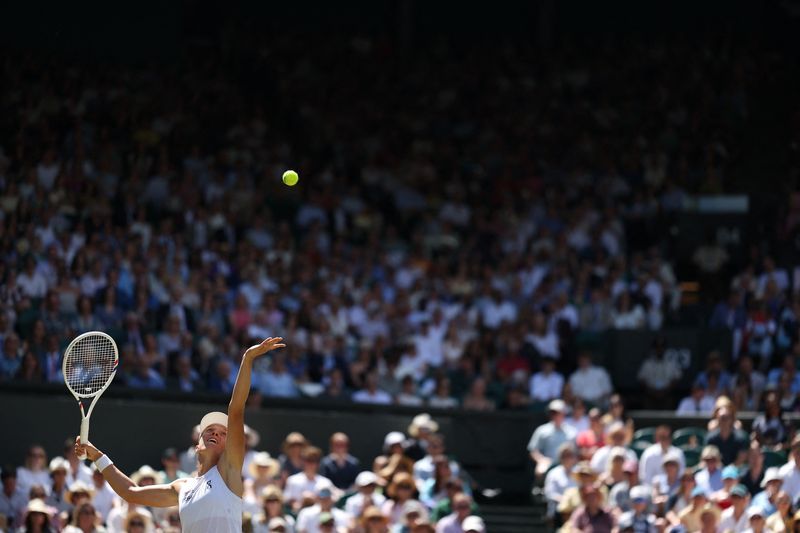
Philippine tennis sensation Alexandra Eala delivered one of the season's most impressive upsets when she dismantled defending Wimbledon champion Iga Swiatek in a riveting Centre Court encounter on Saturday, securing a 7-6(9) 6-2 victory that propelled her into the second week of the Grand Slam and marked a watershed moment for tennis in Southeast Asia.
Swiatek's title defence collapsed spectacularly against the rising Filipina, whose powerful baseline game and unwavering composure overwhelmed the Polish third seed under the summer heat at the All England Club. The loss was particularly stinging for the 25-year-old Swiatek, who had silenced persistent doubts about her ability to perform on the sport's fastest surface when she claimed her maiden grass-court title at Wimbledon the previous year. Yet the defending champion arrived in London diminished by an early exit at the Bad Homburg warm-up tournament, and despite steady victories over Taylor Townsend and Karolina Pliskova in prior rounds, she encountered an opponent performing at the peak of her powers.
For Eala, the magnitude of this triumph extended far beyond the scoreline. In an emotionally charged on-court interview, the young Filipino player reflected on her improbable journey from childhood training sessions in the Philippines, where she honed her craft alongside her brother and grandfather despite modest resources, to competing against some of tennis's elite players on the sport's most hallowed ground. Her recollection of playing in worn socks and light-up shoes, her face rounded with youth, served as a poignant reminder of the sacrifices and determination required to reach the upper echelons of professional tennis. For Eala, reaching the second week of a Grand Slam represented not merely a statistical achievement but the realisation of long-held dreams that seemed impossibly distant during her formative years in Manila.
The first set proved decisive in establishing the trajectory of their encounter. Eala's left-handed strike, particularly her formidable baseline shot-making, caught Swiatek off-guard early in the proceedings, with neither player conceding easy points as they engaged in a series of blistering rallies. The set culminated in a tiebreak where Eala's nerve held firm, ultimately triumphing 9-7 in a dramatic sequence that saw both competitors test their mental fortitude under considerable pressure. Visibly frustrated as the set concluded, Swiatek demonstrated her emotional investment by remonstrating with her coaching team and briefly striking her racket against a chair—a stark contrast to Eala's composed demeanour as she absorbed the thunderous approval of a crowd that had recognised something special unfolding before them.
Eala's performance intensified in the second set, where she seized the initiative by breaking Swiatek's serve twice in rapid succession to establish a commanding 3-0 advantage. While the defending champion briefly rallied and retrieved one break, Eala's superior positioning and execution ultimately prevailed. She delivered the match's decisive blow through a precise forehand winner that secured her passage into the fourth round and a meeting with Italy's Jasmine Paolini, the runner-up from the 2024 edition of the championship.
This victory assumes particular significance within the broader context of Philippine sport and Southeast Asian tennis development. While the nation has produced accomplished athletes across various disciplines, Eala's success at the highest level of professional tennis represents a breakthrough moment for a region that has historically occupied a peripheral position in the global tennis landscape. Her advancement to the second week of Wimbledon, one of tennis's most prestigious tournaments, demonstrates that Philippine players possess the technical proficiency, competitive drive, and mental resilience to compete against and defeat world-class opponents.
Eala's upset over Swiatek also carries interesting undertones regarding the tournament's surface and its impact on players with different stylistic approaches. Swiatek's previous year's title suggested she had conquered her long-standing challenges on grass, yet this encounter revealed that mastery of any surface remains contingent on consistent form and the calibre of opposition faced. Eala's aggressive baseline strategy, underpinned by her natural left-handed advantage, proved particularly effective against Swiatek's more rhythmic clay-court game, illustrating how grass courts can produce unpredictable outcomes and provide opportunities for players willing to take risks.
In her post-match remarks, Eala consciously balanced emotional gratification with pragmatic focus on the challenges ahead. She explicitly rejected notions of satisfaction despite her accomplishment, immediately pivoting toward preparation for her next opponent. This measured perspective suggests a player who understands that breakthrough moments must be converted into sustained advancement. While acknowledging the historical significance of competing on a dream court and defeating a top-seeded opponent before a supportive crowd, Eala demonstrated the competitive hunger essential for players targeting multiple Grand Slam victories rather than celebrating isolated achievements.
The broader implications of Eala's run extend to tournament dynamics and seeding expectations. While Swiatek's loss eliminates one of the tournament's favoured contenders, it simultaneously signals to other competitors that even seemingly secure positions can be overturned through inspired play and mental conviction. For Eala specifically, the victory provides substantial momentum and confidence heading into the fourth round against Paolini, an opponent who has demonstrated her own quality by reaching last year's final. Should Eala advance further, she would cement her status as a genuine threat at major championships and potentially inspire a new generation of Asian tennis players to pursue elite-level professional careers.
The atmosphere at Centre Court during their encounter reflected the captivating nature of their clash, with spectators recognising they were witnessing a pivotal match in real time. Eala's acknowledgment of the crowd's support underscored the reciprocal relationship between players and audience at such prestigious venues, where sporting excellence and narrative drama converge to create memorable moments. Her commitment to maximising opportunities when they arrive, expressed with characteristic humility and determination, suggests that this victory over Swiatek may represent merely the opening chapter of a more substantial Wimbledon campaign.

