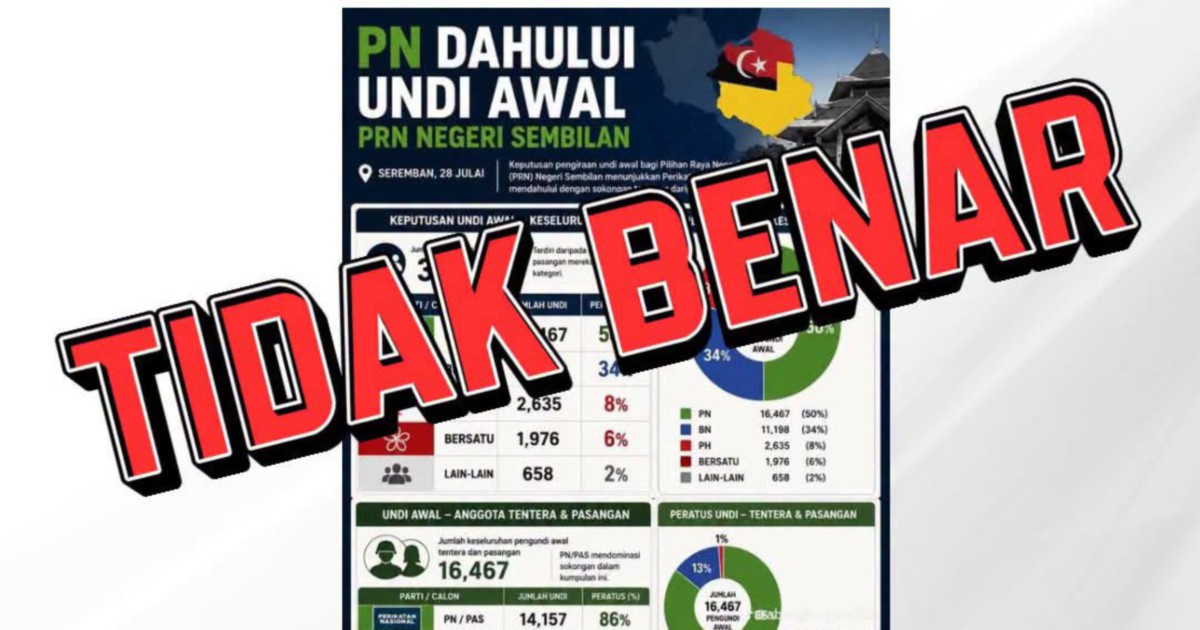
The Election Commission announced Friday that early votes for the 16th Negeri Sembilan state election will be tallied beginning at 5pm on Saturday, establishing a clear timeline for when preliminary results may emerge. This public statement came as part of efforts to manage expectations and counter misleading information spreading across social media platforms regarding the electoral process.
Official confirmation of the counting schedule addresses practical concerns for election observers, media representatives, and political party monitors who need to plan their presence at tabulation centres across the state. The specific time designation allows stakeholders to coordinate their activities and ensure proper oversight of the vote-counting process, which remains a cornerstone of democratic transparency in Malaysian elections.
Concurrently, the EC moved to debunk viral claims circulating online suggesting that Perikatan Nasional had already achieved a substantial lead in early voting. Such unverified assertions have gained traction on social media platforms, where election-related speculation frequently spreads rapidly without verification. The commission's intervention underscores growing challenges surrounding electoral misinformation in Southeast Asia's digitally connected societies.
The spread of premature or fabricated election claims can undermine public confidence in the legitimacy of polling processes and create unnecessary anxiety among voters. By publicly denying these assertions, the EC sought to establish authoritative clarity and discourage further circulation of false narratives. This proactive communication strategy reflects lessons learned from previous electoral cycles where viral misinformation proved difficult to contain once established within information ecosystems.
Negeri Sembilan's state election represents a significant political moment for the sultanate, testing voter preferences following broader shifts in Malaysia's political landscape. The state has traditionally been politically significant, and its outcome often carries implications for understanding regional political dynamics within the larger Peninsular context. Early voting patterns, which this Saturday's count will reveal, frequently offer preliminary indicators of broader electoral trends, though such reading requires caution given the limited sample size of early voters.
Early voting mechanisms, which allow designated groups including security personnel, healthcare workers, and those unable to vote on polling day to cast ballots before the main election date, have become increasingly important in Malaysian electoral administration. These cohorts represent diverse demographic and professional backgrounds, and their voting preferences sometimes diverge from general population patterns. The EC's commitment to transparent counting of this subset provides valuable data for political analysts attempting to forecast final outcomes.
The timing of Saturday's count means preliminary insights into early voting trends will enter public discourse with nearly 24 hours remaining before main polling day voting. This gap creates opportunity for media analysis and political commentary to shape narratives heading into the final campaign hours. Both established and emerging political forces typically scrutinise early voting patterns intensely, as these figures can energise supporters or prompt tactical adjustments during final campaign pushes.
Malaysia's electoral framework has evolved significantly over recent years, incorporating new technologies and procedural refinements aimed at improving transparency and reducing opportunities for irregularities. The EC's clarity regarding counting procedures reflects institutional efforts to maintain public trust in election administration, particularly important given increasing scrutiny from domestic observers and international election monitoring organisations. Clear communication around timelines and procedures serves as an antidote to speculation and rumour in volatile pre-election environments.
The false claims regarding Perikatan Nasional's lead demonstrate broader concerns about electoral misinformation across Southeast Asia, where digital platforms facilitate rapid dissemination of unverified information during politically sensitive periods. Malaysia has experienced previous instances of election-related viral claims that subsequently required official correction. The EC's swift response to this instance reflects institutional learning and commitment to combating manufactured narratives that could distort public understanding of genuine electoral outcomes.
For Malaysian voters and political observers monitoring Negeri Sembilan's contest, Saturday's 5pm count promises the first substantive window into actual voter preferences, replacing speculation with concrete data. The provisional results emerging from early vote tallying will likely dominate political discourse throughout the weekend, as competing narratives about momentum, support bases, and probable final outcomes crystallise around this initial evidence. Analysts will scrutinise not merely the numerical tallies but demographic patterns within early voting to construct explanatory frameworks for the results.

