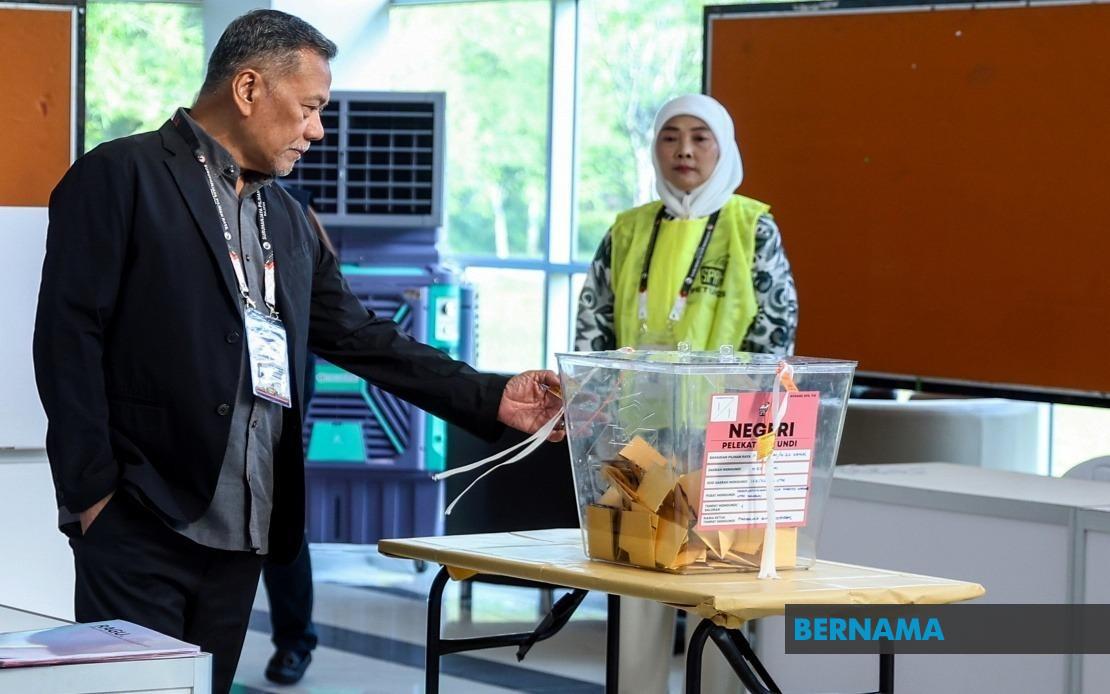
Election Commission chairman Datuk Seri Ramlan Harun conducted an oversight inspection across four polling centres in Johor Bahru on July 11, underscoring the electoral body's commitment to maintaining procedural standards during the state election. His visit encompassed multiple constituencies spread throughout the city, with each stop designed to verify that voting operations were proceeding without irregularities and that all stakeholders—voters and election staff alike—were operating within established protocols.
Ramlan began his morning inspection round shortly before 9 am at the Dewan Raya Taman Ungku Tun Aminah, the designated polling venue for the Skudai constituency. The location operated seven distinct polling streams, requiring careful coordination to manage voter flow and prevent bottlenecks. His presence at the first centre set the tone for a methodical evaluation process, signalling the EC's active role in real-time electoral oversight rather than relying solely on post-election audits.
The chairman subsequently visited the Raja Zarith Sofiah Library situated within Universiti Teknologi Malaysia's campus, which served the Senai constituency. This particular polling station presented a notably different configuration, with only two operational streams, reflecting the typically more concentrated voter population at academic institutions compared to broader residential areas. The contrast between this venue and the Skudai centre illustrated how electoral logistics must adapt to local demographics and infrastructure constraints.
Continuing his tour, Ramlan inspected Sekolah Agama Taman Bukit Mewah in the Kempas constituency, which operated six polling streams. Schools have become standard polling venues throughout Malaysia, offering established facilities and neutral ground accessible to diverse voter populations. The selection of religious schools alongside secular institutions and university facilities demonstrated the inclusive approach to venue selection, ensuring no particular demographic felt discouraged from participating.
The final stop on Ramlan's itinerary was Sekolah Menengah Kebangsaan Bandar Uda Utama in the Perling constituency, the most substantial polling centre of the four, operating nine polling streams. The scaling of stream numbers across these venues—ranging from two to nine—reflected differential voter registration patterns and anticipated turnout levels across constituencies. Managing such variation requires careful resource allocation and personnel deployment to maintain consistency in service quality.
During each inspection, the EC chairman received comprehensive briefings from election officials stationed at the polling centres. These sessions covered operational procedures, voter management, and adherence to electoral protocols. Officials would have detailed the security measures protecting ballot integrity, the authentication procedures for voter verification, and the mechanisms preventing duplicate voting or unauthorized ballot access. Such face-to-face engagement between the EC leadership and ground-level staff helps identify implementation gaps and reinforces institutional expectations regarding conduct standards.
Beyond procedural oversight, Ramlan's visits included assessment of the physical infrastructure and amenities provided to both voters and election personnel. Adequate facilities—including clear signage, accessible voting booths for persons with disabilities, rest areas for poll workers, and proper sanitation—contribute substantially to the voting experience and operational efficiency. Infrastructure deficiencies can dampen voter confidence and create unnecessary delays, particularly problematic in extended voting periods or high-turnout scenarios.
The 16th Johor state election represented a significant political event within Malaysia's federal structure, with state-level contests often serving as barometers for national sentiment and testing grounds for electoral administration practices. The EC's visible presence through leadership inspections communicates institutional seriousness about maintaining electoral credibility, an increasingly important consideration in contemporary Malaysian politics where election management has become subject to heightened public scrutiny and competitive scrutiny among political parties.
This inspection regime reflects broader international best practice in electoral administration, where observation and verification occur continuously throughout voting periods rather than retrospectively. Such real-time monitoring enables rapid response to emerging problems, maintains election staff accountability, and generates contemporaneous documentation of conditions at polling centres. For Malaysian voters and international observers, the active involvement of senior EC leadership provides reassurance that the electoral process receives appropriate supervisory attention.
Ramlan's scheduled press conference following the inspection tour would have provided opportunity to communicate key findings to media and public audiences, setting the narrative around election conduct and operational performance. Public statements from electoral leadership during voting periods serve multiple functions: they update citizens on procedural matters, reinforce adherence to regulations, and address any concerns that have surfaced from election observers or party representatives positioned at polling sites.
For Southeast Asian electoral observers, Malaysia's EC inspection practices contribute to regional understandings of how democracies operationalize electoral oversight. The region encompasses wide variation in election administration maturity and institutional independence, making transparent documentation of procedures and leadership engagement valuable for comparative analysis. The Johor election inspection tour exemplified Malaysia's approach to balancing electoral accessibility with integrity protection, a tension all democracies navigate.

