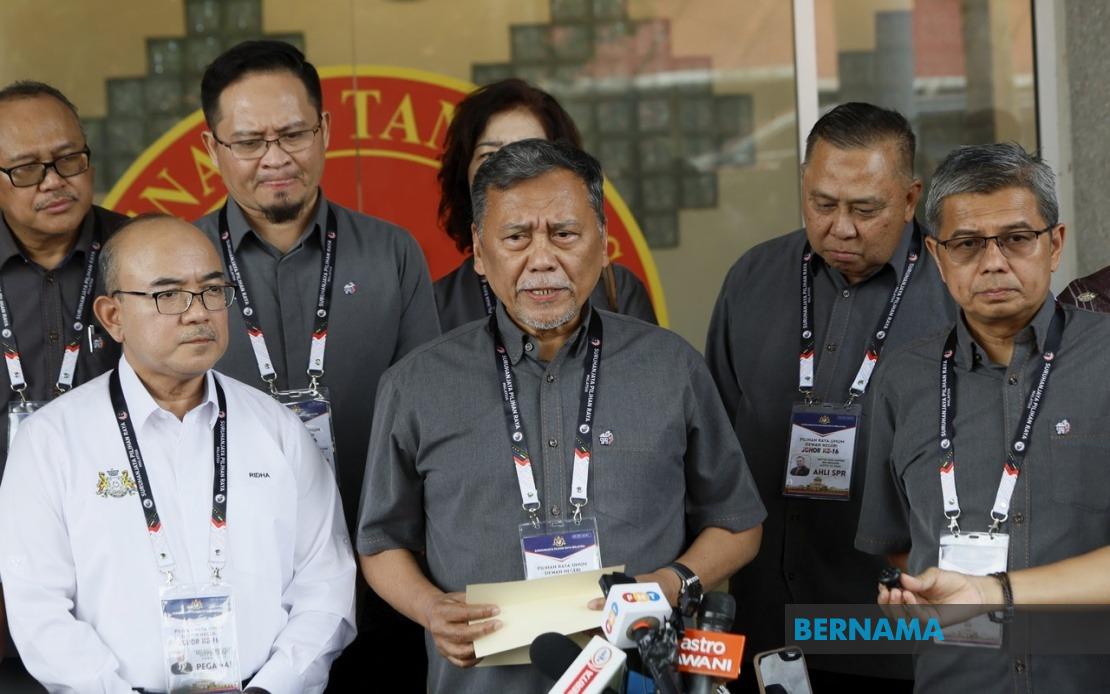
The Election Commission of Malaysia is banking on a 96 per cent turnout for early voting in the Johor state election, reflecting confidence built on track records from past electoral exercises. Commission Chairman Datuk Seri Ramlan Harun disclosed the ambitious projection during a visit to observe early voting procedures at Kem Mahkota in Kluang on July 7, emphasising that this benchmark reflects realistic expectations informed by institutional experience across multiple election cycles.
The early voting infrastructure deployed across Johor reflects careful logistical planning to accommodate distinct cohorts of voters unable to participate in regular polling. A total of 62 voting centres were activated at 8 am, each operating under staggered closing schedules designed to manage voter flow efficiently. The phased closure arrangement saw 29 centres shutting down at midday, five additional venues at 2 pm, and the remaining 28 continuing operations until 5 pm, allowing flexibility for personnel with varying shift schedules to cast their ballots.
The electorate targeted through early voting comprises security personnel and their family members—constituencies whose operational commitments on election day necessitate advance provisions. Specifically, 8,544 voters representing Malaysian Armed Forces members and their spouses participated in the early voting process, alongside 12,063 police personnel and accompanying family members, totalling 20,607 registered early voters. This dual-cohort arrangement underscores the institutional arrangements governing electoral participation among uniformed services, ensuring their democratic engagement despite professional obligations.
Election management protocols governing early ballots emphasise security and procedural integrity throughout the custody and counting phases. Completed ballot boxes from early voting centres are transferred to police station facilities, establishing a secure chain of custody that persists until formal vote tabulation commences. This staged approach separates the early voting collection phase from the verification and counting procedures, maintaining transparency while safeguarding ballot integrity across multiple locations and extended timeframes.
The formal counting operation is scheduled to commence at 5 pm on Saturday, following the close of ordinary polling throughout the state. Commission officials project that comprehensive results determination could occur well before midnight, with possibilities of preliminary findings emerging as early as 10 pm. This accelerated timeline reflects technological improvements in vote-tallying procedures and operational coordination, though Ramlan cautioned that final authoritative results remain contingent on completing all verification protocols.
The broader electoral context encompasses approximately 2.7 million eligible voters across Johor—a substantial electorate whose participation will determine the election's outcome and legitimacy. Ramlan directed an explicit appeal to this ordinary voter population, framing electoral participation as a fundamental civic responsibility and a direct mechanism through which citizens contribute to national governance through democratic processes. This messaging situates the election within Malaysia's established constitutional framework, emphasising continuity of democratic institutions and citizen agency within the system.
For Malaysian observers and regional analysts monitoring Johor's electoral trajectory, the early voting projections offer preliminary indicators regarding voter enthusiasm and participation patterns. High turnout among security personnel, who represent a politically significant and administratively organised cohort, often correlates with broader engagement levels among the general population. However, the early voting figures provide limited predictive value regarding political preferences or competitive dynamics between contesting parties, serving primarily as a gauge of procedural efficiency and institutional capacity.
The 16th Johor State Election represents a significant democratic exercise within Malaysia's federal structure, offering voters opportunity to shape state-level governance through direct ballot participation. The staggered early voting arrangement demonstrates electoral administration's responsiveness to operational realities affecting specific voter populations, balancing inclusivity with security protocols. Successful execution of early voting procedures, reflected in turnout approaching the 96 per cent projection, would validate institutional arrangements and generate momentum for subsequent general polling phases.
Regional implications of Johor's electoral process extend beyond state boundaries, as Malaysia's largest state by population exercises significant influence within national political calculations. Electoral outcomes in Johor historically reverberate through coalition formations and parliamentary dynamics at federal level, making state-level voting patterns consequential for broader governance structures. The electoral commission's operational efficiency and credibility in managing the voting process itself—distinct from political outcomes—contribute to democratic legitimacy regardless of which parties ultimately prevail in vote tallying.
Looking ahead to Saturday's general polling phase, the successful completion of early voting procedures establishes operational precedent and provides logistical validation for broader election day management. The election commission's confidence in projecting near-complete participation among early voters reflects organisational preparedness and voter willingness to engage with prescribed electoral procedures. Whether this enthusiasm translates into elevated turnout among the 2.7 million ordinary voters will become apparent as Saturday's polling concludes and final aggregate participation figures emerge across Johor's electoral landscape.

