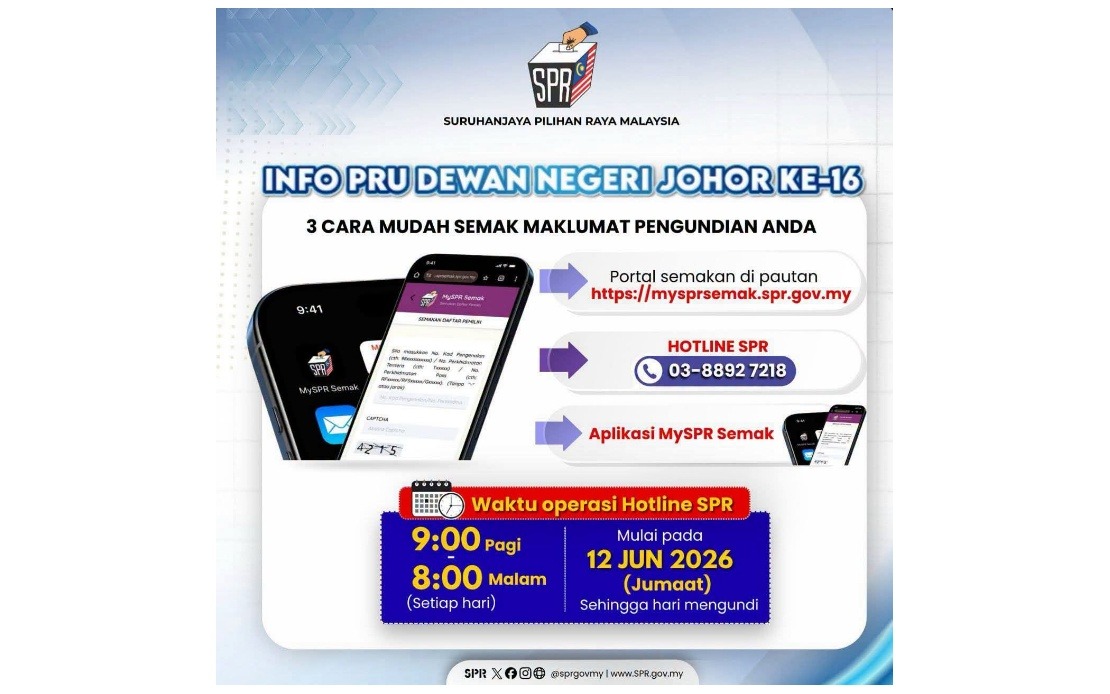
Malaysia's Election Commission has issued a final reminder to registered voters in Johor to confirm their polling stations and assigned voting streams ahead of the 16th state election scheduled for Saturday, July 11. The Commission encouraged voters to utilise the MySPR Semak online portal or mobile application to complete this verification process, emphasising that fulfilling electoral responsibilities remains central to the democratic exercise.
The impending election in Johor represents a significant moment for the southern state, with approximately 2.7 million eligible ordinary voters expected to participate in determining the composition of the state assembly for the coming term. These voters will collectively elect 56 state assembly representatives across the state's various constituencies, making this one of the largest electoral exercises to take place in the peninsula in recent times.
Early voting proved moderately successful when conducted earlier in the week, with a combined turnout of 19,471 early voters casting their ballots. This cohort comprised two distinct groups with essential roles in society: 7,960 military personnel and their spouses, alongside 11,511 police personnel from various branches including the General Operations Force (GOF) and their accompanying family members. The early voting process allowed these frontline and security sector workers to participate without disrupting their operational duties during the main polling day.
The electoral contest has attracted a diverse array of political participants. A total of 172 candidates are contesting across the 56 available seats, reflecting the competitive nature of contemporary Malaysian politics at the state level. The two major coalitions, Pakatan Harapan (PH) and Barisan Nasional (BN), have each fielded the maximum possible slate of 56 candidates, demonstrating their commitment to contesting every seat in the state.
Perikatan Nasional (PN) has adopted a more selective approach, presenting 33 candidates across various constituencies. The political landscape has further diversified with Parti Bersama Malaysia (Bersama) entering 15 candidates into the fray, while MUDA, the youth-oriented political movement, has chosen to contest in only four seats. This variation in candidate numbers reflects differing strategic calculations among different political entities regarding resource allocation and electoral viability.
Beyond the major political coalitions, smaller and newer parties have also secured representation on the ballot. Parti Orang Asli Malaysia (ASLI), which advocates specifically for indigenous Malaysian interests, and Parti Sosialis Malaysia (PSM), representing socialist political ideology, have both entered candidates. Additionally, six independent candidates have registered to contest, maintaining the traditional avenue for non-partisan political participation that characterises Malaysian elections.
The verification process through MySPR Semak has become increasingly important in modern Malaysian elections, as it enables voters to ascertain critical information well ahead of polling day. By checking their designated polling centres and voting stream assignments in advance, voters can plan their Saturday accordingly, minimise queuing time, and avoid potential confusion at their respective voting locations. This preparatory step has become standard practice encouraged by electoral authorities across successive election cycles.
For voters unfamiliar with digital platforms, the MySPR Semak mobile application provides an alternative user-friendly interface to access identical information. The dual availability of portal and app reflects the Commission's recognition of varying levels of technological comfort among Malaysia's diverse electorate. Both platforms maintain real-time accuracy regarding voter registration details and polling station allocations.
The Election Commission's final reminder underscores the logistical coordination required to successfully conduct an election of this magnitude. With over 2.7 million voters across numerous constituencies and polling districts, meticulous planning and voter preparation prove essential to ensuring smooth polling operations. Early verification of polling centres helps distribute voter flow more evenly and reduces the likelihood of congestion at individual voting stations.
The timing of this advisory, released just days before the scheduled poll, represents standard electoral procedure designed to maximise voter awareness during the final preparation window. By providing clear guidance on accessing polling information, the Commission endeavours to facilitate broader participation while maintaining administrative efficiency on election day itself. Malaysian voters are consequently encouraged to act promptly in completing their verification to ensure a seamless democratic experience on Saturday.

