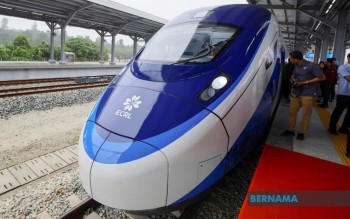
The East Coast Rail Link (ECRL) represents far more than a conventional transport corridor connecting Peninsular Malaysia's less developed regions. According to Deputy Minister of Economy Datuk Mohd Shahar Abdullah, the initiative constitutes a comprehensive overhaul of the regional economic architecture, fundamentally reshaping how businesses operate and entrepreneurs compete across Pahang, Terengganu, Kelantan and Selangor.
Spoken recently in Kuantan, Mohd Shahar's remarks underscore a strategic pivot in how policymakers conceptualise infrastructure investment. Rather than viewing the ECRL through a purely transportation lens, the project embodies what development economists term "inclusive infrastructure"—initiatives deliberately designed to generate multiplier effects across supply chains and service sectors. The Deputy Economy Minister emphasised that the ECRL's true value emerges through construction activities, operational contracts, and maintenance services that will sustain employment and business growth long after the project's completion.
The corridor's economic potential crystallises through transit-oriented development frameworks already gaining traction in regional hubs. Warehousing facilities, logistics parks, and industrial zones materialising along the ECRL route will create geographies of opportunity for both established enterprises and emerging entrepreneurs. Critically, these ancillary facilities address a perennial challenge facing East Coast businesses: the cost disadvantage imposed by geographic remoteness. Reduced logistics expenses translate directly into price competitiveness, allowing local manufacturers to compete nationally without sacrificing margins.
Mohd Shahar articulated how expanded market access fundamentally alters business calculus for regional producers. When a manufacturer can economically serve markets beyond their immediate locality, production economics shift dramatically. The illustration comparing 10,000-unit versus 20,000-unit production runs captures this dynamic succinctly—higher volumes enable economies of scale that compress per-unit costs, creating a virtuous cycle where increased production capacity justifies investment in efficiency improvements and technological adoption.
For small and medium enterprises concentrated in traditional sectors, this infrastructure upgrade presents tangible opportunities for growth trajectory transformation. Food producers, batik artisans, handicraft makers, and agricultural processors—quintessential East Coast economic actors—face structural barriers in reaching urban consumer markets. The ECRL dramatically compresses both temporal and financial dimensions of market access. Shorter delivery times preserve product quality for perishables whilst lower transit costs preserve profit margins across all categories.
Tourism represents an often-overlooked economic multiplier within the ECRL equation. Enhanced rail connectivity will inevitably channel visitor flows toward East Coast destinations, generating demand cascades through hospitality, retail, and cultural sectors. Local entrepreneurs operating small-scale tourism enterprises, food vendors, and handicraft retailers positioned along the corridor stand to benefit from substantially increased footfall. This tourism dimension particularly benefits communities whose competitive advantages rest on cultural authenticity and local craftsmanship—attributes that infrastructure improvement need not dilute.
However, Mohd Shahar's cautionary remarks regarding technological adaptation reveal underlying assumptions about business readiness that warrant scrutiny. The Deputy Minister's exhortation that entrepreneurs must embrace new technologies rather than cling to traditional models presupposes access to capital, training, and digital infrastructure. The implicit message—that business success requires rapid modernisation—rings somewhat hollow for entrepreneurs lacking resources for comprehensive digital transformation. This raises important policy questions about whether complementary support mechanisms will accompany the ECRL's launch.
The project's construction timeline adds urgency to strategic positioning. With Pahang-based segments already at 97.33 per cent completion and the overall megaproject reaching 93.66 per cent progress as of April, with scheduled December completion, the window for enterprises to adapt and position themselves for the logistics revolution narrows considerably. Early adopters positioning warehousing facilities, adjusting supply chains, or expanding production capacity will capture first-mover advantages that later entrants cannot easily replicate.
For Malaysian policymakers and regional business communities, the ECRL exemplifies how infrastructure projects transcend technical specifications to fundamentally reshape competitive landscapes. The corridor's true measure lies not merely in tonnage transported or journey times saved, but in whether it enables East Coast businesses to shed geographic disadvantage and compete as equals in the national marketplace. Success requires more than completing railway construction—it demands proactive business support, digital readiness programmes, and financing mechanisms enabling entrepreneurs to capitalise on newly accessible market opportunities.
The ECRL's emergence as economic catalyst rather than mere transportation facility reflects evolving development philosophy across Southeast Asia. As infrastructure investments grow increasingly sophisticated and intertwined with inclusive growth imperatives, understanding how physical assets translate into business opportunity becomes essential. The East Coast Rail Link demonstrates this evolution concretely, positioning regional entrepreneurs at the intersection of infrastructure modernisation and market access transformation.

