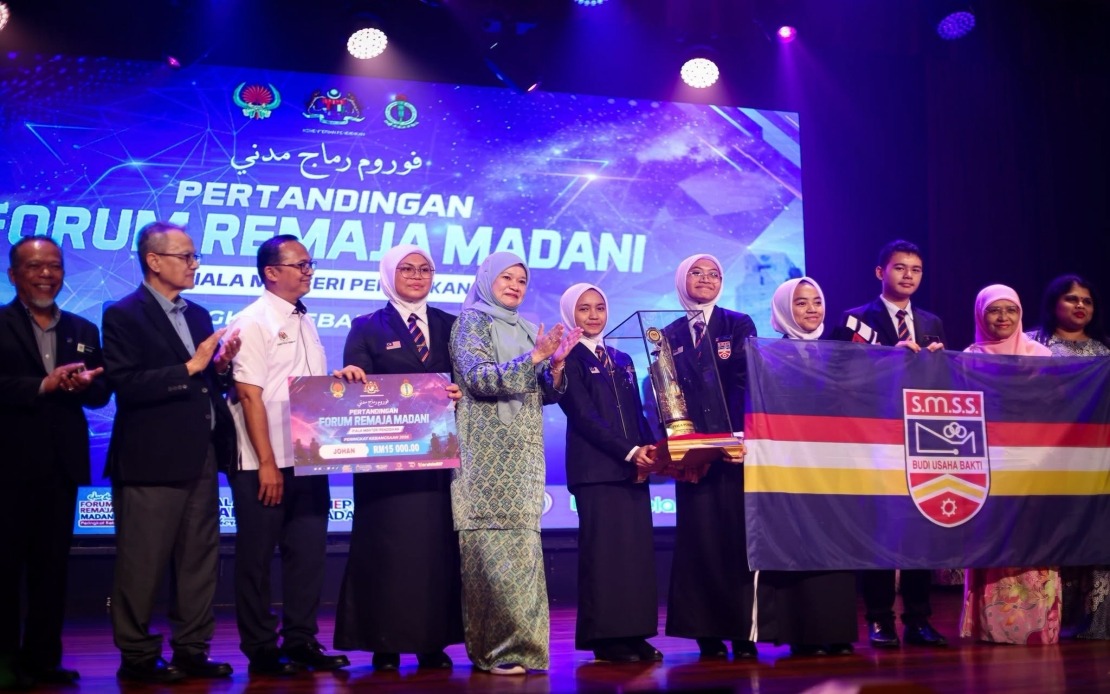
Education Minister Fadhlina Sidek has articulated a vision for character development in Malaysian schools that fundamentally shifts away from passive learning towards active civic participation. Speaking at the National MADANI Youth Forum, she outlined an approach emphasising the cultivation of young people who can articulate positions with conviction while maintaining respect for opposing perspectives. This represents a significant departure from traditional educational models that prioritised obedience and conformity, instead positioning critical engagement as a central pillar of moral development.
The minister's remarks underscore a philosophical reorientation within Malaysia's education landscape. Rather than treating character education as a unidirectional transmission of values from adults to students, Fadhlina envisioned spaces where youth actively construct knowledge through discourse. The forum demonstrated precisely this dynamic—young participants articulated thoughts, defended arguments, and engaged thoughtfully with contrary viewpoints in real time. This participatory model recognises that meaningful character development emerges through practice and reflection rather than memorisation of ethical principles.
Fadhlina's emphasis on respectful disagreement carries particular significance for a nation navigating increasing polarisation across social, religious, and political lines. She explicitly stated that institutional maturity does not require uniform agreement but rather demonstrates itself through citizens capable of disagreeing constructively. This framing positions respectful dissent as a civic virtue rather than a challenge to social harmony, potentially reshaping how Malaysian society approaches contentious issues. By legitimising principled disagreement within educational spaces, the government signals approval for more sophisticated forms of democratic engagement beyond simple consensus-building.
The minister identified articulation and knowledge as foundational elements of effective discourse. Her observation that young people need not just the confidence to speak but also substantive understanding to support their arguments highlights an often-overlooked dimension of civic education. Without grounding in factual knowledge, critical thinking risks devolving into mere opinion-sharing. This integration of content knowledge with communication skills creates a more robust foundation for the informed citizenry democratic societies require.
Equally significant is Fadhlina's insistence on courtesy as a counterbalance to assertiveness. The framework she described—confident expression paired with attentive listening—establishes reciprocal respect as non-negotiable. This dual emphasis prevents the model from becoming a license for aggressive argument or dismissive debate. Instead, it positions dialogue as fundamentally relational, requiring both parties to exercise restraint and openness. For Malaysian schools, operationalising this principle will require substantial training of educators to model and facilitate such conversations effectively.
The connection Fadhlina drew between character education and Malay language promotion reveals strategic thinking about cultural transmission. By positioning Bahasa Melayu as a vehicle for authentic self-expression rather than merely a subject of study, she reframes language learning as instrumental to identity formation and civic participation. When young people encounter their national language as capable of conveying complex ideas and defending nuanced positions, attachment to that language deepens organically. This approach acknowledges that language vitality depends less on mandatory usage than on communities perceiving genuine utility and cultural resonance.
Fadhlina's observation that Bahasa Melayu strengthens when the next generation views it as adequate for intellectual expression addresses a real perception gap in contemporary Malaysia. Among urban youth particularly, English often dominates discussions of science, technology, business, and philosophy, creating associations between these domains and foreign languages. By deliberately creating spaces where Bahasa Melayu serves these functions, educational policy can reinforce the language's prestige and utility. The MADANI Youth Forum exemplified this approach in practice, demonstrating that sophisticated dialogue in Bahasa Melayu remains entirely feasible.
The minister's rejection of prescriptive content—stating government's role is not to determine what young people should say—distinguishes her vision from approaches that weaponise education for ideological conformity. This apparent restraint signals confidence that properly educated citizens will generally make sound judgments. However, this permissiveness operates within boundaries; she specified that speech should be informed by knowledge and tempered by courtesy. The distinction between allowing freedom of expression and establishing standards for its exercise becomes crucial in implementation.
For Malaysian schools, translating Fadhlina's vision into classroom practice presents substantial challenges. Teachers require professional development in facilitating dialogue rather than delivering monologues. Curriculum must balance content coverage with space for discussion. Assessment systems will need to value argumentation skills alongside factual recall. Moreover, school leaders must create psychological safety where students feel genuinely able to dissent without jeopardising grades or relationships with authority figures. These structural changes exceed mere rhetorical reorientation.
The implications extend beyond education to Malaysian civil society more broadly. As younger cohorts progress through schools embodying these principles, their expectations for engagement in workplaces, media, and public discourse will shift. They will likely prove less tolerant of leaders who dismiss criticism or demand unquestioning loyalty. This generational change could gradually reshape institutional cultures across government, business, and civil society. Whether existing power structures adapt gracefully or resist these emerging expectations will significantly influence Malaysia's political development.
Contextualising this initiative within regional dynamics, Malaysia positions itself alongside other Southeast Asian nations grappling with youth engagement and democratic participation. Countries like Indonesia and Thailand have similarly experimented with youth forums and participatory education models, often with mixed results. Malaysia's focus on integrating critical thinking within a framework of respect and language preservation offers a distinctive approach that might resonate across the region's multicultural, multilingual contexts.
The broader challenge lies in sustaining these principles amid competing pressures. National examinations emphasising factual recall, parental expectations for academic achievement, and administrators concerned about classroom order can all constrain the space for genuine dialogue. Without deliberate protection and resources, Fadhlina's vision risks remaining aspirational rather than transformative. Success will require not just ministerial pronouncements but sustained commitment to systemic reform.

