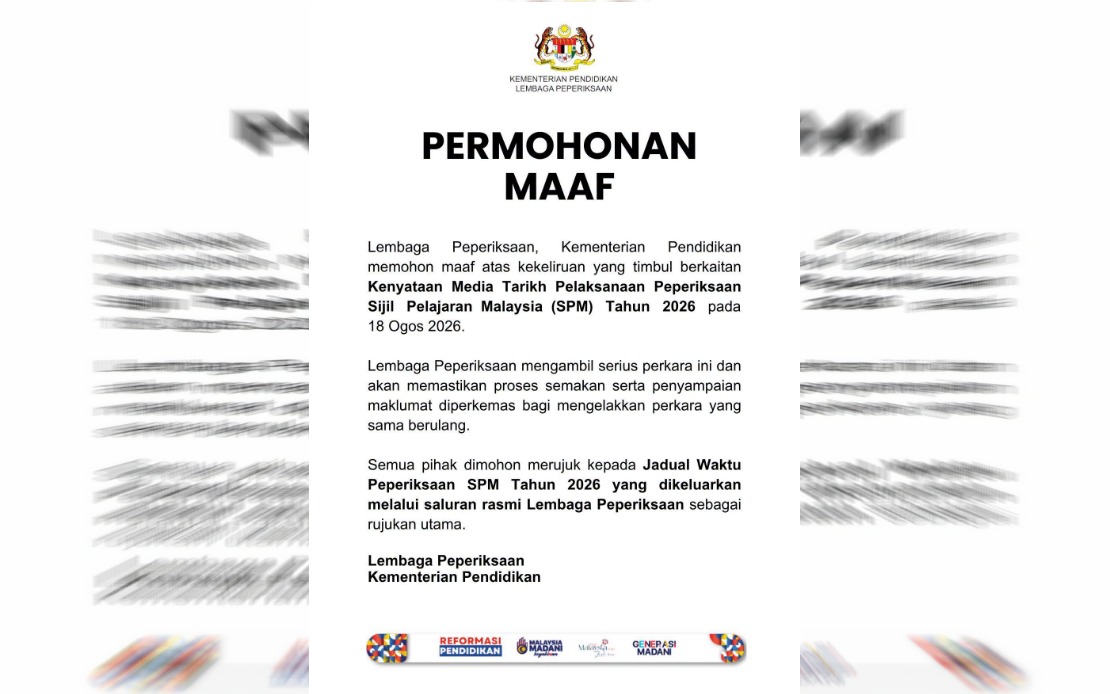
The Malaysian Examination Board under the Ministry of Education issued a formal apology on Tuesday for the confusion created by a press release distributed the previous day regarding the implementation schedule for the 2026 Sijil Pelajaran Malaysia examination. The board acknowledged that the error had caused unnecessary uncertainty among students, parents, and educational institutions across the country, and committed to preventing similar incidents through improved verification procedures.
In an official statement released from Kuala Lumpur, the Examination Board underscored its recognition that the matter warranted serious attention and that internal protocols would be examined to strengthen the accuracy of public communications. The board indicated that both the review mechanisms for verifying information and the delivery processes used to disseminate official announcements would be reinforced to eliminate future miscommunications of this nature. This commitment reflects growing pressure on government agencies to maintain clarity on critical education timelines that affect hundreds of thousands of students.
To resolve the immediate confusion, the Examination Board directed all stakeholders—including students, parents, teachers, and school administrators—to rely exclusively on the official 2026 SPM Examination Timetable published through the board's authorised communication channels. The board emphasised that this documented schedule represents the definitive reference point and supersedes any other information circulating from secondary sources. This guidance is particularly important in Malaysia's digital age, where unofficial versions of educational announcements can spread rapidly through social media and messaging platforms, potentially misleading families about critical dates.
The actual examination dates remain unchanged: the 2026 SPM will commence on November 23 and conclude on December 17, providing an examination window spanning nearly four weeks. This timeframe accommodates the large number of subjects offered under the SPM curriculum and allows sufficient spacing between papers to ensure fairness and prevent candidate fatigue. Schools and education officers have now been instructed to confirm these dates with their respective institutions and stakeholders to eliminate any residual confusion stemming from the erroneous announcement.
The scale of this year's SPM cohort underscores the importance of clear communication from examination authorities. A total of 420,879 candidates have registered to sit for the 2026 SPM examination, representing a significant proportion of Malaysia's secondary school population. These students will sit for their papers across 3,334 examination centers distributed throughout the country, from urban metropolises to remote rural areas. The logistical complexity of administering such a large-scale national examination makes precise scheduling and transparent communication essential to operational success.
The error highlights the high stakes involved in education administration in Malaysia, where the SPM serves as the primary qualification determining entry into tertiary institutions and employment pathways. For many students, the examination represents a culmination of years of study and preparation, making even minor scheduling uncertainties a source of significant stress. Parents and guardians depend on accurate information to plan revision schedules, arrange transport to examination centers, and manage their children's academic and psychological wellbeing during this critical period.
Schools across Malaysia will likely use this incident as an impetus to establish their own internal verification systems before disseminating examination-related information to students and parents. Many institutions will cross-reference all official announcements against the Examination Board's primary channels before incorporating them into school communications, timetables, and student notices. This additional layer of institutional oversight could become standard practice, even though it places additional burden on school administrative staff who must separate authoritative information from potentially inaccurate secondary sources.
The Ministry of Education's commitment to streamlining information delivery processes suggests that a systematic review of how announcements are prepared, approved, and released may be underway. Such improvements could include implementing mandatory fact-checking procedures before publication, establishing clearer chains of approval involving multiple reviewers, and creating backup confirmation mechanisms that verify key details independently. These procedural enhancements, if properly implemented, should reduce the likelihood of similar errors affecting other national examinations or educational initiatives in future years.
For the 420,879 registered candidates and their families, the correction brings reassurance that examination administration remains on track despite this administrative misstep. The confirmed dates allow students to finalise their revision schedules with certainty and permit schools to coordinate final preparations for invigilation, venue arrangements, and student support services. Examination centers nationwide can now proceed with logistics planning based on the definitively confirmed November 23 to December 17 window, ensuring that the physical and administrative infrastructure for administering the examination is properly prepared.

