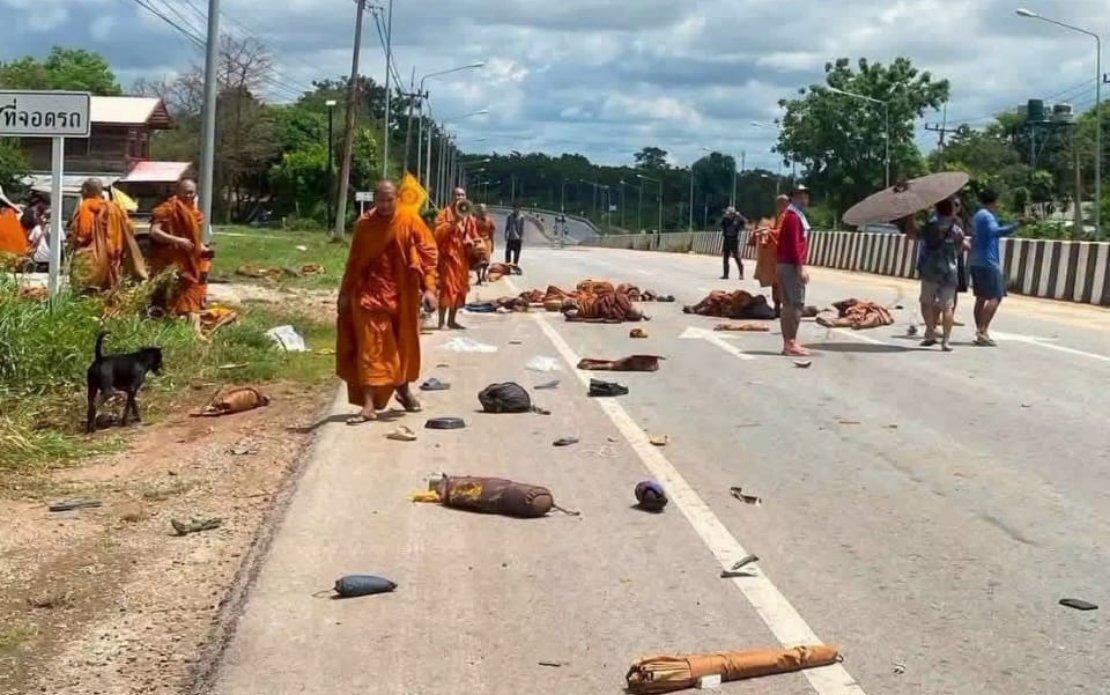
A devastating road accident in Thailand's Mukdahan province has claimed the lives of eight Buddhist monks and left 14 others with injuries ranging from moderate to critical. The tragedy unfolded on Thursday when a pickup truck veered off its intended path and struck the monks as they walked along a road in Mueang district, devastating the religious community and sparking questions about vehicle safety and the supervision of young drivers across the region.
The monks had embarked on a foot pilgrimage early in the morning, departing around 11 am with the intention of reaching Nam Khun district in the neighbouring Ubon Ratchathani province. Walking along Ban Na Si Nuan Road, they adhered to standard pedestrian safety protocols by moving against the flow of traffic, positioning themselves approximately two metres from the roadside edge. This deliberate choice to walk counter to vehicular movement is a widely recommended safety practice intended to give pedestrians better visibility and reaction time when encountering oncoming vehicles.
According to eyewitness accounts collected by authorities, the pickup truck suddenly lost control and veered off course, crossing the roadside edge where the monks were walking. The initial group of five monks managed to escape the vehicle's trajectory, but those following behind were not as fortunate. The truck struck the remaining monks with considerable force, resulting in five deaths at the scene and three additional fatalities occurring later in hospital as the injured succumbed to their injuries. This combination of immediate and delayed casualties underscores the severity of the impact and the extent of injuries sustained.
Mukdahan Provincial Public Health Chief Dr Narong Chankaew provided detailed medical assessments in the immediate aftermath. Among the casualties and injured brought for treatment, four individuals sustained injuries classified as critical, while ten others experienced moderate injuries. In total, 23 patients were hospitalised, comprising 22 monks and one layperson who was apparently in proximity to the pilgrimage group when the accident occurred. The concentration of casualties among the religious community reflects the compactness of the walking group at the moment of impact.
The driver involved in this fatal collision is a juvenile under the age of 15, a detail that has raised significant concerns about youth access to vehicles and parental supervision. Police Major General Phairoj Thaiputra, the Mukdahan Provincial Police Commander, confirmed that the underage driver was taken into custody immediately following the incident. Investigators are actively pursuing multiple lines of inquiry, including questioning the driver and their parents to establish the precise circumstances that led to the vehicle losing control. The investigation encompasses both mechanical failure and driver error as potential causes.
Mukdahan Governor Warayan Boonnarat provided additional context regarding the investigation's preliminary findings. The governor's statement underscored that the monks were exercising responsible pedestrian behaviour, having positioned themselves appropriately for safety reasons. The fact that witnesses consistently reported the vehicle losing control before striking the group suggests possible mechanical failure, sudden driver incapacity, or lack of vehicular control experience—all factors that investigators are examining. The distinction between accidental loss of control and negligent or reckless driving will be crucial in determining the charges and legal consequences.
A particularly concerning aspect of this incident is the question of parental responsibility. Police are investigating the possibility of charging the parents with negligence for permitting an underage child to operate a motor vehicle on a public road. This line of inquiry reflects broader concerns across Southeast Asia regarding inadequate supervision of young drivers and insufficient enforcement of age-appropriate vehicle operation regulations. The potential for parental liability may serve as a deterrent in other cases where guardians allow minors unsupervised access to vehicles.
Police officials have indicated that legal action will be pursued in accordance with applicable Thai law, which likely involves juvenile justice provisions and potentially vehicle operation regulations. The handling of this case may set important precedents for how authorities address traffic accidents involving child drivers and parental negligence across the region. The investigation remains ongoing as authorities continue gathering physical evidence from the accident scene and witness statements.
The aftermath of this tragedy has extended to immediate humanitarian concerns, with Mukdahan Hospital appealing for urgent blood donations to support the medical treatment of the injured monks. Blood transfusions are critical for managing trauma cases with severe injuries, and the hospital's public appeal reflects the scale of medical intervention required. This humanitarian call has galvanised community support and highlighted the practical realities of disaster response in provincial Thailand.
For Malaysian and Southeast Asian readers, this incident serves as a stark reminder of the dangers posed by unsupervised young drivers and the importance of rigorous enforcement of driving age restrictions. Thailand's juvenile driver regulations, much like those in Malaysia and other regional nations, typically establish minimum age requirements for vehicle operation. The tragedy demonstrates that these regulations, when not adequately enforced or monitored by parents and guardians, can fail to protect public safety. Religious pilgrimages and processions, which involve large groups moving along roadsides, require additional attention from traffic authorities to ensure the safety of participants.
The pilgrimage tradition itself, deeply rooted in Buddhist practice throughout Southeast Asia, carries inherent risks when conducted on modern roadways shared with motorised traffic. In Thailand, Cambodia, and other Buddhist-majority nations in the region, such religious walking processions remain culturally significant and regularly undertaken. This accident underscores the need for better coordination between religious communities, local authorities, and traffic management to ensure that sacred traditions can be safely maintained. Establishing dedicated routes, enhanced traffic controls during known pilgrimage periods, and public awareness campaigns could significantly reduce such incidents.
This tragedy also reflects larger questions about vehicle safety standards, driver training, and the enforcement mechanisms that exist to keep underage operators off public roads. While Thailand, Malaysia, and other Southeast Asian nations have established legal frameworks for licensing and age restrictions, the real-world application of these rules remains inconsistent. Parental oversight, combined with community awareness and consistent police enforcement, represents the most practical approach to preventing similar incidents. The investigation's outcome and any charges filed will likely influence how regional authorities approach similar cases moving forward.

