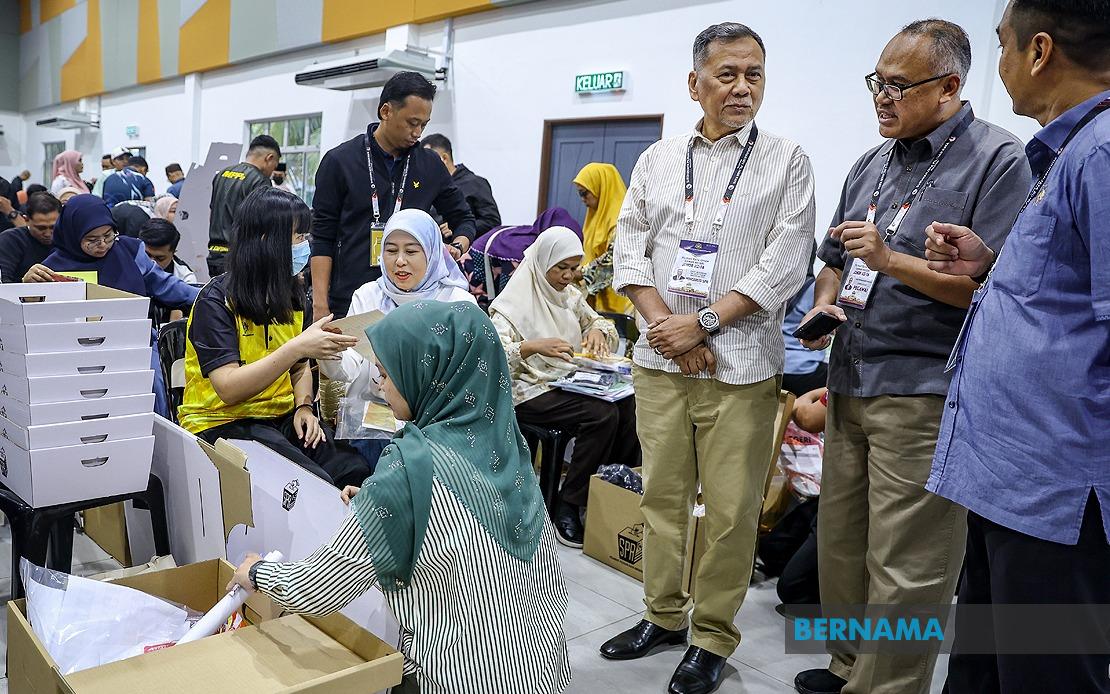
The Election Commission moved into its final operational phase yesterday as personnel across Johor completed last-minute preparations at polling and vote-counting centres throughout the state. The meticulous work reflected the scale of the undertaking, with the 16th Johor State Election set to unfold across 56 constituencies spanning diverse terrain and communities. EC Chairman Datuk Seri Ramlan Harun emphasised that these closing hours of readiness represented a crucial juncture, as logistical flawlessness would directly determine whether the state's 2.7 million registered voters could fulfil their electoral obligations without disruption.
The verification of ballot boxes and polling equipment constituted one of the most rigorous aspects of the EC's pre-election protocol, Datuk Seri Ramlan noted. His personal visits to two separate centres in Pontian and Kukup underscored the Commission's commitment to ensuring not a single detail had been overlooked. With all 56 Returning Officers having substantially completed their duties at respective constituency headquarters, the machinery of democracy had been wound to a state of operational readiness that would allow voting to commence as scheduled.
The Commission took particular care to remind voters about practical matters that would ease congestion and maintain order throughout polling day. Electors were instructed to arrive during their assigned time slots, bring their national identity cards, and cooperate fully with election officials managing each polling stream. This messaging reflected lessons learned from previous elections and represented an attempt to distribute the electorate evenly across available facilities rather than experiencing the bottlenecks that occasionally plague Malaysian polls.
On-the-ground preparations revealed the granular nature of election administration. At Sekolah Kebangsaan Bukit Mutiara, EC personnel spent hours labelling materials, positioning furniture, and erecting signage to guide voters through the process. The Puteri Wangsa polling centre converted twelve classrooms into separate voting streams, with 74 EC staff members and 12 police officers coordinating operations. This decentralised approach reflected recognition that a single polling station attempting to process thousands of voters would generate dangerous delays and frustration.
Accessibility formed another critical dimension of the preparations. The EC had installed wheelchair ramps and assigned dedicated facilities for senior citizens and persons with disabilities, acknowledging that democratic participation must remain genuinely available to all segments of the electorate. In Batu Pahat's Yong Peng location, particular attention was paid to creating comfortable conditions for elderly voters, young first-time voters, and disabled citizens, with furnishings and procedural accommodations tailored accordingly.
The Kluang constituency preparations illustrated how the Commission calibrated its approach to local voter demographics. Sekolah Kebangsaan Kampong Melayu was configured with five separate polling streams to accommodate approximately 3,000 voters within the Mahkota state constituency, with thirty trained personnel ensuring the operation proceeded systematically. Such arithmetic—dividing constituencies into manageable units—permitted the EC to handle high-volume voting while maintaining the security and integrity of ballot procedures.
The Mersing operation presented distinctive challenges that tested the EC's logistical ingenuity. Four islands within the Tenggaroh state constituency—Pulau Aur, Pulau Pemanggil, Pulau Sibu, and Pulau Tinggi—required transporting ballot boxes, polling materials, and election personnel by sea. The operation marshalled approximately 50 EC staff accompanied by Marine Police Force vessels and police escorts from Mersing district headquarters. This complex manoeuvre highlighted how Malaysian elections must accommodate not merely urban centres but also remote and geographically fragmented populations, a challenge less visible but equally important to seamless conduct.
The candidate slate reflected the contemporary composition of Malaysian electoral politics. A total of 172 candidates sought positions across the 56 seats, with Pakatan Harapan and Barisan Nasional fielding contenders in every single constituency, signalling the intensity of their rivalry. Perikatan Nasional presented 33 candidates, Parti Bersama Malaysia 15, MUDA four, while ASLI and PSM each offered one candidate. Additionally, six independent candidates sought election, demonstrating how even within a state poll, Malaysia's fractured political landscape produced competitive multi-cornered contests in numerous seats.
The scale of this electoral engagement required institutional capacity that extended beyond the EC's permanent establishment. Security forces, venue managers, administrative staff, and transport personnel all contributed to creating the infrastructure through which millions of votes would be cast, counted, and recorded. The coordination demanded by this operation—spanning territory from urban Johor Bahru to maritime islands—represented one of Malaysia's recurring achievements: holding democratic elections with regularity and basic competence across a geographically challenging federation.
For Malaysian and Southeast Asian observers, Johor's election illustrated how electoral systems function across developing democracies confronting logistical complexity. The state's population density varies dramatically, ranging from concentrated urban centres to dispersed rural constituencies and maritime communities. Yet the EC's methodical approach—detailed planning, redundancy in equipment, trained personnel dispersed throughout the state, and explicit communication with voters—demonstrated institutional learning and commitment to accessible democracy despite operational challenges that would overwhelm administrative systems in many comparable countries.
The election itself carried implications beyond Johor's borders. As Malaysia's southern economic heartland and a state historically significant to national politics, results would reverberate through the federation's broader political calculations. The competitive intensity visible in candidate deployment—particularly the presence of Pakatan Harapan and Barisan Nasional in every seat—suggested a genuine contest rather than a foregone conclusion, with state governance potentially shifting depending on electoral outcomes.

