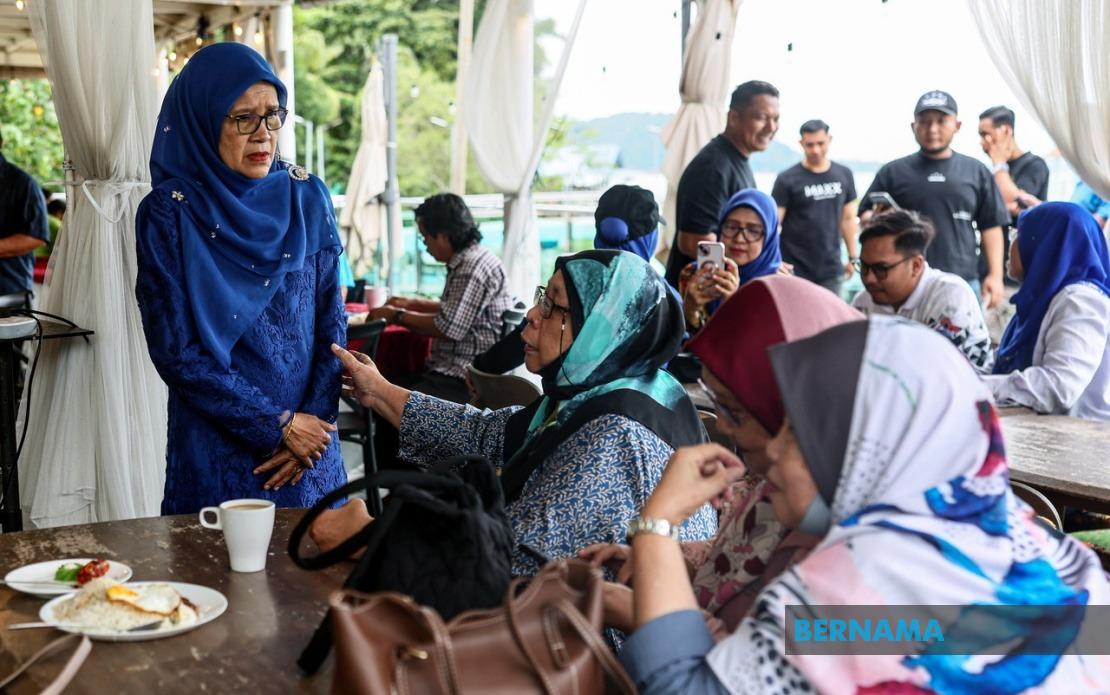
The northern Johor constituency of Endau is shaping up as one of the state's most compelling electoral contests, pitting the experience and incumbent advantage of Barisan Nasional's Alwiyah Talib against Pakatan Harapan's Saiful Nizam Samat, a young economist promising systemic reform. A four-cornered race will also feature Perikatan Nasional's Hasnul Hakimi Hussien and Parti Orang Asli Malaysia's Jati Awang, adding further complexity to what has become the defining ideological duel of Endau: stability versus transformation.
Alwiyah, widely known throughout the constituency as Kak Awi, has constructed her re-election campaign around the foundation of two consecutive terms in office, emphasising the continuity of service and commitment to her constituents. She has placed particular emphasis on tourism development as Endau's economic cornerstone, recognising that the region possesses untapped potential beyond the well-established island tourism products that currently define the area's profile. Her vision centres on transforming the economic proposition of inland Johor, positioning villages and natural attractions within the mainland as competing draws for the tourism market rather than mere feeder communities to offshore destinations.
The incumbent has identified specific properties and locales as catalysts for this inland tourism renaissance, including KampungStay@Teluk Buih, Penyabong, and Tanjung Resang, all of which already demonstrate robust demand with weekend occupancy rates approaching capacity. By her assessment, these sites represent merely the beginning of what could become a more diversified tourism sector. She has also articulated a broader ambition to reposition Mersing's international reputation, moving beyond its current image as primarily a transit point for visitors heading to island destinations. Through developing sustainable homestay infrastructure at locations such as Pulau Mawar, Pantai Air Papan, and Teluk Gorek, Alwiyah proposes a gradual shift in how the region markets itself both domestically and internationally.
Education features prominently in her platform as well, with Alwiyah advocating for the construction of a new secondary school in Pekan Endau to relieve pressure on the existing sole facility, Sekolah Menengah Kebangsaan Ungku Husin, which currently serves the entire locality's secondary-age student population. She has couched her educational ambitions in inclusive language, stressing that benefits from educational investment should extend across all socioeconomic strata from primary through tertiary levels. This emphasis on universal benefit appears designed to counter potential criticism that tourism investment primarily enriches business owners while leaving ordinary residents behind.
Alwiyah's political history adds complexity to her positioning. She initially won the Endau seat in 2022 under the Perikatan Nasional banner before crossing over to Barisan Nasional, a transition that raises questions among voters about her political loyalties and the stability of her coalition affiliation. In addressing her campaign narrative, she has framed political participation as inherently demanding, describing elections as battles requiring sincerity and authenticity rather than opportunistic positioning. This language choice appears designed to acknowledge her party switch while repositioning it as evidence of her independent thinking rather than opportunism.
Her principal challenger, Saiful Nizam Samat, represents a markedly different archetype of candidate. At 42 years old and currently engaged in doctoral research in economics, he embodies the technocratic intellectual profile increasingly prominent in opposition campaigning throughout Southeast Asia. His platform departs significantly from Alwiyah's tourism-focused incrementalism, instead proposing what he terms systematic economic restructuring across five interconnected pillars: education, economic diversification, food security, fisheries modernisation, and youth retention. This comprehensive policy architecture reflects his academic background and positions him as offering not incremental improvements but fundamental reconfiguration of how Endau's economy functions.
The centrepiece of Saiful Nizam's economic vision centres on what he brands the Fishermen's Economy 2.0 initiative, designed to transform the primary sector from its current structure into a sustainably profitable enterprise capable of competing with urban employment opportunities. His reasoning extends beyond the fishing community itself, as he argues that modernising and professionalising the fisheries sector creates spillover benefits throughout the local economy, generating entrepreneurial opportunities for suppliers, processors, and service providers while simultaneously anchoring young people to their hometowns. Complementing this sectoral focus, he proposes targeted support for small and medium enterprises through digital marketing assistance, business development training, and systematic linkage to broader market opportunities.
Educational access forms the second pillar of his reform agenda, though his approach differs fundamentally from Alwiyah's infrastructure-focused strategy. Rather than simply constructing additional facilities, Saiful Nizam advocates for removing financial barriers to education through the establishment of an Endau Children's Education Fund, targeting students whose potential might otherwise remain unrealised due to economic constraint. His skills development emphasis encompasses both traditional vocational pathways through TVET programmes and emerging technical fields via STEM instruction, alongside English language training explicitly framed as essential for participation in an increasingly globalised economy.
Food security constitutes a third element of his platform, with Saiful Nizam advocating for agricultural modernisation through promotion of advanced farming methodologies intended to simultaneously enhance farmer incomes and strengthen Malaysia's broader food production resilience. This positioning links local agricultural productivity to national strategic interests, potentially broadening his appeal beyond Endau's immediate farming community to voters concerned about food inflation and supply stability. His framing of agricultural reform as interconnected with national food security rather than merely local income generation reflects a sophistication in political messaging often found among candidates with academic credentials.
The contest between these two candidates crystallises a broader tension evident throughout Malaysian state-level politics: whether constituencies benefit more from experienced representatives focused on targeted local development projects, or from reform-minded challengers proposing systemic economic restructuring. Alwiyah emphasises proven capability, continuity, and tangible projects visible within constituencies, the traditional incumbent advantage. Saiful Nizam counters with promises of deeper transformation, arguing that incremental projects cannot address root causes of youth outmigration, economic vulnerability, and limited opportunity that characterise rural Malaysian constituencies. The constituency comprises 28,767 registered voters who will render their verdict on July 11, with early voting scheduled for July 7.
The Endau race gains additional significance within the broader context of the 16th Johor state election, where 172 candidates compete for 56 seats across the entire state. Electoral observers have noted that contests between well-established incumbents and reform-oriented challengers typically determine whether incumbent parties expand or contract their majorities. The presence of two additional candidates from Perikatan Nasional and Parti Orang Asli Malaysia adds further unpredictability, as both could fragment opposition or government support depending on how particular voter cohorts are distributed geographically within the constituency. The four-way race means that victory margins could potentially be tighter than in previous two-way contests, potentially amplifying the strategic importance of voter mobilisation and coalition building among candidates.

